
Trump Blocks Chip Deal, Citing National Security and China Concerns

Donald Trump on Friday blocked a $3 million deal in which U.S. photonics firm HieFo Corp sought to acquire assets from New Jersey-based aerospace and defense supplier Emcore, citing national security and China-related risks.

In an order released by the White House, Trump said HieFo was “controlled by a citizen of the People’s Republic of China,” raising concerns that the transaction could threaten U.S. national security. He ordered HieFo to divest all interests in the Emcore assets within 180 days.

The decision followed a review by the Committee on Foreign Investment in the United States, which identified national security risks linked to the deal, according to the U.S. Treasury Department. Officials did not specify the nature of those risks.

Emcore has said HieFo acquired its chip business and indium-phosphide wafer fabrication operations for about $2.92 million. The company was publicly traded at the time of the transaction and has since gone private.

HieFo previously said it was co-founded by Genzao Zhang, a former Emcore vice president of engineering, and Harry Moore, a former senior sales director at Emcore. Neither company immediately responded to requests for comment following Trump’s order.

Moon and Sun Take Center Stage in 2026’s Lineup of Cosmic Events

The moon and the sun will headline a busy calendar of celestial events in 2026, from major eclipses to lunar missions and eye-catching supermoons.

The year begins with renewed focus on the moon as NASA prepares to send astronauts past it for the first time in more than 50 years under its Artemis program. Alongside human missions, a wave of robotic landers is planned, including Blue Origin’s oversized Blue Moon prototype, as well as landers from U.S. and Chinese companies targeting scientifically rich regions of the lunar surface.

Solar activity will also draw attention, highlighted by two major eclipses. A rare “ring-of-fire” annular solar eclipse will occur over Antarctica in February, followed by a total solar eclipse on Aug. 12 that will sweep across parts of the Arctic, Greenland, Iceland and Spain. Several lunar eclipses are also scheduled throughout the year.

Skywatchers can expect planetary spectacles as well. Six planets will line up in late February, with most visible to the naked eye, while Mars joins a similar parade in August. Jupiter, Saturn, Venus and Mercury will be the easiest to spot shortly after sunset, weather permitting.

Three supermoons will brighten the night skies in 2026, including a particularly close and bright one on Christmas Eve. These full moons appear larger than usual as the moon reaches the closest point in its orbit around Earth.

Meanwhile, scientists expect continued bursts of solar activity, increasing the chances of vivid auroras in lower latitudes, though activity should gradually ease as the sun moves into the quieter phase of its 11-year cycle. For astronomers and casual stargazers alike, 2026 promises no shortage of cosmic drama.

Scientists Capture First 3D Images of the Interior of Mexico’s Popocatépetl Volcano

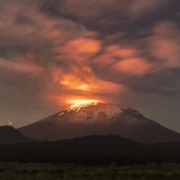
Scientists from National Autonomous University of Mexico have produced the first three-dimensional images of the interior of Popocatépetl, one of the world’s most active volcanoes and a major threat to nearby population centres.

After five years of fieldwork and data collection, researchers used seismic sensors and artificial intelligence to map the volcano’s internal structure down to about 18 kilometres below the crater. The images reveal multiple magma reservoirs at different depths rather than a single magma chamber, offering new insight into how eruptions may develop.

The project leader, volcanologist Marco Calò, said the findings help explain where magma accumulates and why seismic activity is stronger in certain areas, particularly on the southeast side of the volcano. Around 25 million people live within 100 kilometres of Popocatépetl, making accurate monitoring critical for risk management.

Picture background

The team expanded the existing seismic network around the volcano and analysed ground vibrations using AI-based algorithms adapted for Popocatépetl’s unique behaviour. This approach allowed researchers to distinguish different types of tremors and infer temperature, depth and material composition underground.

Scientists say the 3D model will improve eruption forecasting and help authorities respond more effectively during periods of heightened activity. The research is set to be published soon and is expected to serve as a baseline for tracking future changes inside the volcano.