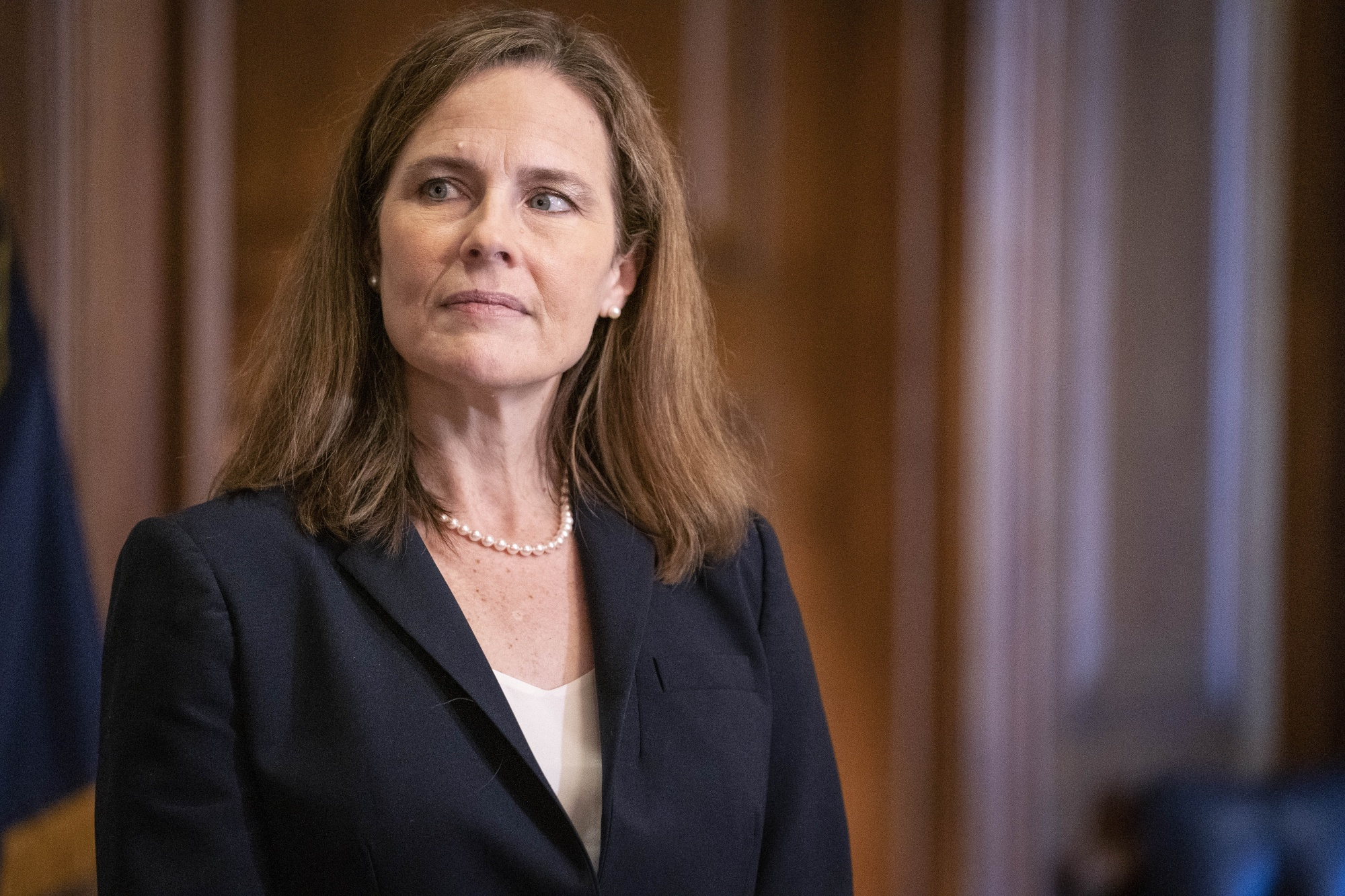
The Last Best Hope for Supreme Court Liberals: Amy Coney Barrett

Supreme Court Justice Amy Coney Barrett has emerged as a surprising figure in the polarized environment of the current Court, one that liberals on and off the bench are looking to as a potential counterbalance to the conservative majority. As the only former law professor among the Court’s right-wing bloc and its sole female member, Barrett stands apart in more ways than one.

What makes Barrett particularly intriguing is her distinct background. Unlike the other conservative justices, she never served in a high-level Republican administration, which gives her a more independent voice on the bench. While her judicial philosophy aligns with the right on many major issues, including abortion, affirmative action, and executive power, her more methodical and analytical approach has led some liberals to see her as a potential ally in securing a more moderate judicial consensus.

Since her appointment in 2020, Barrett has been closely watched by both liberals and conservatives. On the one hand, she has cast votes with the conservative majority in significant cases like Dobbs v. Jackson (overturning Roe v. Wade), New York State Pistol & Rifle Association v. Bruen (expanding gun rights), and Students for Fair Admissions v. Harvard (striking down affirmative action). On the other hand, her nuanced legal reasoning and willingness to engage with both sides of a case have earned her a reputation as a potential voice of moderation.

Barrett’s approach to legal interpretation is rooted in originalism and textualism, following in the footsteps of the late Justice Antonin Scalia. But her willingness to challenge her conservative colleagues on methodological grounds—such as in her disagreements with Justice Thomas over historical analogies—sets her apart. In cases like student loan forgiveness and agency powers, Barrett has voiced concern over the overreach of executive authority, aligning with more moderate perspectives.

While Barrett’s votes have overwhelmingly favored conservative positions, her engagement with the left on legal doctrine and her occasional departures from the far-right bloc make her a critical figure. She has even worked alongside liberal justices during oral arguments, with Justice Sotomayor and Justice Kagan frequently referring to Barrett’s questions to support their own arguments. This kind of cross-ideological dialogue, though not always resulting in alignment on the final decision, suggests that Barrett could serve as a bridge in an increasingly divided Court.

Despite this, Barrett remains firmly within the conservative fold on most cultural issues, and her votes continue to uphold conservative priorities. In her most recent opinions, she joined with the conservative majority in curbing the powers of federal agencies and bolstering protections for religious freedoms. Nevertheless, her more cautious approach to certain cases, such as the Idaho abortion ban, reveals a potential willingness to temper her conservative inclinations in pursuit of a more balanced outcome.

Barrett’s impact on the Court is still evolving. As her tenure progresses, her role as a potential moderator may become more pronounced, especially as the country navigates a new phase of political polarization. While she is not expected to dramatically shift the Court’s ideological composition, her legal rigor and willingness to engage in cross-ideological dialogue could help mitigate some of the Court’s more contentious decisions.


 

Elwood Edwards, Voice of AOL’s ‘You’ve Got Mail,’ Passes Away at 74

Elwood Edwards, the voice behind the iconic AOL greeting “You’ve Got Mail,” has passed away at the age of 74 after a long illness, according to his former employer, Cleveland’s WKYC television station.

Edwards became a household name in the 1990s, thanks to his simple yet unforgettable voice recordings for AOL. In 1989, while working as a graphics and camera operator at WKYC, Edwards recorded four phrases for the fledgling company, then known as America Online: “Welcome,” “You’ve Got Mail,” “Files done,” and “Goodbye.” These phrases would go on to become synonymous with the AOL experience and be heard by millions around the world.

Edwards’ wife, Karen, worked for Quantum Computer Services (later known as AOL). In a 2012 YouTube video, he explained that she overheard AOL’s co-founder, Steve Case, discussing the need for a voice to accompany the new software. Karen volunteered her husband, and Edwards recorded the lines in his living room on a simple cassette deck.

“I had no idea it would become what it did,” Edwards said in a 2019 interview. “Suddenly, AOL took off… I remember standing in line at CompUSA and seeing stacks of AOL CDs, thinking, ‘my voice is on every one of those, and nobody has a clue.’”

Before his voice became a staple of the internet era, Edwards worked behind the scenes at WKYC, where he was a jack-of-all-trades. He was known for his role as a graphics operator and camera technician, and for sharing his expertise with colleagues. Frank Macek, senior broadcast director at WKYC, remembered Edwards fondly for his generosity in teaching new systems to his peers.

As his voice became inseparable from AOL’s rise, Edwards found himself becoming a local celebrity, recognized by fans and colleagues alike. He even made appearances on popular shows, including “The Tonight Show Starring Jimmy Fallon,” where he would pronounce random phrases suggested by the audience.

Originally from New Bern, North Carolina, Edwards began his career in high school radio before transitioning to television booth announcing and hosting a radio show. However, despite his iconic voice, Edwards was more comfortable working behind the scenes than in front of the camera, a preference he shared in interviews.

Edwards leaves behind a legacy as the unintentional voice of a generation and the person behind a line that became part of internet culture forever.


Almaty: From Soviet Drabness to Central Asia’s Cultural Capital

Almaty, Kazakhstan’s largest city with a population of 2.2 million, has undergone an extraordinary transformation since the fall of the USSR. Once a typical Soviet metropolis, it has reinvented itself into the beating heart of Central Asia, blending modernity with tradition to create one of the most dynamic cities in the region.

Today, Almaty boasts a world-class metro system, a flourishing banking and finance sector, luxury boutiques, and contemporary shopping malls alongside its vintage bazaars. The city has also become a culinary hotspot, fusing traditional Kazakhstan flavors with modern techniques, drawing international praise. In fact, Almaty’s food scene, with its “neo nomad” cuisine, has become a key part of the city’s cultural renaissance, with restaurants offering innovative dishes like marinated horse meat samosas and smoked brisket.

The city has evolved into the cultural epicenter of Central Asia, with an ever-expanding array of world-class museums, galleries, and performance spaces. Almaty is home to the Abilkhan Kasteev State Art Museum, which showcases Kazakhstan’s rich artistic heritage, as well as the avant-garde Tselinny Center of Contemporary Culture, opening next year, which will highlight cutting-edge music, theater, and art. Public spaces, such as the Almaty Metro, feature beautiful, elaborately decorated stations that pay homage to both Kazakhstan’s past and present.

Long-time American resident Dennis Keen, who advocates for historic preservation, notes that Almaty is “incredibly livable.” The city offers green spaces, a clean environment, and a reliable public transport system that makes owning a car unnecessary. The thriving creative scene, coupled with its lively culinary culture, has transformed Almaty into a destination for entrepreneurs, artists, and foodies alike.

Once, the city was a modest fort under Russian rule, growing into a modest city in the mid-19th century. After Kazakhstan gained independence from the Soviet Union in 1991, Almaty’s status as the national capital was moved to Astana (now Nur-Sultan). However, instead of dampening the city’s spirit, this shift sparked a cultural and entrepreneurial revival. Almaty quickly became a beacon for creativity and innovation, its entrepreneurs and artists embracing the freedom that came with this new chapter.

The culinary scene is a prime example of this reinvention. Almaty chefs have embraced the legacy of the nomadic people who once roamed the vast steppes of Kazakhstan, reinterpreting traditional techniques like open-flame cooking and meat-smoking in a contemporary context. Restaurants such as Auyl in the Medeu Valley offer luxurious takes on traditional dishes, using heirloom ingredients and slow-cooked meats to create artful seven-course tasting menus. The city’s neo nomad cuisine marries Kazakhstan’s past with its present, delighting visitors with a fusion of flavors that speak to both the region’s history and its future.

Along with food, art is thriving in Almaty. The city’s underground art scene is just as exciting as its public displays, with hidden gems like a secret private museum, whose location and owner are closely guarded. This mysterious collection offers an eclectic mix of Kazakhstan’s cultural history, from medieval chastity belts to Soviet-era mementos. Meanwhile, the forthcoming Tselinny Center of Contemporary Culture will provide a hub for contemporary thought, bringing together artists, intellectuals, and creatives from around the world.

Public art is another area where Almaty excels. The city is dotted with striking pieces of Socialist Modernist architecture and vibrant murals. Keen has spent years documenting and preserving these hidden treasures, showcasing them on walking tours that reveal the city’s Soviet-era artistic roots.

Almaty’s appeal is not just limited to its cultural renaissance. For those seeking adventure, the surrounding Tien Shan Mountains offer stunning scenery and a glimpse into Kazakhstan’s nomadic traditions. Visitors can stay in traditional yurts and embark on horseback treks to remote lakes, where ghost forests add an eerie atmosphere to the natural beauty.