Trump Administration Renegotiates Biden-Era Chips Act Grants, Says Commerce Secretary Lutnick

The Trump administration is actively renegotiating semiconductor manufacturing grants originally awarded under the Biden-era CHIPS and Science Act, according to U.S. Commerce Secretary Howard Lutnick. Speaking before the Senate Appropriations Committee on Wednesday, Lutnick indicated that some of these awards may be significantly altered or even cancelled as part of efforts to secure better terms for U.S. taxpayers.

“Some of the Biden-era grants just seemed overly generous, and we’ve been able to renegotiate them,” Lutnick told lawmakers, emphasizing that the renegotiations aim to deliver greater value to the American public. “All the deals are getting better, and the only deals that are not getting done are deals that should have never been done in the first place.”

$52.7 Billion CHIPS Act Under Review

The $52.7 billion CHIPS and Science Act, signed by President Biden in 2022, was designed to bolster domestic semiconductor manufacturing and reduce reliance on Asia, particularly Taiwan and South Korea. Under the program, billions of dollars in grants were awarded to both U.S. and foreign chipmakers, including Taiwan’s TSMC, South Korea’s Samsung and SK Hynix, as well as U.S.-based Intel and Micron.

Though many of these awards were signed before Biden left office, most of the funds have yet to be fully disbursed. The grant payments are generally structured to be released as companies meet specific production and investment milestones tied to their U.S. plant expansions.

TSMC Award Revised Amid Expanding U.S. Investment

Lutnick cited Taiwan Semiconductor Manufacturing Co. (TSMC) as an example of successful renegotiation. Under the original agreement, TSMC was awarded $6 billion to support its U.S. manufacturing expansion. Lutnick revealed that TSMC subsequently increased its planned investment from $65 billion to $165 billion, while still receiving the same $6 billion in federal funds.

Although TSMC confirmed in March that it would invest an additional $100 billion in the U.S., the company has not commented on whether the new investment was directly tied to renegotiated CHIPS Act terms.

White House Seeking Delays and New Terms

The renegotiation efforts are not new. In February, Reuters reported that the White House was already seeking to renegotiate several awards and delay some upcoming disbursements to ensure better returns on government spending.

Lutnick’s comments suggest that the Trump administration intends to continue scrutinizing past agreements to maximize taxpayer value and may block deals it deems wasteful or excessive.

AI Computing Capacity Also a Focus

During the hearing, Lutnick also addressed concerns about the global race for artificial intelligence computing capacity. He emphasized the administration’s commitment to ensuring that over 50% of global AI compute power remains based in the United States. This statement comes amid criticism of a Trump administration deal allowing the United Arab Emirates to purchase advanced American AI chips, raising fears about exporting critical technology.
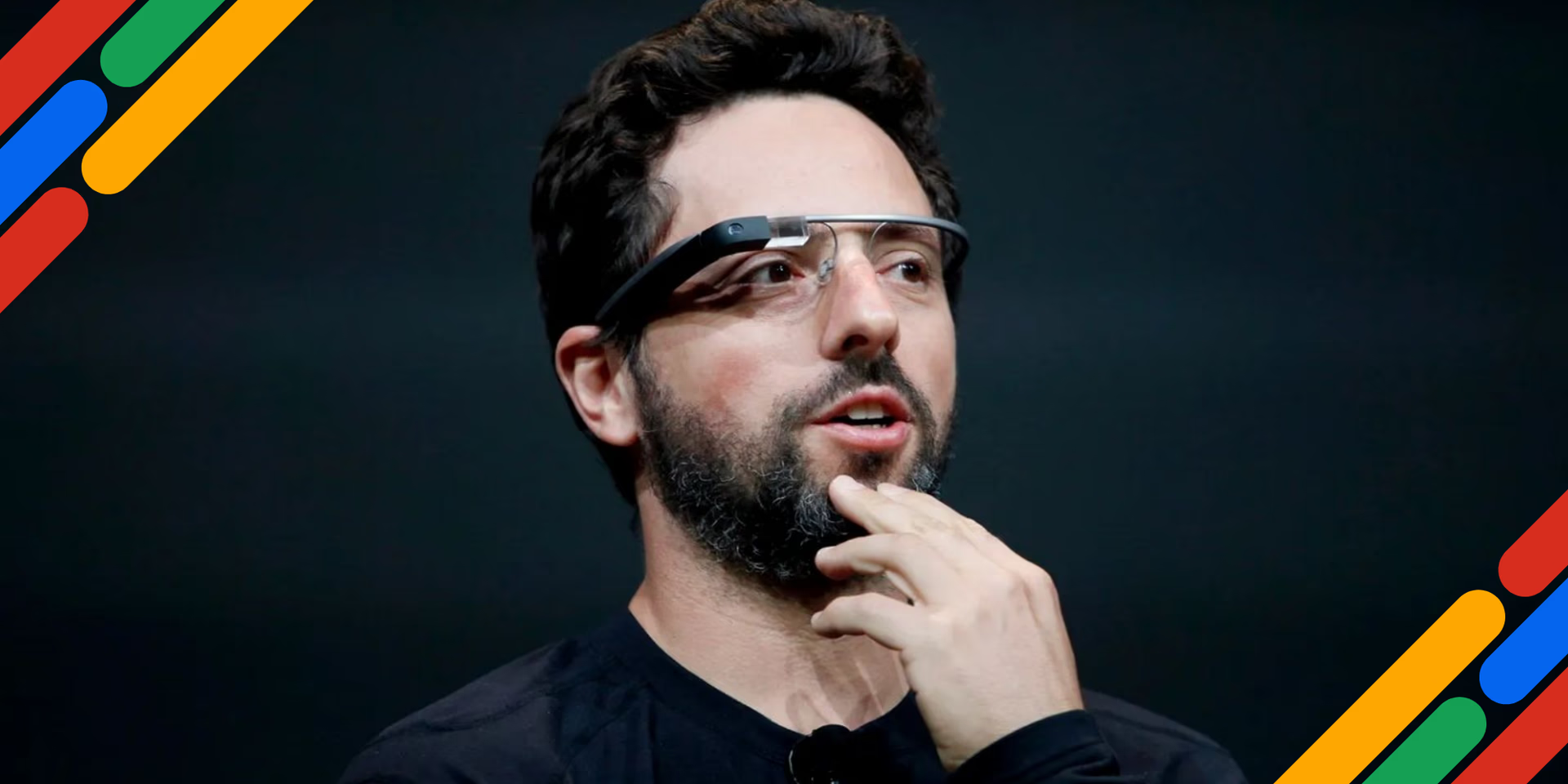
Sergey Brin Breaks Silence at Google I/O 2025, Shares Why He Came Back

At the Google I/O 2025 developer conference, attendees were treated to a major surprise on day one: the unexpected appearance of Google Co-Founder Sergey Brin. Scheduled as a fireside chat between DeepMind CEO Demis Hassabis and moderator Alex Kantrowitz, the session quickly turned into something far more notable when Brin joined the stage. The conversation centered around artificial intelligence, highlighting Google’s latest Gemini tools, the capabilities of its newest AI models, and a bold look toward the future of artificial general intelligence (AGI). Brin also used the opportunity to share why he returned to Google after years of stepping away from day-to-day operations.

Brin’s reentry into the spotlight appeared to be driven by a renewed sense of purpose. He expressed his excitement about the progress in AI and the potential for meaningful breakthroughs that could reshape technology—and even society. Speaking candidly, Brin acknowledged that developments like Gemini represent a pivotal shift in computing, and he believes his presence can help steer Google toward achieving AGI responsibly and effectively. “This is the most interesting and important challenge I’ve seen in decades,” he remarked.

Throughout the discussion, Demis Hassabis emphasized the distinction between current AI models and true AGI. According to Hassabis, AGI is not just about performing tasks—it’s about replicating the broad cognitive flexibility of the human brain. He explained that while today’s models are capable of impressive feats, they still fall short of the consistency, reasoning, and creativity that define general intelligence. Hassabis pointed to the need for breakthroughs in world modeling and logical reasoning before AGI becomes a reality, though he remains optimistic that those breakthroughs are within reach.

When pressed on a timeline for AGI, the panelists offered slightly different forecasts. Brin confidently predicted that AGI would arrive before 2030, aligning with Google’s ambitions for its Gemini platform. Hassabis, slightly more cautious, estimated it might emerge just after that milestone. Regardless of the exact date, both leaders agreed that AGI is no longer a distant dream but a near-future goal—one that Brin is now personally invested in helping realize.

FTC Probes Media Matters Over Alleged Role in X Advertiser Boycott

The U.S. Federal Trade Commission (FTC) has opened an investigation into Media Matters, demanding documents about potential coordination with other watchdog groups accused by Elon Musk of organizing advertiser boycotts targeting X, the social media platform formerly known as Twitter.

According to a document reviewed by Reuters, the FTC issued a civil investigative demand (CID) requesting details about Media Matters’ communications with groups like the Global Alliance for Responsible Media (GARM)—a now-disbanded initiative under the World Federation of Advertisers. Both organizations are also being sued by Musk’s company for allegedly coordinating an illegal boycott of X.

The investigation is focused on whether Media Matters and other entities colluded to pressure advertisers into pulling ad spending from X, which Musk acquired in 2022.

Escalation Under Trump-Era FTC Chair

The probe reflects a shift in priorities under FTC Chairman Andrew Ferguson, appointed by President Donald Trump. In December, Ferguson stated:

“We must prosecute any unlawful collusion between online platforms, and confront advertiser boycotts which threaten competition among those platforms.”

The FTC has not made any formal accusations, and a CID is not an indication of wrongdoing. However, the demand signals that federal regulators are scrutinizing possible anticompetitive conduct in the ad industry amid rising political and legal tensions between progressive media groups and Musk-led platforms.

Media Matters Responds

Angelo Carusone, President of Media Matters, condemned the probe:

“The Trump administration has been defined by naming right-wing media figures to key posts and abusing the power of the federal government to bully political opponents and silence critics.”

“These threats won’t work; we remain steadfast to our mission.”

Media Matters is engaged in two legal battles with X—defending itself from a 2023 defamation lawsuit and pursuing its own case accusing X of retaliatory litigation tactics.

Background and Broader Legal Context

  • X sued Media Matters in 2023 for publishing reports that showed major brand ads appearing next to extremist content on the platform.

  • Media Matters countersued, alleging that Musk’s company was trying to silence critical reporting with costly, meritless lawsuits.

  • X also sued the World Federation of Advertisers and major brands in Texas federal court, alleging unlawful conspiracy to limit advertising.

  • The U.S. House Judiciary Committee, chaired by Rep. Jim Jordan, has previously accused GARM of coordinating an illegal group boycott. The initiative was shut down in August 2023.

Market Context

While X has struggled with declining ad revenue since Musk’s takeover, research by Emarketer suggests ad spending could increase in 2025, although it still remains below pre-acquisition levels.

Elon Musk, a major Trump campaign donor, has been publicly vocal about alleged efforts to suppress conservative voices and crypto innovation, while also pushing a broader federal workforce reduction initiative.