
US Government Agency Acknowledges ‘Very Anomalous Objects’ but No Verifiable UFO Sightings

In a recent testimony before the U.S. Senate Armed Services Subcommittee on Emerging Threats and Capabilities, Jon T. Kosloski, Director of the Pentagon’s All-Domain Anomaly Resolution Office (AARO), provided an update on the agency’s ongoing investigations into unidentified anomalous phenomena (UAP). Speaking on November 19, Kosloski emphasized that, despite numerous reports of unexplained sightings by military personnel, AARO has not found any verifiable evidence pointing to extraterrestrial life or advanced technology. He stressed that the office investigates every sighting using scientific methods and a commitment to transparency, examining anomalies across various domains, including sea, sky, and space.

The AARO was created in 2022 with the goal of centralizing and streamlining UAP investigations, allowing for more efficient assessment of sightings from both government and military sources. Kosloski noted that the majority of UAP cases have been resolved and attributed to known objects, such as birds, drones, or balloons. However, he acknowledged that a small number of incidents remain unexplained, signaling the need for continued investigation. The director’s comments reflect a careful, methodical approach to understanding these phenomena while avoiding premature conclusions.

During his testimony, Kosloski referred to specific cases, including a notable 2013 UAP sighting in Puerto Rico. In this case, a mysterious object appeared to vanish into the ocean, leading to speculation about its nature. After thorough investigation, AARO concluded that the sighting was likely the result of an optical illusion caused by the camera’s inability to differentiate the object’s temperature from the surrounding environment. This case exemplifies the complex nature of UAP investigations, where initial impressions may be misleading, and thorough analysis is crucial.

Despite the lack of evidence pointing to extraterrestrial origins, Kosloski reaffirmed AARO’s commitment to transparency and scientific inquiry in its ongoing investigations. He acknowledged the public’s fascination with UAPs and stressed the importance of maintaining an objective stance, ensuring that each case is examined on its merits. The continued investigation of UAPs, even when they remain unexplained, demonstrates the Pentagon’s determination to understand these phenomena and their potential implications for national security and scientific advancement

Dark Energy Spectroscopic Instrument Provides Ultimate Test for Einstein’s Theory of Relativity

A recent study from the Dark Energy Spectroscopic Instrument (DESI) project suggests that dark energy—the enigmatic force driving the accelerated expansion of the universe—may not be constant over time. This finding challenges a key assumption in cosmology but simultaneously reaffirms the accuracy of Albert Einstein’s theory of general relativity. The study, published on the DESI project’s website and arXiv, expands on earlier findings from April that pointed toward a similar conclusion. If confirmed, the results could have profound implications for our understanding of the universe’s long-term evolution.

DESI’s Revolutionary 3D Galaxy Mapping

The DESI project, based at the Kitt Peak National Observatory in Arizona, has constructed the most comprehensive 3D map of galaxies to date. By analyzing this detailed map, researchers can study the large-scale structure of the universe and how it changes over time. Unlike earlier studies that focused on baryon acoustic oscillations—echoes of sound waves from the universe’s infancy—DESI’s latest work delves into the evolution of galaxy clusters. These shifts are particularly sensitive to dark energy’s influence and could reveal changes in its behavior. Dr. Dragan Huterer, a cosmologist from the University of Michigan, noted that this approach provides critical insights into how gravitational forces and dark energy interact over cosmic timescales.

Variable Dark Energy: A Possible Shift in Paradigm

The study’s findings align with earlier DESI analyses, as well as data from other astronomical observations like the cosmic microwave background (CMB), the universe’s oldest light. Together, these data sets suggest that dark energy’s density may have fluctuated over time, rather than remaining static as traditionally assumed. Cosmologist Dr. Pauline Zarrouk of the National Centre for Scientific Research (CNRS) emphasized the importance of these results matching prior analyses, as consistency strengthens the case for a revision of existing cosmological models. If dark energy is indeed variable, it could lead scientists to reimagine the fate of the universe and refine theories about its fundamental composition.

Implications for General Relativity and Cosmology

Despite the intriguing possibility of changing dark energy, the DESI study reinforces the validity of Einstein’s theory of general relativity. The theory continues to accurately describe how gravity operates on both local and cosmic scales, even under the complex conditions observed in the universe’s evolution. However, these findings highlight the need for a deeper understanding of dark energy’s nature and role in shaping the cosmos. As DESI continues its galaxy-mapping mission, future discoveries may provide clearer answers to whether dark energy evolves over time or if alternative explanations better fit the data, potentially redefining our understanding of the universe’s structure and fate.

James Webb Telescope Detects First Signs of Einstein Zig-Zag Effect in a Remote Quasar

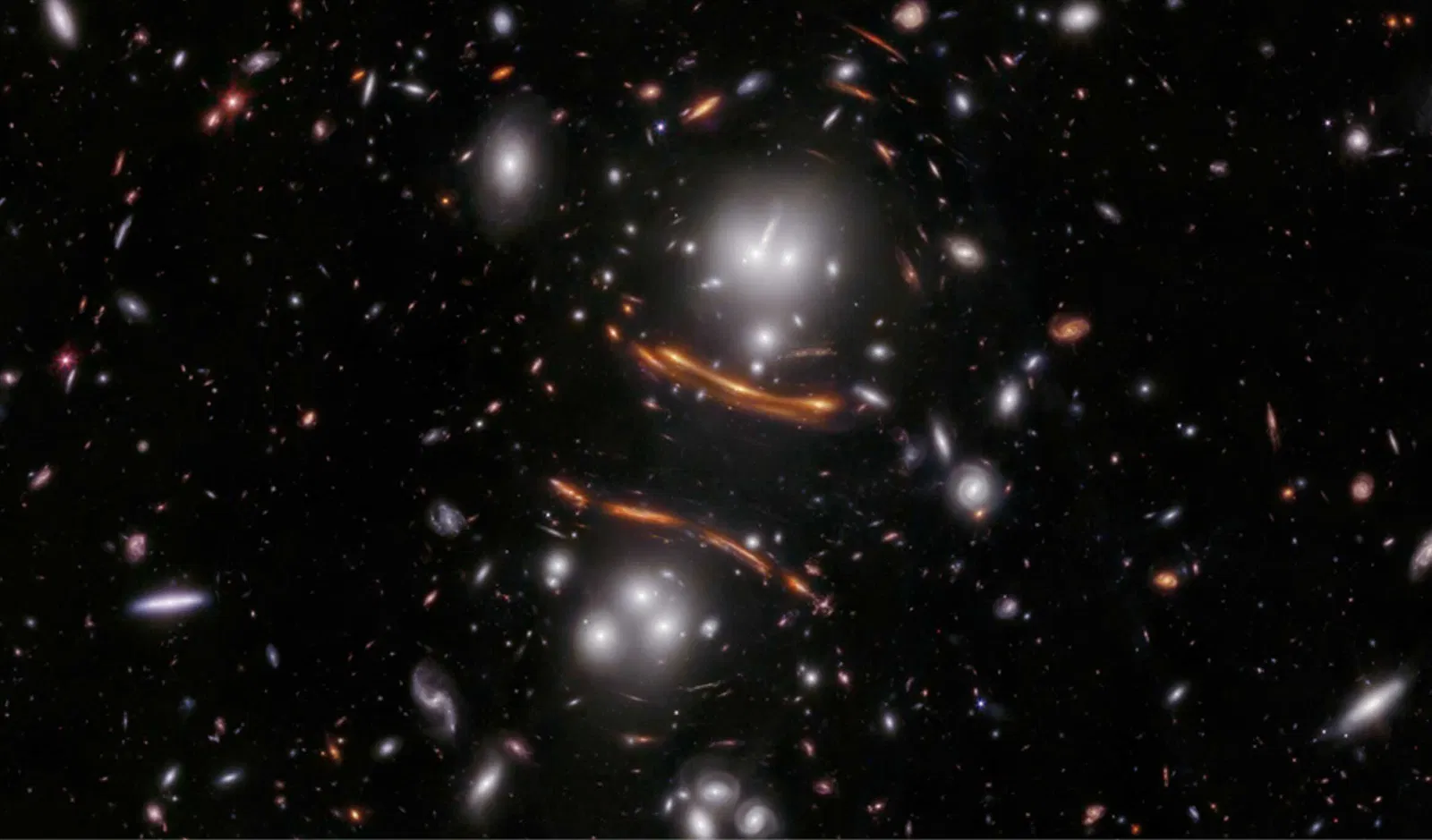
A groundbreaking study leveraging data from the James Webb Space Telescope (JWST) has unveiled a rare cosmic phenomenon termed the “Einstein zig-zag.” This effect occurs when light from a distant quasar travels through two distinct warped regions of space-time, producing multiple mirrored images. Researchers identified six duplicates of a luminous quasar, J1721+8842, providing unprecedented insights into the dynamics of gravitational lensing and offering potential solutions to long-standing questions in cosmology.

The Discovery of a Complex Quasar Configuration

Quasar J1721+8842 was first observed in 2018, appearing as four distinct mirrored points of light situated billions of light-years away. These images were attributed to gravitational lensing, a phenomenon where light from a far-off celestial object bends due to the immense gravity of an intervening galaxy. However, further observations in 2022 revealed two additional, fainter points of light, hinting at a more intricate gravitational lensing scenario involving multiple massive objects.

JWST Sheds New Light on the Phenomenon

With the high-resolution capabilities of the JWST, researchers reanalyzed the data and confirmed that all six images originated from the same quasar. As detailed in a recent study published on arXiv, the quasar’s light was bent by two massive lensing galaxies in a complex manner, forming not only the mirrored images but also a faint Einstein ring. The unique configuration, where the light traveled in opposing directions around the lenses, inspired the term “Einstein zig-zag” to describe the observed effect.

Implications for Cosmology and Gravitational Lensing

This discovery holds profound implications for the study of gravitational lensing and the structure of the universe. By analyzing the “Einstein zig-zag,” scientists can better understand the distribution of dark matter in lensing galaxies and refine models of cosmic evolution. Additionally, the intricate lensing system offers an invaluable tool for probing the nature of quasar light and testing general relativity under extreme cosmic conditions. As researchers continue to explore such phenomena with JWST, new opportunities to unlock the mysteries of the universe are emerging.