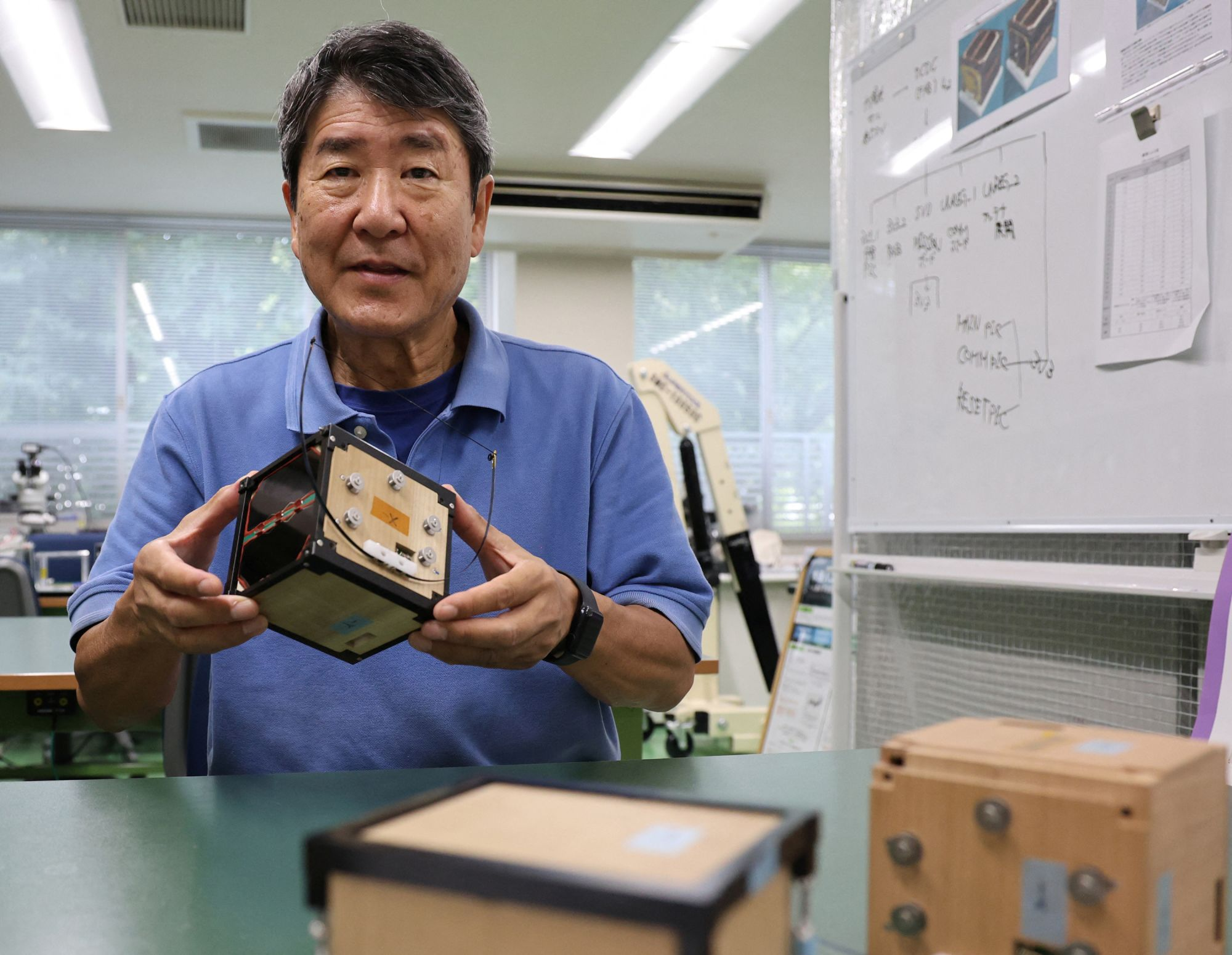
World’s First Wooden Satellite, Developed in Japan, Heads to Space

The world’s first wooden satellite, crafted by researchers in Japan, was launched into space on Tuesday, marking a pioneering step in exploring the use of timber for lunar and Martian missions.

LignoSat, developed by Kyoto University in collaboration with homebuilder Sumitomo Forestry, is on a SpaceX mission to the International Space Station (ISS), from where it will be released into orbit approximately 400 kilometers (250 miles) above Earth. Named after the Latin term for “wood,” LignoSat is designed to assess the potential of renewable materials for long-term human habitation in space.

Takao Doi, an astronaut and human space activities researcher at Kyoto University, emphasized the significance of using timber: “With timber, a material we can produce by ourselves, we will be able to build houses, live, and work in space forever.” His team envisions a 50-year initiative focused on planting trees and constructing timber habitats on the Moon and Mars, prompting the development of this NASA-certified wooden satellite to validate the viability of wood as a space-grade material.

Koji Murata, a forest science professor at Kyoto University, noted, “Early 1900s airplanes were made of wood. A wooden satellite should be feasible, too.” He added that wood might actually perform better in space conditions, as it is less prone to rot or combustion without the presence of water or oxygen.

The environmental benefits of a wooden satellite are also significant, as it would produce less pollution upon decommissioning. Current metal satellites must re-enter the atmosphere to prevent space debris; during this process, they generate aluminum oxide particles. In contrast, wooden satellites would simply burn up, resulting in a cleaner re-entry, according to Doi, who suggested that “metal satellites might be banned in the future.”

Industrial Applications
The research team determined that honoki, a magnolia species native to Japan and traditionally used for sword sheaths, is the most suitable material for space applications after a 10-month study on the ISS. LignoSat is constructed using traditional Japanese craft techniques, without the use of screws or glue.

Once deployed, LignoSat will orbit the Earth for six months, with onboard electronics monitoring how wood withstands the extreme conditions of space, where temperatures can vary from -100 to 100 degrees Celsius (-148 to 212 degrees Fahrenheit) every 45 minutes as it transitions between light and darkness.

Additionally, LignoSat will evaluate wood’s effectiveness in shielding semiconductors from space radiation, which could have practical implications for constructing data centers, according to Kenji Kariya, a manager at Sumitomo Forestry’s Tsukuba Research Institute. He remarked, “It may seem outdated, but wood is actually cutting-edge technology as civilization heads to the Moon and Mars. Expansion into space could invigorate the timber industry.”


 

China’s Efforts to Boost Birth Rates Face Criticism, Struggle to Gain Traction

At a recent wedding expo in Changsha, China, bright pink neon signs with phrases like “Having three children is the best” reflected the government’s growing urgency to boost marriage and birth rates amid an aging population and declining births. However, the low turnout and backlash on social media suggest that the government’s traditionalist messaging may be missing the mark with modern audiences, especially women.

The expo featured hands-on activities for couples, such as experiencing simulated childbirth pain and practicing parenting skills, as part of the government’s broader attempt to promote family life. Yet, slogans reinforcing gender roles — “Housework is the best” and “Best at raising kids” — have drawn widespread criticism online. Many saw the language as outdated and sexist. “All the slogans seem directed at women. Isn’t sharing housework the right thing to do?” commented one Weibo user. Another on Xiaohongshu claimed the expo “probably persuaded a lot of hesitant people to give up marriage.”

Government figures show that marriage registrations dropped 16.6% in the first three quarters of 2024 compared to the previous year, indicating that young people are increasingly delaying or forgoing marriage altogether. This trend has alarmed officials, prompting Beijing to urge local governments to promote marriage and childbirth with policies like improved maternity leave, childcare support, and housing incentives for larger families. However, these policies lack detailed funding plans, and many experts doubt their effectiveness without significant changes in work culture and gender equality.

The government’s recent actions reflect a growing anxiety over demographic decline. In 2015, China ended its one-child policy, yet birth rates have continued to fall, reaching record lows last year. Some local governments have resorted to tactics like cold-calling women to promote pregnancy and offering free vitamins, which have done little to sway public opinion. Shanghai resident Aiqi, 32, dismissed the latest measures as inadequate, citing high costs and systemic pressures. “We need to change the competitive education system, the high-intensity work environment, and the high cost of housing,” she noted.

Experts believe that economic constraints may hinder the effectiveness of Beijing’s policies. According to demographer Yi Fuxian, the long-term costs of raising a child mean that debt-burdened local governments have little incentive to encourage childbirth. Research from the Yuwa Population Research Center suggests that stabilizing China’s population would require an investment of 10% of the country’s GDP. While similar policies have had success in Western countries like France and Sweden, they’ve struggled in East Asia, largely due to persistent gender inequality. China’s ranking of 107th in the World Economic Forum’s gender gap index places it far behind nations like South Korea and Japan, both of which have also struggled to raise birth rates despite policy interventions.

Sociologists like Yun Zhou of the University of Michigan argue that top-down policies rarely shift individual choices on family planning. “Measures that tell people to have more children are rarely effective,” she said. This sentiment was echoed by Weibo user Yuxiao, who criticized the festival’s focus on gendered expectations. “Treat girls as human beings and respect them,” Yuxiao wrote. “Many don’t want to marry in the first place, and now there’s added pressure on them and their families to have children.”

The marriage expo in Changsha will continue to run every weekend through November, but the mixed reactions highlight a widening gap between policy goals and public sentiment. For many, China’s approach seems disconnected from the lived realities of modern Chinese families, raising questions about the future effectiveness of government efforts to reverse the demographic decline.

JWST Unveils Solitary Supermassive Black Hole Quasars from the Dawn of the Universe

Astronomers have made a puzzling discovery using the James Webb Space Telescope (JWST): supermassive black hole-powered quasars dating back 13 billion years, appearing in isolation. This revelation defies current models, which suggest that black holes require an abundance of surrounding material to rapidly grow. Instead, these quasars seem to exist in nearly barren regions of space, leaving scientists baffled as to how they amassed so much mass so quickly.

A team led by Anna-Christina Eilers, an assistant professor of physics at MIT, examined five of the universe’s earliest known quasars. While some of these quasars were located in dense environments, others were found in nearly empty fields, a surprising discovery. Typically, quasars thrive in regions rich with gas and dust, which black holes use as fuel to grow. Yet, the seemingly isolated quasars observed by JWST challenge this understanding. Eilers expressed the mystery succinctly: “It’s difficult to explain how these quasars grew so massive if there’s nothing nearby to feed them.”

This unexpected finding has put pressure on existing theories of black hole growth. In today’s universe, supermassive black holes are found at the centers of galaxies, pulling in nearby matter to fuel their growth, which produces the bright emissions seen in quasars. However, the newly identified quasars seem to lack such resources, sparking a debate about whether we need to rethink our understanding of how black holes in the early universe could have become so large in such a short span of time.

Scientists are now faced with a perplexing challenge: coming up with new or revised theories that account for these isolated but rapidly growing quasars. Some ideas propose that perhaps these black holes had an extraordinary initial boost or that unknown mechanisms may have supplied them with matter early on. Whatever the explanation, these observations from JWST are revolutionizing our view of how the cosmos evolved, demonstrating that the formation and growth of black holes might be far more complex than previously believed