
SpaceX Launches 23 Starlink Satellites, Expanding Global High-Speed Internet Network

SpaceX has achieved yet another milestone in its ambitious Starlink project, successfully launching 23 additional satellites on Wednesday evening, October 23rd. The liftoff occurred at 5:47 p.m. ET from the Cape Canaveral Space Force Station in Florida, following a one-day delay due to unfavorable weather conditions. This launch is a crucial part of SpaceX’s ongoing mission to expand its global satellite-based internet coverage, aiming to provide high-speed connectivity to even the most remote areas of the world.

The launch vehicle, a Falcon 9 rocket, once again showcased SpaceX’s engineering prowess and reusability strategy. After propelling the Starlink satellites into low Earth orbit, the rocket’s first stage executed a flawless return, landing on the drone ship “A Shortfall of Gravitas” stationed in the Atlantic Ocean. This landing occurred roughly eight minutes post-liftoff, demonstrating the reliability of SpaceX’s booster recovery system. Impressively, this flight marked the 18th successful mission for this particular Falcon 9 booster, emphasizing the company’s ability to recycle and reuse hardware, a critical factor in making space exploration more cost-effective and sustainable.

The mission represents another significant step forward for the Starlink constellation. After the successful separation of the Falcon 9’s first stage, the upper stage continued its journey, placing the 23 satellites in their designated orbit. Deployment of these satellites is anticipated to occur approximately 65 minutes after launch, adding to the ever-expanding Starlink network. With each launch, SpaceX inches closer to its goal of providing widespread global internet coverage, a vision that is gradually becoming a reality as the number of operational satellites increases.

Astrophysicist Jonathan McDowell, who frequently monitors and reports on satellite activities, estimates that SpaceX now has over 6,400 Starlink satellites in orbit. This rapidly growing megaconstellation aims to bridge digital divides and bring reliable internet to regions where traditional connectivity options are limited or nonexistent. As SpaceX continues to launch more satellites and improve the capabilities of Starlink, the company is poised to transform global communications, providing new opportunities and enhancing connectivity for millions worldwide.
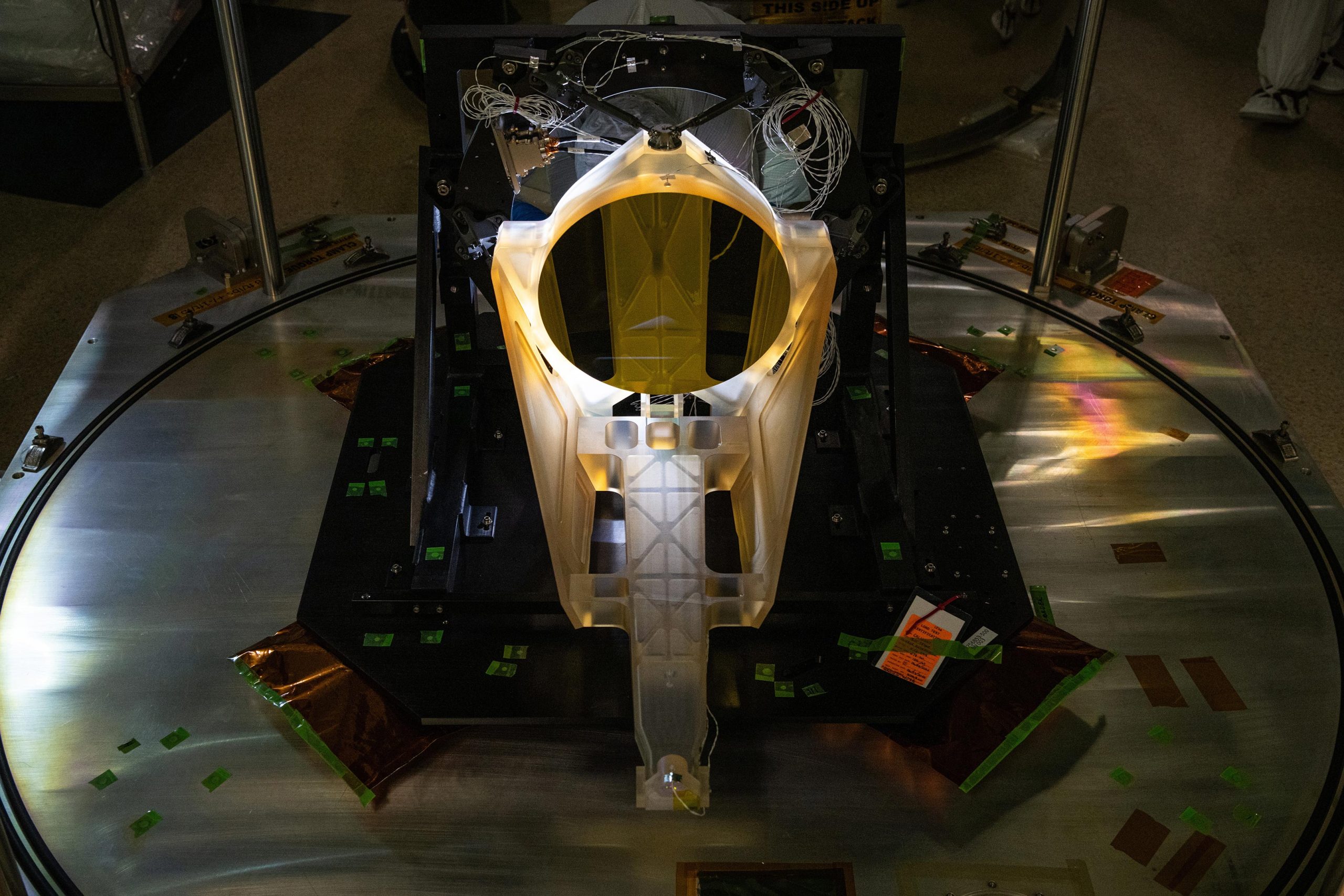

NASA Reveals Prototype Telescope for LISA Mission to Detect Gravitational Waves from Space

NASA has unveiled a full-scale prototype of the telescopes that will be integral to the LISA (Laser Interferometer Space Antenna) mission, designed to observe gravitational waves from space. Gravitational waves, ripples in the fabric of spacetime caused by massive cosmic events like the merging of black holes, offer crucial insights into the universe’s most mysterious phenomena. The LISA mission, a collaborative effort between NASA and the European Space Agency (ESA), will employ laser-based measurements to detect these waves. By measuring minute distance changes between spacecraft, LISA aims to revolutionize our understanding of gravitational forces and spacetime.

At the heart of this ambitious mission is an innovative array of three spacecraft, arranged in an equilateral triangle with each side stretching roughly 1.6 million miles (2.5 million kilometers) apart. The telescopes are fundamental components of the system, as they will handle the precise transmission and reception of infrared laser beams across the enormous distances. Each spacecraft will be equipped with twin telescopes, forming the basis of the laser communication system. NASA is tasked with building all six telescopes for this mission, and the recent prototype, referred to as the Engineering Development Unit Telescope, marks a major milestone in the development process.

The Engineering Development Unit Telescope prototype arrived at NASA’s Goddard Space Flight Center earlier this year, where it has been thoroughly examined and tested. The prototype was manufactured by L3Harris Technologies and constructed from a unique material known as Zerodur, a glass-ceramic that maintains exceptional thermal stability in the extreme temperature fluctuations of space. This stability is critical to ensure that the telescope’s shape and performance remain consistent. Additionally, the telescope’s primary mirror is coated in gold, a choice that optimizes its reflectivity for infrared laser light, minimizing heat loss and enhancing the telescope’s efficiency.

Ryan DeRosa, a researcher at NASA’s Goddard Space Flight Center, highlighted the importance of this prototype for informing the design of the final flight hardware. The telescope will play a key role in the success of the LISA mission, which represents a groundbreaking approach to space-based gravitational wave detection. By using this advanced laser technology, scientists hope to detect and analyze gravitational waves more accurately than ever before. The mission will not only contribute to fundamental physics but could also open new windows into observing the cosmos, offering a unique perspective on events that have shaped the universe.

Novel Way to Beat Dengue: Deaf Mosquitoes Stop Having Sex

Scientists have discovered a unique strategy to combat mosquito-borne diseases like dengue, yellow fever, and Zika by rendering male mosquitoes deaf, thereby hindering their ability to mate. This innovative approach takes advantage of the fact that male mosquitoes rely on their hearing to locate and pursue females, responding to the attractive wingbeats that signal potential mates.

Researchers at the University of California, Irvine, conducted experiments on Aedes aegypti mosquitoes, known for transmitting viruses to approximately 400 million people annually. The team focused on the insects’ aerial mating behaviors, which typically last from a few seconds to just under a minute, and sought to disrupt these interactions using genetic modification.

The scientists targeted a specific protein, trpVa, which plays a crucial role in the hearing process of male mosquitoes. By altering a genetic pathway linked to this protein, the team successfully created male mosquitoes that were unable to detect the flight tones or wingbeats of females. As a result, these genetically modified males were unable to make physical contact with females even after being housed together for three days.

The impact of this gene modification was profound; the altered males did not mate at all, while their wild counterparts copulated multiple times, successfully fertilizing nearly all the females in the same enclosure. This complete elimination of mating among the deaf males suggests a potential avenue for controlling mosquito populations by reducing reproduction rates.

Dr. Joerg Albert, a mosquito mating expert from the University of Oldenburg in Germany, praised the study as a promising direction for mosquito control, though he emphasized the need for careful study and management. He noted that the findings provide the first direct molecular evidence confirming that hearing is not only important but essential for mosquito reproduction. Without the ability to hear and acoustically pursue females, male mosquitoes could face extinction.

In addition to this approach, researchers are also exploring the release of sterile males in regions with outbreaks of mosquito-borne diseases as another method of population control. While mosquitoes are often viewed as disease carriers, they play a critical role in the ecosystem as a food source for various animals, including fish, birds, bats, and frogs, and some species are essential pollinators.