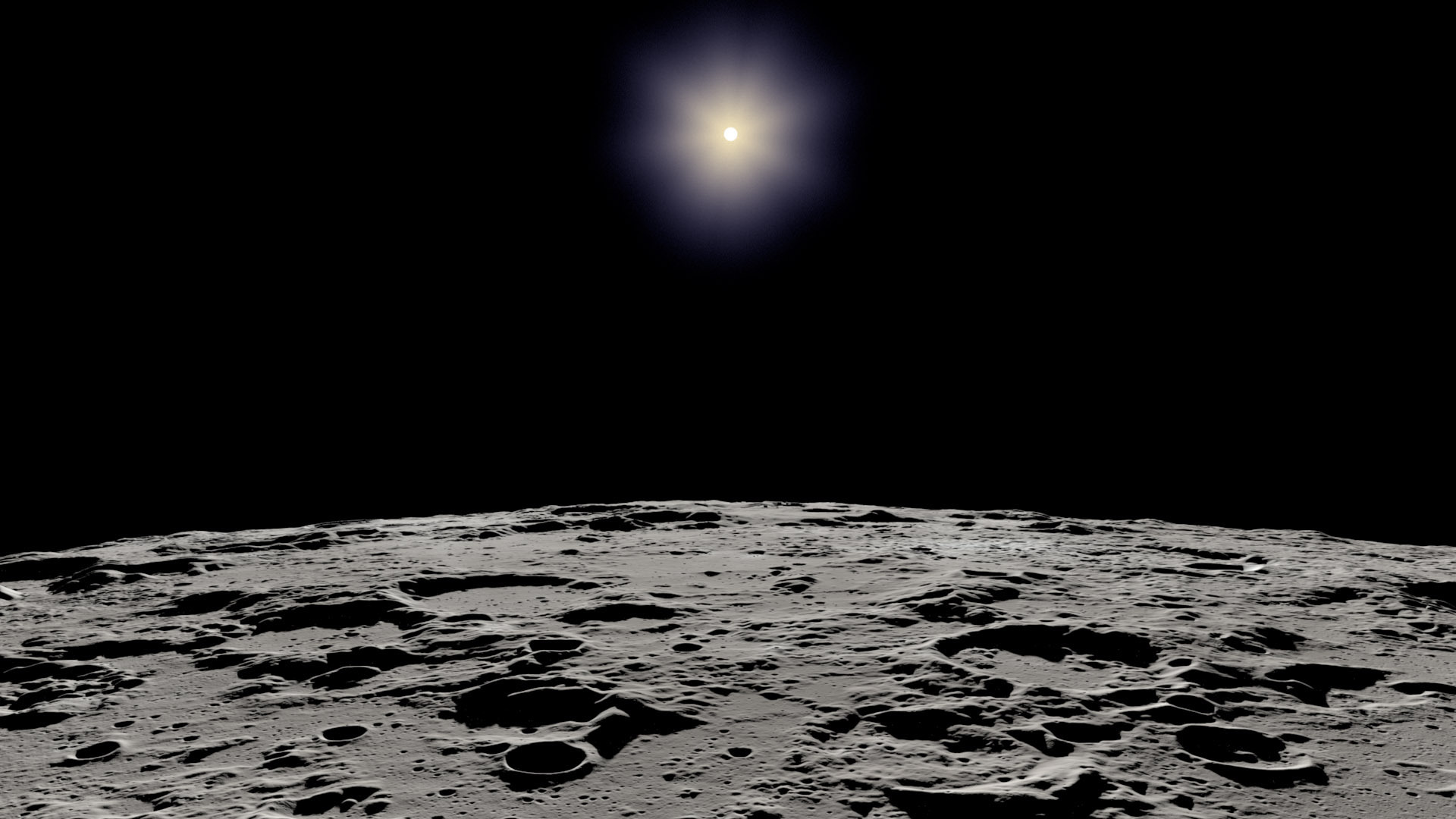
NASA Study Suggests Solar Wind Plays a Crucial Role in Water Formation on the Moon

A recent study has revealed an intriguing possibility: solar wind may play a pivotal role in the formation of water on the Moon. The Moon’s surface, covered in a layer of dust and rock known as regolith, has long been thought to contain traces of water—an essential resource for future lunar missions, especially for fueling rockets. Researchers found that this water, found in the form of both water molecules and hydroxyl groups, is embedded within the regolith, which is constantly bombarded by meteoroids and charged particles from the Sun. Surprisingly, the amount of water detected ranged from 200 to 300 parts per million, a significant but modest amount that could have important implications for future lunar exploration.

One of the most striking findings from the study was the low levels of deuterium, an isotope of hydrogen, present in the water and hydroxyl molecules. This suggests that the hydrogen atoms that form the water molecules likely originate from the Sun. The solar wind, a continuous stream of charged particles, delivers these hydrogen particles to the Moon’s surface. When these particles interact with oxygen embedded in the lunar surface rocks, chemical reactions occur, resulting in the formation of water molecules. This discovery not only sheds new light on the Moon’s water composition but also suggests that other airless celestial bodies in the solar system, such as asteroids, may possess water as well.

This groundbreaking research builds on a long-held hypothesis that dates back to the 1960s, when scientists first proposed that the solar wind could be responsible for generating water on the Moon. For decades, this idea remained theoretical, with limited evidence to support it. However, a recent lab simulation conducted by NASA has provided compelling evidence to confirm this hypothesis. The simulation mimicked the process of solar wind interacting with lunar regolith, successfully demonstrating that the charged particles from the Sun can indeed lead to the creation of water on the Moon’s surface. This finding holds significant implications for NASA’s Artemis program, which is preparing to send astronauts to the lunar South Pole, where much of the Moon’s water is believed to be frozen in permanently shadowed craters.

The solar wind, composed mainly of protons (hydrogen nuclei), constantly flows from the Sun, bombarding celestial bodies throughout the solar system. While Earth is shielded from these particles by its magnetic field and atmosphere, the Moon lacks such protection, making it more susceptible to the solar wind’s effects. Computer models and lab tests have shown that when protons collide with the lunar regolith, they interact with electrons and recombine to form hydrogen atoms. This hydrogen then combines with oxygen in the regolith, forming hydroxyl and water molecules. Although hydroxyl and water are chemically similar and difficult to differentiate with current technology, their presence beneath the lunar surface is undeniable. This discovery marks a significant step forward in our understanding of the Moon’s potential as a resource for future space missions.

Study Reveals Private Buyers Are Hoarding Tyrannosaurus Rex Fossils

A recent study led by Thomas Carr, an associate professor of biology at Carthage College, has uncovered a troubling trend in the fossil market that is hindering scientific research into one of the most iconic prehistoric creatures: the Tyrannosaurus rex. Carr’s research reveals that private and commercial ownership of T. rex fossils has now surpassed the number of specimens housed in public museums and trusts, making it harder for researchers to access these valuable fossils. The private market is also more prolific than previously understood, with commercial entities reportedly discovering twice as many T. rex fossils as public institutions. This shift is significantly limiting the amount of information available for scientific study, particularly when it comes to understanding the full life cycle of the T. rex.

Carr’s study focused on what he termed “scientifically informative” specimens, such as complete skulls, skeletons, and significant isolated bones. These fossils provide critical insights into the physiology, behavior, and development of the T. rex. Unfortunately, the private market has made it increasingly difficult for researchers to obtain these specimens. One of the key concerns highlighted in the study is the loss of juvenile and subadult fossils, which are already rare and underrepresented in the fossil record. The absence of these fossils represents a major gap in our understanding of how the T. rex grew and developed, making it one of the most significant losses in paleontological research.

In his findings, published in Palaeontologia Electronica, Carr emphasized the disparity between public and private holdings of T. rex fossils. His research revealed that while there are 61 specimens of T. rex in public trusts, there are 71 in private hands, including 14 juveniles. The fact that more T. rex fossils are now privately owned than publicly accessible is a concerning development for the scientific community. The study’s conclusions underline the urgent need for greater regulation of the fossil trade to ensure that these specimens are preserved and made available for research.

Carr’s work is not just a call for attention to the T. rex, but to the broader implications of the growing luxury fossil market, which affects not just the famous dinosaur, but other ancient species as well. In 2024, a Stegosaurus fossil broke auction records by selling for $44.6 million, a price tag that highlights the increasing commercialization of fossils. Carr hopes that his research will spark further academic inquiry into the influence of the fossil trade on the study of prehistoric life. By raising awareness of this issue, he aims to inspire other researchers to examine how the commercialization of fossils is impacting our understanding of ancient ecosystems and species.

Researchers Create Self-Healing, Stretchable Lithium Batteries with Improved Durability

Scientists have recently pushed the boundaries of battery technology by developing a groundbreaking self-healing, stretchable lithium battery. Unlike traditional lithium-ion batteries, which are often used in smartphones and electric vehicles, this new type of battery is designed to be far more flexible and resilient. While most conventional batteries are encased in sturdy layers to prevent damage, they are still unsuitable for applications in soft robots and wearables. A team of researchers from the University of California, Berkeley, Georgia Institute of Technology, and the Hong Kong University of Science and Technology has now created a battery that can withstand extreme stress, such as twisting or puncturing, making it ideal for more flexible applications.

The innovative self-healing stretchable battery is the result of extensive research and collaboration between several top-tier institutions. Published in Science Advances, the research demonstrates that the new battery can endure up to 500 charge/discharge cycles while maintaining its stability and performance. The secret behind its durability lies in its unique jelly-like structure and self-healing capabilities, which allow it to recover from damage without compromising functionality. This breakthrough not only enhances the battery’s longevity but also opens up new possibilities for its use in soft robotics and wearable technologies.

One of the key elements that make this battery so effective is the use of zwitterionic polymers. These polymers possess both positive and negative charges, allowing them to bind with water molecules in a way that enhances the battery’s stability. The negative charge attracts lithium ions, while the positive charge holds onto the water tightly, preventing the battery from splitting and losing its functionality when voltage is applied. The addition of acrylic acid and a fluorine-free Li salt-based hydrogel electrolyte further strengthens the battery, providing a stability window of up to 3.11 volts.

As a result of these innovations, the stretchable lithium battery is composed of 19% water and is capable of maintaining its performance even under high humidity conditions (50%). When tested in real-world applications, such as powering a circuit board running LED lights, the battery exhibited exceptional durability. It continued to function flawlessly for over a month, even after enduring multiple forms of damage, including stretching, punctures, and cuts from needles and razors. This advancement is particularly promising for industries that require flexible, durable, and non-toxic power sources, including soft robotics and wearable devices. The development represents a significant leap forward in battery technology, proving that innovation in this field is only just beginning.