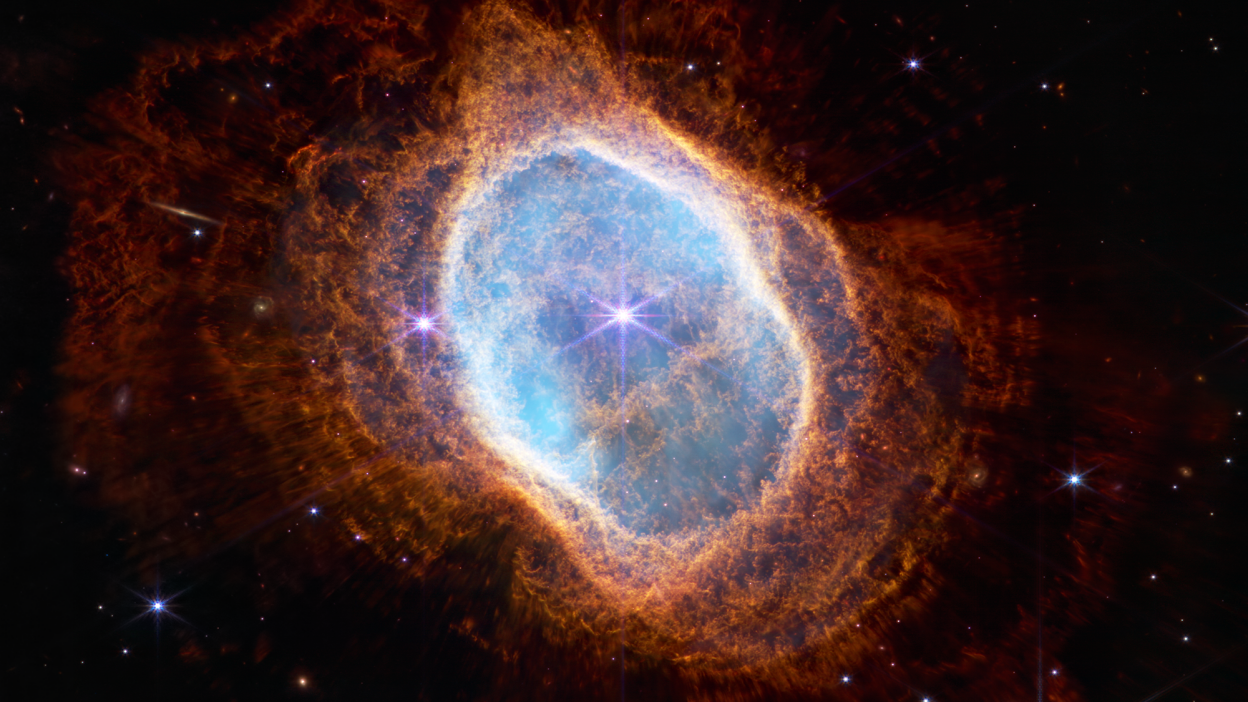
NASA’s James Webb Space Telescope Uncovers Detailed Structure of a Planetary Nebula

NASA’s James Webb Space Telescope (JWST) has uncovered the intricate details of NGC 1514, a planetary nebula that has been evolving over a span of at least 4,000 years. The nebula, which can only be seen in infrared light, exhibits a series of “fuzzy” clusters arranged in twisted patterns. These patterns highlight the complex structure of the nebula, revealing the presence of sharper holes near the center. These holes indicate areas where faster-moving materials have pierced through, providing insight into the dynamics of the nebula’s formation. An orange arc of dust surrounds the stars at the center of the nebula, which are in a close, elongated orbit that lasts about nine years. One of these stars, which was once several times more massive than the Sun, played a critical role in shaping the nebula’s structure.

The JWST has allowed astronomers to observe the dual gas rings that surround the dying star at the core of the nebula. The star’s interaction with its companion, as well as its evolution, is thought to have influenced the nebula’s distinctive hourglass shape. The rings of gas are unevenly illuminated, with the mid-infrared light casting a textured appearance. In particular, the clumped pink center of the nebula contains high concentrations of oxygen, particularly around the boundaries of the bubble-like holes. The nebula’s structure is of particular interest because of what it lacks: the absence of certain complex molecules. This absence may be due to the merging orbits of the two central stars, which have hindered the formation of these molecules.

NGC 1514, located in the Taurus constellation and situated 1,500 light-years from Earth, offers astronomers a valuable opportunity to study the final stages of a star’s life. The nebula’s dual rings of expelled material, traced back to the interaction of the two central stars, are particularly fascinating. The study of these rings offers a unique glimpse into the ongoing processes that shape star systems over long periods. These insights could help astronomers better understand the role of gravitational pull in shaping the dynamics of star outflows, providing key data on how stars evolve and interact over time.

The stars at the center of NGC 1514 are part of a binary system with one of the longest known orbits—about nine years. Astronomers believe that the creation of the nebula is largely attributed to the more massive of the two stars. As this star aged, it shed layers of gas and dust, producing a hot, compact core known as a white dwarf. The winds from this white dwarf likely carried away the earlier, slower-moving material, forming faint, clumped rings that are visible only in infrared light. Despite the lack of complex carbon-based molecules, JWST’s observations have revealed significant oxygen concentrations in the nebula, furthering the understanding of stellar processes. These findings underscore the importance of the JWST in advancing our knowledge of stellar evolution and the life cycles of stars.


Stone Age Beliefs Tied to Ancient Amber Bear Figurine Unearthed in Poland

In 1887, workers digging through a peat bog made a remarkable discovery — a small carved amber bear, believed to date back to the Stone Age. Thought to have been worn as a protective charm, the bear reflects the reverence early humans had for the powerful and fearsome animal. This artifact was later affectionately named “Słupcio,” meaning “little guy from Słupsk,” by a Polish kindergartner who won a naming contest. Today, the amber bear is displayed at the National Museum in Szczecin, located about 220 kilometers from where it was originally found.

The discovery of Słupcio ties into broader archaeological findings from the Pomerania region along the southern Baltic Sea. During the Stone Age, most people lived as hunters, leaving behind few traces of their daily lives. However, sites along the Baltic coast have revealed an array of tools, pottery, and amber objects washed ashore. A 2023 study by archaeologists Daniel Groß and Peter Vang Petersen uncovered several similar amber bear figurines, suggesting these objects date back to the Paleolithic era — between roughly 50,000 and 12,000 years ago — highlighting a longstanding tradition of animal representation in prehistoric cultures.

Słupcio’s journey through history is just as fascinating as its ancient origins. At the end of World War II, the artifact, along with many others, was taken from Poland by German forces and housed in the Stralsund Museum. It remained there for decades until its eventual return to Szczecin in 2009. In Germany, it was referred to as “Bernsteinbär,” meaning “amber bear,” and scholars confirmed its ancient roots. Despite being discovered over a century ago, debates about the exact age and origin of the carving continue to intrigue experts.

Today, the amber bear has become a beloved cultural symbol. Measuring 10.2 centimeters in length, 4.2 centimeters in height, and weighing 85 grams, the figurine features a hole through its midsection — likely used to string it as a necklace or attach it to clothing or gear. The material’s translucent glow when polished and its distinct fragrance when burned gave amber a mystical quality, turning it into a Stone Age amulet believed to hold protective powers. The bear not only represents ancient craftsmanship but also offers a glimpse into the spiritual beliefs of early humans navigating a world filled with powerful natural forces.

SpaceX Set to Launch NASA Cargo Mission to the International Space Station This Month

NASA has officially scheduled the next commercial resupply mission to the International Space Station (ISS), with SpaceX once again taking the lead. The mission, known as CRS-32, is set to launch on April 21, 2025, at 4:15 a.m. EDT (1:45 p.m. IST). SpaceX’s Dragon spacecraft will be packed with more than 6,400 pounds (about 2,902 kilograms) of supplies, science tools, and hardware vital for ongoing experiments aboard the ISS. The spacecraft will ride atop a Falcon 9 rocket launching from NASA’s Kennedy Space Center in Florida, continuing a crucial partnership that supports the station’s research and daily operations.

The CRS-32 mission carries an impressive array of scientific equipment aimed at pushing the boundaries of space research. A major highlight is a robotic maneuvering demonstration that will test improvements to free-floating robots, enhancing autonomous operations in microgravity. Additionally, the Dragon capsule will deliver an air quality monitoring system designed to safeguard astronaut health during future missions to the Moon and Mars. Another important payload includes two atomic clocks, which will help verify Einstein’s theory of relativity and advance the precision of timekeeping technologies critical for deep-space navigation.

Following its launch, the Dragon spacecraft is expected to reach the ISS the next day. After lifting off, Dragon will approach the space station and is scheduled to dock autonomously at the zenith port of the Harmony module by 6:45 a.m. EDT on April 22. NASA will provide full coverage of the launch and docking events through its NASA+ streaming platform, beginning at 3:55 a.m. EDT on launch day. Mission controllers will closely monitor every phase of the journey to ensure a smooth arrival and successful integration with the ISS.

For those eager to witness a piece of space history, NASA is offering a front-row seat via its live broadcast. The livestream will capture both the thrilling launch and the intricate docking process in real-time, offering viewers an inside look at how SpaceX and NASA are collaborating to sustain human presence in low Earth orbit. With so many scientific advancements riding aboard CRS-32, this mission represents not just a resupply effort, but a major step forward in humanity’s journey into deeper space.