Scientists Pin Down the Elusive Length of a Day on Uranus

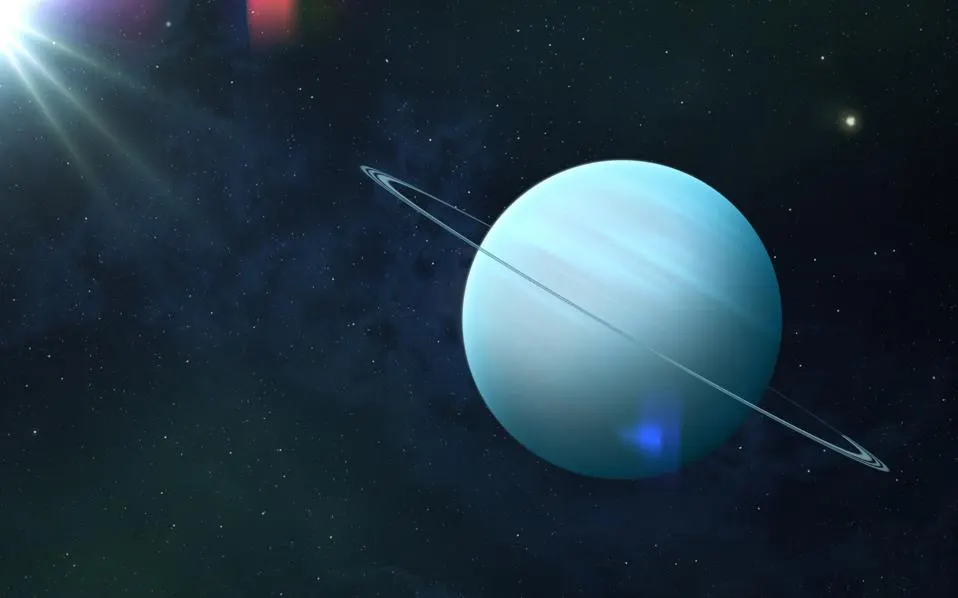
Uranus’ Day Finally Measured: A 17-Hour Spin on Its Side

After decades of uncertainty, scientists have finally nailed down how long a day lasts on Uranus, thanks to a detailed analysis of data collected over ten years by the Hubble Space Telescope. According to the latest findings, the ice giant takes 17 hours, 14 minutes, and 52 seconds to complete a full rotation. That’s just 28 seconds longer than the earlier estimate provided by NASA’s Voyager 2 mission in the 1980s. The breakthrough came from tracking subtle signals—specifically, magnetic field variations and radio emissions tied to the planet’s auroras.

The new study, led by Laurent Lamy of the Paris Observatory, used long-term aurora observations to reveal the exact location of Uranus’ magnetic poles. These poles helped researchers determine the planet’s rotation period more accurately than ever before. While Uranus takes roughly 84 Earth years to complete one orbit around the Sun, its daily spin has remained elusive due to its chaotic atmospheric conditions. On a planet where high-speed winds and tilted axes complicate surface measurements, auroras offer a more reliable method for timing the rotation.

Unlike Earth or Mars, Uranus presents unique challenges for scientists. Its unusual 98-degree axial tilt means it essentially spins on its side, making traditional rotational tracking methods less effective. Back in 1986, Voyager 2 observed that the planet’s magnetic field was offset by 59 degrees from the planet’s axis, which added further complexity to measuring a day. The new measurements not only refine Voyager’s findings but also provide crucial context for understanding Uranus’ strange orientation and inner workings.

These updated figures are more than just trivia—they’re essential for future exploration. As space agencies consider missions to the outer planets, having an accurate understanding of Uranus’ spin rate and magnetic field behavior can help scientists design better instruments and flight plans. With its sideways spin and extreme seasons, Uranus continues to be one of the most mysterious planets in our solar system—but bit by bit, its secrets are being revealed.


Ancient Farallon Slab Tugs at Midwest Crust, Triggering Regional Thinning

Ancient Slab Beneath U.S. Heartland Linked to Crustal Thinning Across the Region

A massive underground structure deep beneath the central United States is quietly reshaping the continent from below. Scientists have discovered that a buried remnant of ancient crust is dragging surface materials downward, drawing rock from a wide area into a funnel-like zone beneath the Midwest. This movement is believed to be causing parts of Earth’s crust in the region to thin significantly—a phenomenon that surprisingly stretches beyond the immediate area affected.

At the heart of the discovery is the Farallon slab, a long-subducted tectonic plate that now rests roughly 660 kilometers below the surface. Published in Nature Geoscience, the new study connects this ancient remnant to what geologists call “cratonic thinning.” Cratons are some of the oldest and most stable parts of Earth’s crust, typically untouched by tectonic shifts. But the presence of the Farallon slab seems to be disturbing this stability, pulling at the base of the continent and causing unexpected changes to the deep structure of North America.

The research was led by Junlin Hua, who conducted the seismic mapping as a postdoctoral researcher at The University of Texas at Austin. Now a professor in China, Hua described the widespread crustal thinning as an eye-opening find. According to him, the study presents a novel explanation for long-observed changes beneath the region. It’s a departure from conventional thinking, and the research team believes it provides a clearer view of how deep-Earth processes can influence surface geology over vast distances.

To explore these hidden movements, scientists relied on a powerful seismic imaging technique called full-waveform inversion. This method allowed researchers to capture detailed 3D images of Earth’s interior, offering an unprecedented look at the interaction between the lower mantle and the overlying lithosphere. Thorsten Becker, chair of geophysics at UT Austin, noted that the imaging revealed a distinctive “dripping” pattern in the lithosphere—only present when the Farallon slab was included in computer models. When the slab was removed from simulations, the phenomenon vanished, reinforcing its role in reshaping the continent from below.

T Corona Borealis Could Erupt Soon: Rare Nova May Be Visible Without Telescope

T Corona Borealis, a binary star system in the Northern Crown constellation, has become a focal point for astronomers closely watching for signs of a rare stellar eruption. The system consists of a white dwarf and a red giant, with the white dwarf drawing material from its companion. Over time, this accumulation of matter on the surface of the white dwarf could lead to a thermonuclear explosion, known as a Nova. The last such eruption was recorded in 1946, and there are increasing indications that another outburst might be imminent, sparking global interest among scientists and stargazers alike.

The potential for a nova eruption has been suggested by the recent observations of the system. In 2015, a brightening event was recorded, followed by a dimming in 2023, which mirrored the pattern seen in the lead-up to the 1946 eruption. These fluctuations in brightness are fueling speculation that T Corona Borealis could soon erupt again. If this occurs, the resulting nova could be visible to the naked eye, becoming one of the brightest objects in the sky, comparable in visibility to some of the most prominent stars.

A study published in the Monthly Notices of the Royal Astronomical Society has added weight to the eruption predictions. Researchers have noted that the system’s behavior between 2015 and 2023 closely resembles the activity seen before previous eruptions, particularly the high levels of brightness and activity in the accretion disc surrounding the white dwarf. T Corona Borealis is one of only eleven known recurrent novae, with documented eruptions occurring in 1217, 1787, 1866, and 1946. Given this historical pattern, scientists are predicting that the next eruption could take place as soon as within the next one or two years, with specific dates being suggested between March 27 and November 10 of this year, or as far out as June 25, 2026.

There has also been speculation about the potential influence of a third object within the binary system, which could be affecting the behavior of the stars. However, leading astronomers such as Dr. Léa Planquart of Université de Strasbourg and Dr. Jeremy Shears of the British Astronomical Association have dismissed this theory, pointing out the lack of supporting evidence. Instead, they believe that the most likely cause of the impending nova eruption is the heightened activity in the accretion disc of the white dwarf. With experts predicting the eruption’s timing with increasing certainty, the world may soon have the opportunity to witness one of nature’s most spectacular cosmic events.