Engineers Develop Innovative Methods to Shape Bread-Based Carbon Electrodes for Sustainable Applications

A team of engineers has pioneered two new methods for shaping carbon electrodes derived from bread, offering promising potential for more sustainable electrode production. The innovative techniques are a continuation of prior research, aiming to address the challenges of producing carbon electrodes from food waste, specifically stale bread. By repurposing bread—an often discarded item—the researchers have found a way to convert it into a valuable material that can be used in various applications, such as desalination systems. This breakthrough process involves heating stale bread in an oxygen-free environment, transforming it into carbon, a substance commonly used for manufacturing electrodes. The team’s ultimate goal is to refine these techniques for large-scale production, providing an environmentally friendly alternative to traditional carbon electrode materials.

The research, published in Royal Society Open Science, was carried out by engineers David Bujdos, Zachary Kuzel, and Adam Wood from Saint Vincent College and the University of Pittsburgh. Building upon earlier work by Adam Wood, which established that stale bread contains sufficient carbon to be used in electrode production, the team has developed new methods to refine the shaping process. Wood’s initial work demonstrated that stale bread, once heated and transformed, could serve as a viable material for carbon electrodes. This discovery opened up new possibilities for using food waste in high-tech applications, a concept that has captured the attention of sustainability advocates.

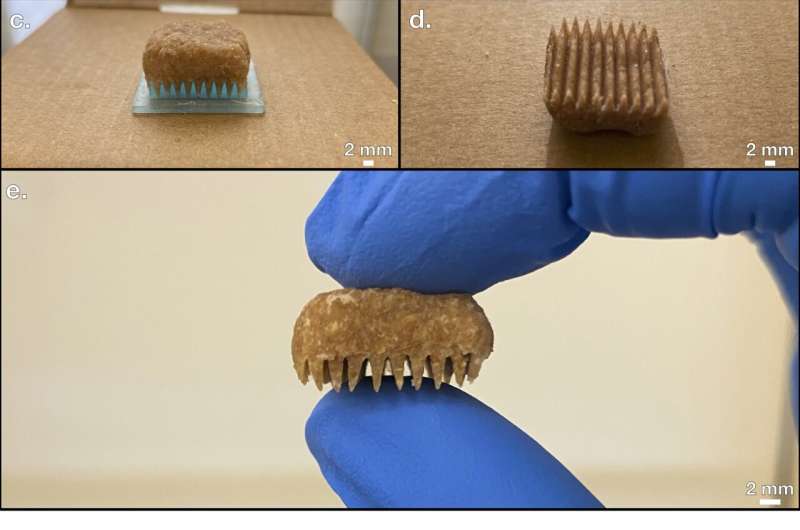
The newly developed methods involve two distinct approaches for molding carbon electrodes into precise, sturdy shapes. One technique uses 3D-printed molds to compress the bread before it undergoes the heating process. This compression step ensures that the bread retains its shape and forms a consistent structure suitable for electrode production. In one demonstration, a zigzag mold was employed to showcase the potential for creating electrodes with complex shapes. This ability to control the final shape of the electrodes is a significant advancement, as it allows for more targeted applications in industries that require specific electrode configurations.

These new shaping techniques represent a significant step forward in making the production of carbon electrodes more sustainable. By utilizing a commonly wasted food source like stale bread, the engineers have found a way to reduce waste while simultaneously addressing the growing demand for eco-friendly alternatives in industrial manufacturing. The team’s work not only holds promise for the future of electrode production but also contributes to the broader movement towards sustainability in science and technology. If successful at scale, this method could revolutionize how electrodes are made, offering a green solution to a critical component in various industrial and environmental technologies.

Modern Societies Experience Increased Sleep, but with Irregular Patterns

Recent research has cast doubt on the commonly held view that modern, industrialized living leads to chronic sleep deprivation. While issues like excessive screen time and daily stress are often blamed for poor sleep quality, studies suggest that individuals in industrialized societies actually sleep longer than those in less industrialized environments. Despite concerns about modern life’s impact on sleep, data from multiple studies indicate that the average sleep duration in industrialized societies is longer than in their non-industrialized counterparts, challenging assumptions about sleep loss in modern times. However, although people in industrialized nations may get more sleep, their circadian rhythms—our natural sleep-wake cycles—are often more disrupted.

One of the key studies examining these patterns was published in Proceedings of the Royal Society B by anthropologists David Ryan Samson and Leela McKinnon from the University of Toronto Mississauga. Their meta-analysis reviewed 54 global studies on sleep, including data from 866 healthy adults. The findings reveal that, on average, people living in hunter-gatherer societies sleep significantly fewer hours compared to those in industrialized societies. In fact, some hunter-gatherer groups reported sleeping only about 5.5 hours per night, with the general average sleep duration in non-industrialized societies being around 6.4 hours. In contrast, individuals in industrialized countries sleep for more than seven hours per night on average, suggesting that modern life provides more opportunities for sleep, despite other factors at play.

Moreover, the research also points out that sleep efficiency, defined as the proportion of time spent in bed actually sleeping, is higher in industrialized settings. According to the study, 88 percent of the time spent in bed in industrialized societies is used for sleep, compared to just 74 percent in non-industrialized settings. This suggests that, although people in industrialized societies may sleep more, their sleep is generally more efficient. Yet, this improvement in sleep efficiency doesn’t extend to circadian rhythms. The study found that the regularity of sleep-wake cycles, measured by the circadian function index, was less consistent in industrialized environments. Non-industrialized societies had a higher circadian rhythm regularity, with an index score of 0.7, while industrialized societies had a lower score of 0.63, indicating more disruption in sleep patterns.

In conclusion, while modern industrialized societies may offer more sleep opportunities, they also come with disruptions that affect the quality of sleep, particularly in terms of circadian rhythm regularity. This new perspective challenges the longstanding narrative that modern life leads to widespread sleep deprivation, providing a more nuanced understanding of how our sleep patterns are shaped by the environment we live in.

NASA’s SPHEREx Telescope Set for Launch on SpaceX Falcon 9 to Unravel the Mysteries of Cosmic Evolution

NASA is preparing to launch its latest infrared space telescope, SPHEREx (Spectro-Photometer for the History of the Universe, Epoch of Reionization, and Ices Explorer), on February 28. The $488 million mission will lift off from Vandenberg Space Force Base in California aboard a SpaceX Falcon 9 rocket. SPHEREx is designed to scan the entire sky in infrared light, capturing data from over 450 million galaxies and 100 million stars in the Milky Way. Its observations will target regions of the universe that are typically too distant or faint for conventional telescopes, offering an unprecedented look at cosmic history.

One of SPHEREx’s key scientific goals is to investigate cosmic inflation, the rapid expansion of the universe that took place within the first second after the Big Bang. By mapping large-scale structures in space, the telescope will help astronomers understand how galaxies formed and evolved over billions of years. Additionally, SPHEREx will search for icy molecules in interstellar space, providing crucial data on the origins of water and organic compounds essential for life. Scientists believe these insights could deepen our understanding of planetary system formation and the potential for habitability beyond Earth.

From a technical perspective, SPHEREx is an advanced yet compact observatory. Weighing approximately 500 kilograms, it operates on 270 to 300 watts of power and is equipped with a cutting-edge spectrophotometer. This instrument can detect 102 different wavelengths of infrared light, allowing it to identify unique chemical signatures across vast cosmic distances. According to NASA’s Jet Propulsion Laboratory (JPL), this capability will enable SPHEREx to create a detailed spectral map of the sky, helping researchers decipher the composition of celestial objects.

Beyond its planned objectives, SPHEREx may also yield unexpected discoveries. James Fanson, the mission’s Project Manager at JPL, told NPR that the telescope’s extensive dataset could lead to breakthroughs in areas not yet anticipated. As scientists analyze SPHEREx’s observations, they hope to uncover new insights into the structure and evolution of the universe, potentially reshaping our understanding of cosmic history.