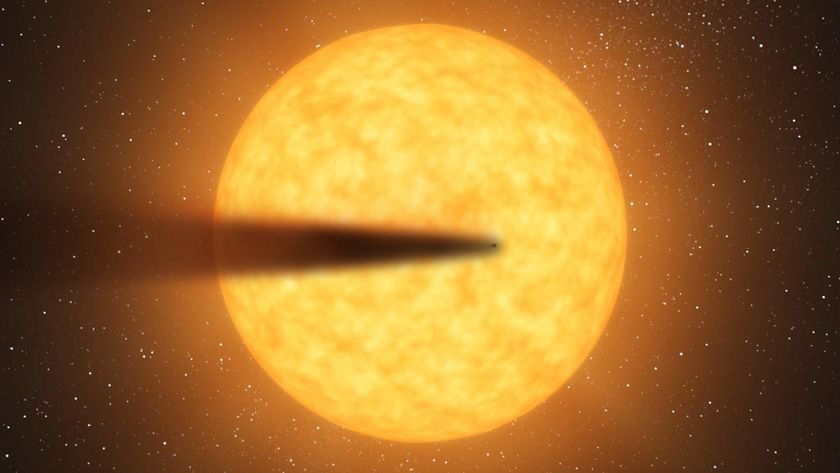
WASP-121 b’s Atmosphere Revealed to Have Iron Rains, Jet Streams, and Other Extreme Phenomena

Astronomers have discovered that the exoplanet WASP-121 b, located around 900 light-years from Earth, experiences some of the most extreme weather phenomena ever observed in space. The planet, an ultra-hot Jupiter, has been found to feature intense atmospheric dynamics, including iron rains and incredibly strong winds that exceed the power of the most intense hurricanes in our own solar system. The planet’s violent weather is attributed to powerful jet streams that move vaporized metals through its atmosphere, creating a volatile and ever-changing climate.

WASP-121 b’s atmosphere has captivated scientists due to its unique and complex weather patterns. A recent study published in Nature reveals that elements like iron and titanium are not only vaporized on the planet’s scorching dayside but are also transported by fast-moving winds to the colder nightside. There, these metals condense and fall as liquid metal rain. Dr. Julia Victoria Seidel, a researcher at Observatoire de la Côte d’Azur, highlighted that the planet’s dynamic climate challenges our current understanding of meteorological processes, pushing the boundaries of what we know about planetary atmospheres.

The planet’s proximity to its host star makes it a prime example of an ultra-hot Jupiter, a class of exoplanets that experience extreme conditions. With a mass 1.2 times that of Jupiter, WASP-121 b completes an orbit in just 30 hours, making it one of the fastest orbiting exoplanets known. Because of its close distance to its star, the planet is tidally locked, meaning one side always faces the star, while the other remains in eternal darkness. On the sun-facing side, temperatures soar to extremes, causing metals to vaporize and form a toxic cloud. This heated atmosphere, combined with the planet’s rapid rotation, drives powerful winds that funnel these metal vapors across the planet.

In order to gain a deeper understanding of these phenomena, astronomers used the Very Large Telescope (VLT) in Chile’s Atacama Desert, specifically utilizing the ESPRESSO instrument. By combining light from multiple telescopes, the team was able to map different layers of the planet’s atmosphere, providing detailed insights into its chemical composition. These observations suggest that the complex weather systems on WASP-121 b may hold valuable clues for understanding the atmospheric behavior of exoplanets, further expanding our knowledge of alien worlds.


James Webb Telescope Spots Continuous Flares Erupting from Sagittarius A at the Milky Way’s Center

Astronomers have recently observed the supermassive black hole at the center of the Milky Way, Sagittarius A*, emitting continuous flares, revealing new and intriguing behaviors in this cosmic giant. These observations were made using the James Webb Space Telescope (JWST), which provided unprecedented detail and clarity on the black hole’s activity. The flares, which vary in duration and intensity, add to the growing body of research on black holes, their accretion disks, and their interactions with surrounding matter. This discovery sheds light on a level of variability in Sagittarius A* that was previously not well understood, providing new insights into the dynamics of supermassive black holes.

The flares detected by JWST occurred over several observation sessions, totaling two full days of data collected during the past year. Using the telescope’s Near-Infrared Camera (NIRCam), researchers closely examined Sgr A* across multiple eight-to-ten-hour periods. The results were striking: the black hole produced bursts of energy ranging from quick, short-lived flashes to much longer, sustained outbursts. These bursts, occurring up to six times a day, were linked to the accretion disk surrounding the black hole, which is a dense ring of gas and dust spiraling inward. Some of these bursts were even accompanied by smaller sub-flares, further adding to the complexity of the black hole’s behavior.

While flares are a known phenomenon in supermassive black holes, the activity of Sgr A* is particularly unpredictable, setting it apart from other known black holes. The exact causes behind these flares are still being investigated, with scientists considering a variety of mechanisms. Shorter, fainter flares could be the result of small disturbances in the accretion disk, akin to ripples caused by minor disruptions. In contrast, the larger and brighter flares may be driven by more dramatic events, such as magnetic reconnection—an event in which charged particles accelerate to nearly the speed of light, producing powerful bursts of radiation.

Interestingly, the researchers compared the flaring activity of Sgr A* to solar flares, which are driven by magnetic activity on the sun’s surface. However, they noted that the processes near a black hole are far more extreme, with much greater forces at play. The NIRCam’s ability to observe multiple infrared wavelengths has proven invaluable in understanding these flares. It revealed a slight delay in the brightness of longer-wavelength emissions compared to shorter-wavelength ones, offering new clues about the complex mechanisms at work in the vicinity of the black hole. As research continues, these findings are helping scientists piece together a more complete picture of the behavior and characteristics of supermassive black holes.

Ancient Egyptian Tomb of Meketre Yields Exquisite Wooden Diorama of Granary and Scribes

A remarkable wooden diorama depicting a granary with scribes was uncovered in the tomb of Meketre, an influential official from Egypt’s Middle Kingdom. Discovered in 1920 in a concealed chamber within his tomb at Thebes (modern-day Luxor), the model dates back to around 1980 B.C. This artifact provides valuable insight into the role of grain storage and record-keeping in an ancient agricultural society where wheat and barley were essential commodities. Today, this well-preserved model is housed at the Metropolitan Museum of Art in New York, where it continues to captivate historians and visitors alike.

The diorama, meticulously crafted from wood, measures approximately 74.9 by 56 by 36.5 cm. It showcases a granary divided into two primary sections: one for storing grain and the other for administrative tasks. Inside, 15 miniature figurines, each around 20 cm tall, are arranged to depict various activities. Some figures are shown carrying sacks of grain, while others diligently record inventory on wooden tablets and papyrus scrolls. The model also illustrates architectural elements designed to protect stored grain from theft and rodent infestations, highlighting the sophisticated grain management practices of the time.

The discovery of this diorama sheds light on the economic foundation of ancient Egypt, which was heavily dependent on agricultural production. The Nile Valley’s fertile lands allowed for abundant cereal harvests, making grain a vital resource for both sustenance and trade. Pharaohs exercised strict control over grain distribution, ensuring food security and stability throughout the kingdom. Meketre, as the chief steward, played a crucial role in overseeing royal estates and managing the storage and allocation of grain supplies.

Beyond its historical significance, this model offers a glimpse into the daily operations of an ancient Egyptian granary, emphasizing the importance of administrative roles in maintaining a well-functioning economy. The presence of scribes in the diorama underscores the meticulous record-keeping that was integral to managing resources efficiently. As one of the best-preserved examples of ancient Egyptian craftsmanship, the granary model remains an invaluable artifact that continues to deepen our understanding of life and labor in the Middle Kingdom.