Yazılar

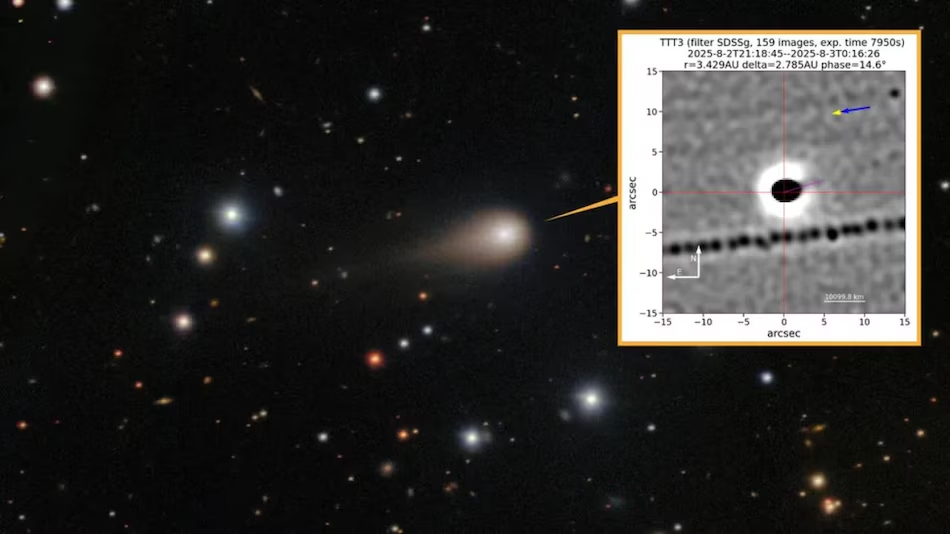
New Photos of Interstellar Object 3I/ATLAS Reveal Massive Jet Pointing Toward the Sun

Newly captured images of the interstellar comet 3I/ATLAS reveal a spectacular jet of gas and dust shooting directly toward the Sun, offering scientists a closer look at the object’s natural behavior. First detected in late June and confirmed by NASA in July, 3I/ATLAS originates from a distant star system and is only the third interstellar object ever observed entering our solar system. Measuring between 5 and 11 kilometers wide, it is the largest interstellar visitor discovered so far and may also be the oldest, with an age estimated at billions of years, predating the formation of the Sun. Devamını Oku

Sun Ejects Massive 600,000-Mile Plasma Filament in Intense Solar Eruption

A spectacular solar eruption captivated scientists and skywatchers alike, as a massive filament stretching 600,000 miles erupted from the sun’s northern hemisphere. This incredible outburst, occurring around 8 p.m. EDT (0000 GMT), sent a colossal cloud of plasma and magnetic energy hurtling into space. The filament’s length was more than twice the distance between Earth and the moon, making it one of the most impressive solar events observed in recent times. Despite its scale, early models suggest that this fiery eruption, known as a coronal mass ejection (CME), poses no immediate threat to Earth, although researchers continue to monitor the phenomenon closely.

The eruption originated from a filament composed of cooler, denser solar plasma suspended above the sun’s surface by magnetic fields. These filaments often appear as dark, ribbon-like structures across the solar disk and can suddenly become unstable, triggering powerful eruptions. According to reports from Space.com, this event dwarfed recent similar outbursts in both size and intensity. Aurora enthusiast Jure Atanackov described the CME as one of the most spectacular of the year, noting thankfully that it is directed away from Earth toward the sun’s northern regions.

Online, the event quickly gained the nickname “angel-wing” or “bird-wing” eruption due to its vast, wing-like shape as it stretched across space. Another aurora chaser, Vincent Ledvina, praised its striking visual impact, suggesting it’s an eruption worth watching on repeat. The length of this filament eruption, extending over a million kilometers, is not only scientifically significant but also visually stunning. While such coronal mass ejections can lead to geomagnetic storms capable of disrupting satellites, communication networks, and power grids, this particular event is forecasted to miss Earth entirely.

This dramatic solar eruption serves as a vivid reminder of the dynamic and sometimes unpredictable forces emanating from our nearest star. As Solar Cycle 25 approaches its peak in 2025, solar activity is expected to intensify, potentially bringing more powerful and Earth-affecting eruptions in the coming months. For astronomers and casual observers alike, the sun remains both a source of wonder and a critical object of study, underscoring the delicate balance between cosmic power and life on our planet.

Astronomers Spot ‘Teleios’: A Rare Supernova Remnant with Near-Perfect Symmetry

Astronomers Uncover ‘Teleios’: A Strikingly Symmetrical Supernova Remnant

An international team of astronomers has identified a rare and unusually symmetrical supernova remnant (SNR) using data from Australia’s Square Kilometre Array Pathfinder (ASKAP). Officially designated G305.4–2.2 and nicknamed “Teleios”—derived from the Greek word for “perfect”—this SNR displays an extraordinary degree of circular symmetry, setting it apart from the majority of known remnants that typically appear irregular or distorted. The discovery was made as part of the Evolutionary Map of the Universe (EMU) project, which aims to chart millions of galaxies and deep-sky structures through radio-continuum surveys.

What makes Teleios so remarkable is its near-perfect spherical structure. Most SNRs expand unevenly due to the chaotic nature of the surrounding interstellar medium (ISM), which disrupts the shockwave’s outward propagation. However, a few rare remnants, such as SN1987A or MC SNR J0509–6731, have been noted for their symmetrical shapes—though even among these, Teleios stands out. Its uniform shell-like appearance suggests that the ISM in its vicinity may be unusually homogeneous, or that the explosion dynamics were particularly well-balanced.

Researchers estimate that Teleios lies at a distance of either 7,170 or 25,100 light-years, depending on the model used. These distances correspond to a diameter of 45.6 or 156.5 light-years, respectively. Further analysis of radio emissions within the southeastern portion of the shell revealed faint extended signals. This suggests possible interaction with nearby ISM structures. Additionally, the remnant’s steep spectral index of -0.6 indicates that it is either relatively young or has evolved in a unique way, maintaining a low surface brightness throughout its life cycle.

The discovery of Teleios adds a fascinating new case study to the catalog of known SNRs and highlights the power of next-generation radio telescopes like ASKAP. As researchers continue to probe its characteristics, Teleios may provide new insights into the physics of supernovae, shockwave propagation, and the large-scale structure of the ISM. Its rare symmetry makes it an ideal target for follow-up studies across multiple wavelengths, potentially unlocking new clues about the life and death of stars in our galaxy.