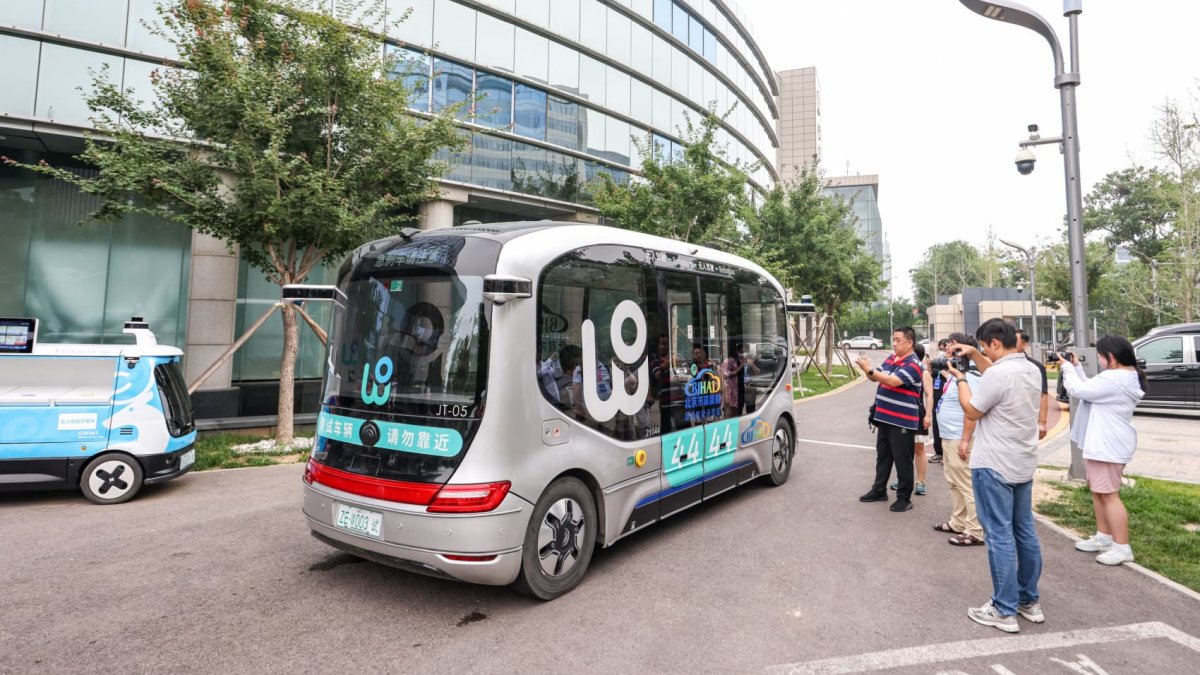
After years of costly failures and repeated delays, the self-driving car industry is once again pushing forward as chipmakers, technology firms and auto suppliers bet that artificial intelligence and deep partnerships can reignite progress. Companies including Nvidia are positioning themselves at the center of this renewed effort, even as automakers remain cautious about costs, scalability and consumer demand.
Fully autonomous vehicles promise to transform transportation, but delivering systems safe enough for public roads has proved far more complex and expensive than initially expected. While a handful of players such as Waymo and Tesla have chosen to pursue in-house development, legacy automakers including General Motors and Ford Motor have pulled back from their own fully autonomous programs.
At this year’s Consumer Electronics Show in Las Vegas, a wave of new collaborations signaled fresh momentum. Amazon Web Services and German supplier Aumovio announced a partnership to support the commercial rollout of self-driving vehicles. Autonomous trucking firm Kodiak AI teamed up with Bosch to scale production of autonomous hardware and sensors.
Nvidia also unveiled its next-generation autonomous driving platform, which will underpin a robotaxi alliance involving Lucid Group, Nuro and Uber. Separately, Mercedes-Benz said it will launch a new advanced driver-assistance system in the United States later this year, powered by Nvidia chips, allowing limited autonomous operation on city streets under driver supervision.
Artificial intelligence is increasingly seen as the key to overcoming some of the industry’s biggest hurdles. Generative AI tools are speeding up development and validation while reducing the resources required, according to Ozgur Tohumcu of AWS, who described AI as a “big accelerant” for autonomous driving.
Western automakers are also feeling pressure from China, where regulators last month approved two vehicles with Level 3 autonomous capabilities, allowing hands-off driving under certain conditions. Still, industry leaders caution against unrealistic expectations. Jochen Hanebeck, CEO of Infineon, warned against “market fantasy” that fully self-driving cars could soon become commonplace, noting that automakers currently prefer revenue-generating Level 2 driver-assistance systems.
Robotaxi trials are expanding in small pockets across China, the United States, Europe and the Middle East, but scaling them remains costly. According to Jeremy McClain, expanding coverage requires massive data, fleets and logistics investments.
The industry’s long history of hype still looms large. Tesla CEO Elon Musk famously predicted in 2019 that a million self-driving Teslas would be on the road within a year, yet only launched a limited robotaxi service last year. Early setbacks, including the shutdown of GM’s Cruise unit after a high-profile accident, forced many automakers to retreat.
Nvidia executives argue that AI breakthroughs are finally addressing long-standing weaknesses, particularly in handling rare “edge cases.” Ali Kani said foundational advances are making the technology feel closer to readiness. Analysts, however, say Tesla still holds a significant lead, even as Nvidia’s open-source platform gives rivals a shared alternative.