Yazılar

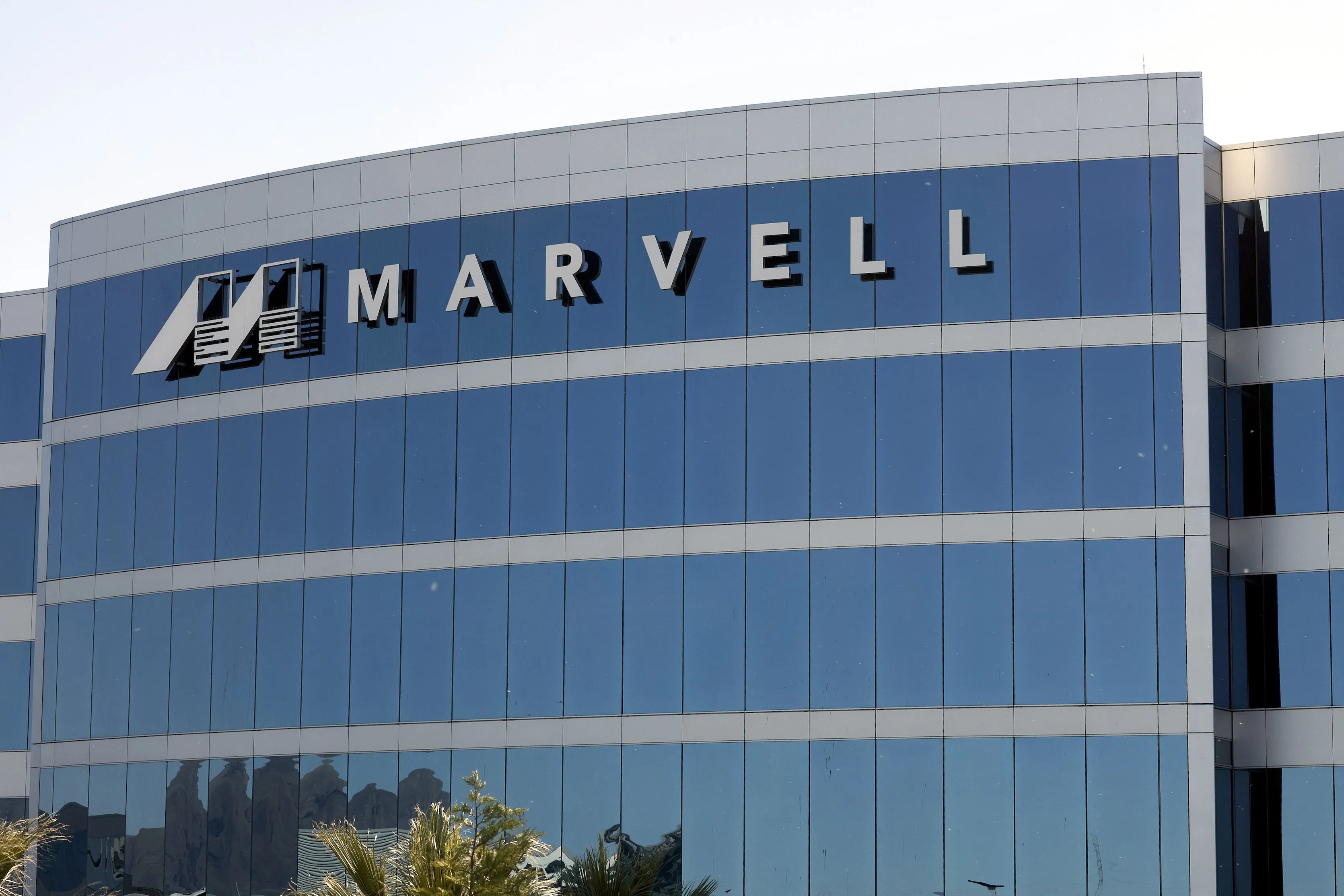
Marvell Technology Forecasts In-Line Q1 Revenue, Shares Drop 15%

Marvell Technology (MRVL.O) predicted first-quarter revenue in line with Wall Street’s expectations, but its shares fell sharply by 15% in after-hours trading. Investors were underwhelmed by the forecast, as they had hoped for more substantial growth driven by the surging demand for artificial intelligence (AI) chips.

The AI chip market has seen booming demand, particularly for sector-leader Nvidia’s (NVDA.O) AI processors. Major tech companies like Microsoft (MSFT.O), Meta Platforms (META.O), and Amazon.com (AMZN.O) have been working to reduce their reliance on Nvidia by developing their own AI chips, a trend that has benefited companies like Marvell and Broadcom (AVGO.O).

“The earnings print was generally OK, but I believe investors were expecting more given all the bullish data points in the overall AI space and the ramp of custom ASICs (AI chips) with certain hyperscalers,” said Tore Svanberg, an analyst at Stifel Nicolaus and Co.

Marvell’s data center segment performed well, with revenue up 78% year-over-year to $1.37 billion in the fourth quarter, driven by increased demand for custom AI chips as businesses work to optimize their AI workloads. In December, the company also signed a five-year chip deal with Amazon that includes custom AI chips.

“We’re engaged, we expect revenue to grow, but obviously, it’s like anything, you’ve got to show you can do it, and you’ve got to show it consistently,” Marvell COO Chris Koopmans said, emphasizing the “sticky” nature of the Amazon deal.

Marvell has pledged to focus its investments on data centers, seeing them as the best way to capitalize on the AI boom. Data center revenues accounted for 75% of its total revenue in the most recent quarter. However, Koopmans added that Marvell had not yet experienced any impact from tariffs affecting its data center business.

Despite posting solid results, Marvell’s shares dropped to $77.65 in after-hours trading, following a year-to-date increase of over 83%. In contrast, its larger competitor Broadcom saw a stock jump of around 107%. Analysts pointed to concerns over geopolitical pressures, AI monetization, and the magnitude of Marvell’s earnings beat as factors contributing to the decline.

Marvell forecast first-quarter revenue of $1.88 billion, slightly above analysts’ expectations of $1.87 billion.

GlobalFoundries Projects Weak First Quarter Amid Tariff Concerns and Smartphone Market Weakness

GlobalFoundries, the contract chipmaker based in Malta, New York, issued a bleak forecast for its first-quarter revenue and profit, citing the potential impact of U.S. President Donald Trump’s tariffs on automakers and a struggling smartphone market in 2025. Despite the outlook, the company’s shares reversed earlier losses, rising nearly 4% in morning trading.

For the first quarter, GlobalFoundries expects revenue to range between $1.55 billion and $1.60 billion, below the Wall Street estimate of $1.66 billion, according to data compiled by LSEG. The company also projects adjusted earnings per share to fall between 24 cents and 34 cents, with the midpoint of this range under analysts’ expectations of 32 cents per share.

The automotive sector, which is GlobalFoundries’ third-largest revenue contributor, is especially vulnerable to the effects of tariffs on steel and aluminum imports in the United States. In 2023, the company signed a long-term agreement with General Motors to produce chips exclusively for the carmaker at its Malta facility.

Additionally, GlobalFoundries is facing challenges in its largest segment, smartphones. The global smartphone market is expected to face a turbulent 2025, according to research firm Canalys, further adding pressure on the company’s performance.

For the fourth quarter, GlobalFoundries posted revenue of $1.83 billion, meeting analysts’ estimates. The company also reported a profit of 46 cents per share, excluding items, which was slightly above the expected 44 cents.

Earlier this month, the company announced the appointment of Tim Breen as its new CEO, succeeding Thomas Caulfield.

Qualcomm Shares Fall on Downbeat Forecast for Licensing Business

Qualcomm’s (QCOM.O) shares dropped by around 5% in early trading on Thursday following a disappointing forecast for its patent licensing business, despite strong expectations for quarterly sales and profits. The chipmaker revealed that its licensing business, which contributed 14.8% to its total revenue in the reported quarter, would experience no sales growth this year due to the expiration of its agreement with Huawei Technologies (HWT.UL).

TD Cowen analysts had initially expected the removal of Huawei’s royalty payments to have a mild impact, but they noted that the development adds to the “wall of worry” surrounding Qualcomm’s stock. However, analysts pointed out that Qualcomm has secured licensing agreements with two other Chinese smartphone manufacturers, which may help mitigate some of the losses.

The company’s first-quarter performance exceeded expectations, driven by strong demand for AI features in mobile devices, and is often seen as a barometer for broader smartphone industry trends. Qualcomm’s second-quarter sales forecast of $10.75 billion, with adjusted profits of $2.80 per share, surpassed analysts’ estimates of $10.34 billion and $2.69 per share, respectively, as reported by LSEG data.

While Qualcomm credited growth in its smartphone division to strong sales from China, powered by government subsidies and flagship smartphone launches, it also highlighted positive performance across other business segments, including handsets, autos, and IoT.

Despite gains in 2024, Qualcomm’s stock has underperformed AI chip leader Nvidia (NVDA.O), whose shares surged by 171%. Qualcomm’s stock has increased by 6% this year, far surpassing the losses seen by competitors like Intel (INTC.O), which saw a 60% decline, and Advanced Micro Devices (AMD.O), which dropped by 18%.

As a result of the company’s outlook, Qualcomm’s median price target decreased slightly to $192, down from $199 prior to the report, according to LSEG data. The company’s forward price-to-earnings ratio stands at 15.02, significantly lower than Nvidia’s 27.64 and Intel’s 32.21.