Yazılar

Microsoft Forms New Team to Develop ‘Humanist’ Superintelligence, Says AI Chief

Microsoft’s Vision for Humanist Superintelligence: A People-Centric Future for AI

Microsoft has announced its ambitious goal to build what it calls a “humanist superintelligence” — an advanced form of artificial intelligence that serves humanity’s best interests. The company envisions this next-generation AI as one that “always works for, and in service of, people and humanity more generally.” The declaration comes amid an intensifying race toward achieving artificial general intelligence (AGI), with tech giants like Google, OpenAI, and Meta all vying for leadership in the space. Yet, Microsoft stresses that while the competition for capability continues, there must also be a global discussion about the kind of AI future society truly wants.

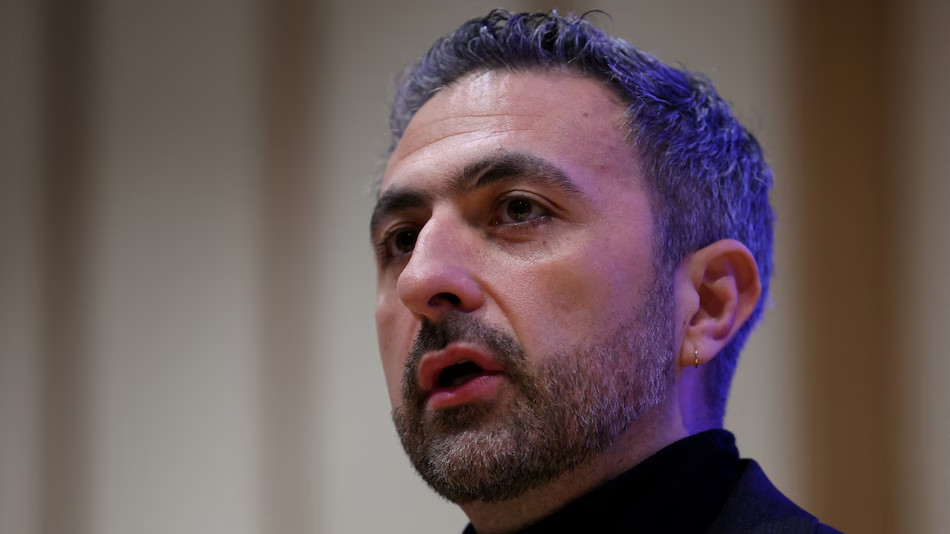
In a detailed blog post, Mustafa Suleyman, the CEO of Microsoft AI, emphasized that defining the purpose and boundaries of superintelligence should be a priority before the technology reaches maturity. He noted that the industry has already crossed an inflection point with the rise of “reasoning models” — AI systems capable of complex problem-solving and contextual understanding. According to Suleyman, this shift marks a crucial moment to set ethical and practical frameworks that ensure AI remains beneficial and controllable.

Suleyman further explained that Microsoft does not aim to create an “unbounded and unlimited entity with high degrees of autonomy.” Instead, the company seeks to develop systems that are “carefully calibrated, contextualized, and within limits.” This human-centered approach reflects Microsoft’s long-standing stance on responsible AI development, where transparency, accountability, and safety are integral to innovation.

Ultimately, the company’s vision of humanist superintelligence is rooted in empowering people rather than replacing them. Microsoft wants its AI to amplify human potential, helping address global challenges such as climate change, healthcare disparities, and education gaps. By focusing on a humanist framework, the tech giant hopes to ensure that the dawn of superintelligence strengthens — rather than disrupts — the foundations of human progress.
Microsoft and G42 to Add 200 MW of Data Center Capacity in $15 Billion UAE Investment Push

Microsoft and Abu Dhabi’s G42 announced plans on Wednesday to expand data center capacity in the United Arab Emirates by 200 megawatts, marking a major milestone in the U.S. tech giant’s $15 billion investment drive across the Gulf region.

The new capacity will be delivered through Khazna Data Centers, a G42 subsidiary, and is expected to begin operations before the end of next year, the companies said in a joint statement. The project forms part of a sweeping effort to transform the UAE into a global hub for artificial intelligence and cloud computing.

Microsoft said its total investment in the UAE will reach $7.3 billion between 2023 and the end of 2025, with another $7.9 billion planned for 2026 through 2029. The expansion underscores the deepening ties between the company and G42, following Microsoft’s $1.5 billion investment last year for a minority stake in the Abu Dhabi-based AI and cloud firm.

G42, backed by Mubadala, Silver Lake, and billionaire Ray Dalio’s family office, has emerged as one of the Middle East’s leading AI players. The UAE government has been channeling billions into the sector to boost economic diversification and technological self-reliance.

The companies also confirmed that the Trump administration has approved exports of Nvidia’s advanced chips for data centers in the Gulf country — a key step in enabling large-scale AI model training and cloud services.

“The expansion strengthens Microsoft Azure’s secure, scalable, and sovereign cloud infrastructure in the UAE,” the firms said.

Microsoft Signs $9.7 Billion Cloud Deal with IREN to Boost AI Computing Power

Microsoft has signed a $9.7 billion cloud computing deal with U.S.-based data center operator IREN to expand its artificial intelligence infrastructure and ease ongoing computing bottlenecks. The agreement, which includes access to Nvidia’s powerful GB300 chips, underscores the growing global demand for AI processing capacity.

Shares of IREN surged nearly 25% to a record high following the announcement before settling up around 10%. Dell Technologies, which will supply Nvidia’s advanced chips and related equipment to IREN, also gained about 1%. Under the five-year agreement, Microsoft will use roughly $5.8 billion worth of IREN’s computing hardware and infrastructure capacity.

The deal allows Microsoft to scale its AI operations without immediately building new data centers or acquiring additional power resources — key hurdles that have limited the company’s ability to meet soaring demand for applications like ChatGPT and Copilot. The approach also helps reduce heavy capital spending on rapidly depreciating hardware as newer processors enter the market.

IREN operates data centers across North America with a total capacity of 2,910 megawatts. The Nvidia chips will be deployed in phases through 2026 at the company’s 750-megawatt facility in Childress, Texas, which will include liquid-cooled centers providing 200 megawatts of new IT capacity.

The deal follows Microsoft’s recent $17.4 billion agreement with AI cloud provider Nebius and reflects the company’s strategy to leverage “neocloud” partners such as IREN and CoreWeave to expand capacity. IREN said Microsoft’s prepayment will help fund its $5.8 billion Dell contract, though the deal could be canceled if deadlines are missed.