Yazılar

Honda and Nissan Set to Merge in 2026 as Negotiations Begin: Reports

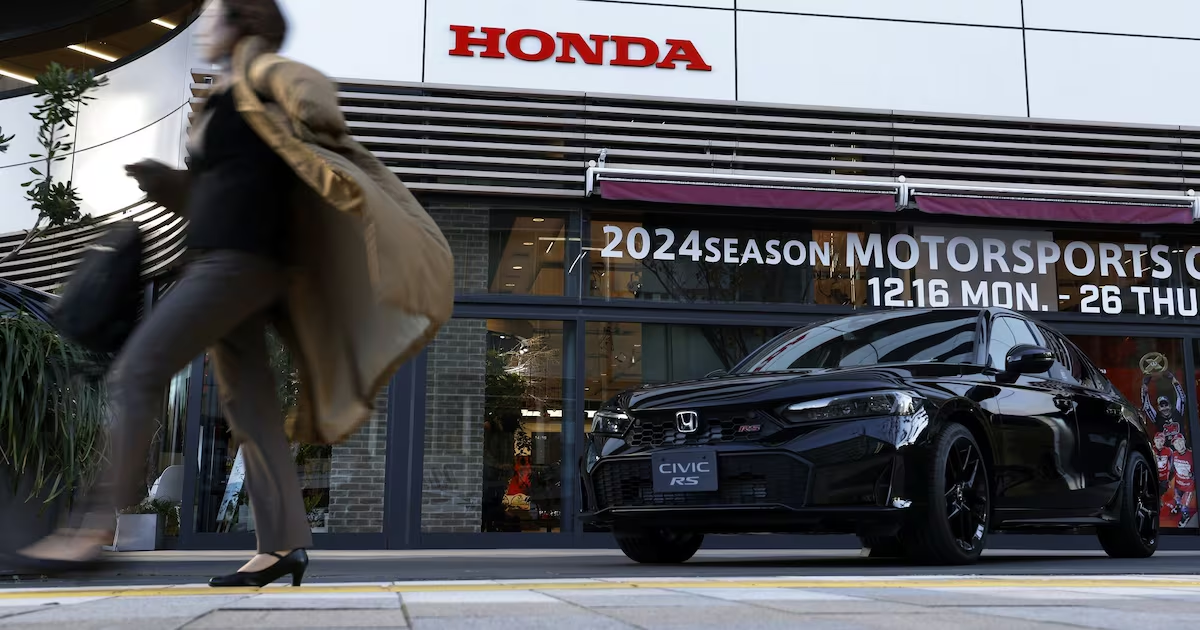
Honda Motor and Nissan Motor are in the early stages of finalizing a merger agreement, with talks expected to gain momentum in the coming weeks. According to reports from Japanese media, the two automakers are aiming to combine their operations by 2026. The merger would see the creation of a holding company, led by a president appointed by Honda. Negotiations between the two companies are set to begin later this week, and both automakers are anticipated to hold a press conference on Monday to provide further details after their respective board meetings.

On Monday morning, executives from Honda, Nissan, and Mitsubishi Motor Corp., Nissan’s junior partner, were spotted entering and leaving Japan’s transportation ministry. It is believed that they were there to inform officials about the launch of formal merger talks. However, when approached for comments, the executives remained tight-lipped, and spokespeople for both Honda and Nissan also declined to offer any immediate statements.

Reports suggest that the merger, which could see Nissan and Honda pool their resources in the face of growing competition in the global automotive market, is set to be officially finalized by 2026. According to the Yomiuri newspaper, the holding company resulting from the merger would be listed on the stock market, with Nissan’s shares experiencing a decline of up to 2.6% following the news. In contrast, Honda’s stock saw a slight increase of 2.1%. However, both companies have experienced significant declines in their stock prices over the course of the year, with Nissan’s share value dropping around 21%, and Honda’s down by 14.4% since January.

Both Honda and Nissan are grappling with serious challenges in an increasingly competitive market, particularly from the rapid rise of electric and hybrid vehicles produced by Chinese manufacturers. In response to these pressures, the two companies are exploring a merger as a means of strengthening their position in the automotive industry by pooling resources, sharing technology, and collaborating on research and development. This strategic move could help both companies better compete with newer entrants in the electric vehicle market while mitigating the financial strain they are currently experiencing.
Carlos Ghosn Warns of “Carnage” for Nissan in Honda Merger

Carlos Ghosn, the former CEO of Nissan, has raised concerns about the potential consequences of a merger between Nissan and Honda, predicting that Nissan would bear the brunt of the cost-cutting measures. In an interview with CNBC, Ghosn expressed his belief that Honda would take control in the merger, which he described as “sad” considering his long tenure at Nissan. He emphasized that there is little complementarity between the two automakers, and any synergies would likely come through cost reductions and duplication of plans and technologies, which would harm Nissan, the “minor partner.”

Ghosn, who led Nissan for 19 years and was instrumental in its growth, criticized the lack of alignment between Nissan and Honda, suggesting that the merger would lead to significant layoffs and operational cuts at Nissan. He also pointed out that Nissan’s former partnership with Renault offered more complementarities, implying that the Nissan-Honda merger was not as strategically sound.

The merger speculation gained traction earlier this month, and both companies confirmed their talks on Monday. The proposed merger would result in a $54 billion entity, with Honda assuming the dominant role due to its significantly larger market capitalization. If successful, the combined group would become the world’s third-largest automaker, surpassing Hyundai. However, both Nissan and Honda executives have stressed that the merger would create economies of scale, particularly in the electric vehicle (EV) transition, and deliver long-term profitability.

Despite these assurances, concerns remain about the merger’s viability. Nissan is undergoing a major restructuring, which includes cutting production capacity and laying off 9,000 employees, while Honda’s CEO acknowledged that some shareholders may see the deal as a form of support for Nissan’s struggles. Ghosn suggested that Nissan’s move towards the merger indicated a sense of desperation, as the company appears unable to resolve its issues independently.

Investor reactions have mirrored these concerns. Kei Okamura, a portfolio manager at Neuberger Berman, noted that while the merger’s long-term vision seems promising, the integration process would be crucial to its success. He emphasized the uncertainty around the merger’s execution, particularly the challenges of integrating the companies’ assets, cultures, and people. Okamura also noted that the deal could fall through if Nissan’s restructuring efforts fail to yield results.

Both Nissan and Honda have declined further comment on Ghosn’s statements or the merger plans.


Honda and Nissan in Talks for Potential Merger Amid Rising Competition

Honda and Nissan are reportedly in discussions to deepen their partnership, which could include a possible merger, according to sources on Wednesday. This move signals the increasing pressure on Japan’s automotive industry as it faces fierce challenges from EV leaders like Tesla and emerging Chinese automakers such as BYD.

Potential Scale of the Merger

If a merger proceeds, the combined entity would be valued at $54 billion, producing 7.4 million vehicles annually, ranking it as the world’s third-largest automaker behind Toyota and Volkswagen. The two companies already entered a strategic partnership in March to collaborate on electric vehicle (EV) development. However, worsening financial difficulties for Nissan have created urgency for closer ties.

Nissan’s Struggles and the Case for Collaboration

Nissan has been grappling with declining sales in the U.S. and China, which led to an 85% plunge in Q2 profits. Last month, the company announced a $2.6 billion cost-cutting plan, including eliminating 9,000 jobs and reducing production capacity by 20%. Analysts suggest the merger could serve as a rescue move for Nissan while also helping Honda address future challenges in EV development and cash flow.

“Honda’s EV ventures have struggled, and its cash flow could deteriorate next year. This deal, while aiding Nissan, is also forward-looking for Honda,” said Sanshiro Fukao, an executive fellow at Itochu Research Institute.

Market Reactions

The possibility of a merger caused Nissan shares to surge 24%, while Honda shares dropped 3%. Mitsubishi Motors, in which Nissan holds a 24% stake, saw its shares climb nearly 20%. The news also boosted shares of Renault, Nissan’s largest shareholder, by 6.7%.

Broader Challenges in the Auto Industry

The discussions come amidst intensifying global competition. An EV price war initiated by Tesla and BYD has created additional pressure on automakers struggling to stay competitive in the next-generation vehicle market. Moreover, geopolitical concerns, including U.S. President-elect Donald Trump’s threats of heavy tariffs on vehicles imported from Canada and Mexico, add to the uncertainty.

A Honda-Nissan merger could provide a new competitive axis against Toyota, which dominates the Japanese auto market. However, experts warn that such a partnership must overcome significant obstacles.

Cultural and Strategic Challenges

Analysts highlight potential difficulties in reconciling the different corporate cultures of Honda and Nissan. Honda is known for its technology-focused approach, particularly in powertrains, while Nissan’s recent struggles have raised concerns over its strategic direction.

“Mergers between major automakers rarely yield significant benefits due to culture clashes and strategy misalignments,” stated S&P Global Ratings. Tang Jin, a senior researcher at Mizuho Bank, added, “Honda’s tech-driven culture may resist a merger with a struggling competitor like Nissan.”

Broader Implications and Next Steps

The automakers are reportedly exploring ways to collaborate, such as establishing a holding company, with the possibility of a full merger under discussion. Additionally, there are plans for deeper cooperation with Mitsubishi.

Renault, Nissan’s largest shareholder, has expressed openness to a deal but will examine its implications. Meanwhile, Taiwan’s Foxconn, which has been expanding into EV manufacturing, unsuccessfully approached Nissan with a bid to take a controlling stake.

The three Japanese automakers are expected to hold a joint press conference on Monday in Tokyo, potentially to outline their plans for deeper collaboration.