
Yazılar

Astronomers Discover Youngest Exoplanet Orbiting a Protostar 520 Light-Years Away

Researchers have identified one of the youngest exoplanets ever observed, a gas giant named TIDYE-1b, estimated to be only 3 million years old. Orbiting a protostar in the Taurus molecular cloud, roughly 520 light-years from Earth, this discovery offers a rare glimpse into the earliest stages of planetary formation. Published in the journal Nature on November 20, the findings provide key insights into the processes that shape young planetary systems. The planet’s unusual environment, including a tilted protoplanetary disk, has intrigued scientists.

TIDYE-1b is described as a gas giant with a diameter slightly smaller than Jupiter’s and a mass approximately 40% that of the largest planet in our solar system. It completes an orbit around its host protostar in just 8.8 days, an incredibly close proximity for such a young planet. According to lead researcher Madyson Barber, a graduate student at the University of North Carolina at Chapel Hill, this rapid orbital period highlights the dynamic and accelerated processes involved in the formation of gas giants. These findings contrast with the slower development typically associated with terrestrial planets like Earth.

One of the most striking aspects of this system is the orientation of the protoplanetary disk surrounding the host star. The disk is misaligned, tilted at an angle of about 60 degrees relative to the planet and the star. Such a configuration is highly unusual, as planets are generally thought to form within flat, aligned disks of gas and dust. Andrew Mann, planetary scientist and co-author of the study, emphasized that this misalignment challenges established theories of planetary formation and raises new questions about the forces influencing early planetary systems.

This discovery has far-reaching implications for understanding the diversity of planetary formation. TIDYE-1b’s unique characteristics suggest that young planets and their systems may undergo more complex and chaotic development than previously thought. By studying such rare and early-stage systems, scientists hope to refine existing models and uncover new mechanisms that contribute to the formation and evolution of planets across the galaxy.

Study Reveals Two Proto-Human Species Coexisted in Kenya 1.5 Million Years Ago

A groundbreaking discovery in Kenya has provided new evidence that two distinct hominin species, Homo erectus and Paranthropus boisei, coexisted approximately 1.5 million years ago. Published in the journal Science, the findings are based on fossilized footprints uncovered in 2021 at Koobi Fora, near Lake Turkana. This revelation suggests not only that these proto-human species shared the same environment but also raises the possibility of interactions between them. The research team, led by paleoanthropologist Kevin Hatala of Chatham University, analyzed a 26-foot trail of fossilized footprints to draw their conclusions.

Advanced 3D imaging techniques were employed to examine the unique features of the footprints, revealing significant differences in foot anatomy and locomotion. Tracks with high arches and a heel-to-toe walking pattern were attributed to Homo erectus, whose anatomy closely resembles that of modern humans. Conversely, footprints with flatter shapes and deeper impressions at the forefoot were linked to Paranthropus boisei, a species characterized by a robust build and a divergent big toe. This distinction highlights the varied adaptations of these species to their shared habitat.

The footprints provided detailed insights into the anatomical and behavioral differences between these ancient hominins. Among the findings was a single trackway containing a dozen prints left by an individual of P. boisei, whose foot size is estimated to match a modern US men’s size 8.5. This detailed preservation of footprints allows researchers to better understand the walking mechanics and physical characteristics of these species.

These findings have significant implications for understanding early human evolution. The coexistence of H. erectus and P. boisei in the same environment challenges long-held assumptions about competition and survival among early hominin species. Instead, it suggests that diverse evolutionary adaptations may have allowed these species to share resources and coexist, shedding light on the complexities of human ancestry.

Study Suggests Jupiter’s Earth-Sized Storms May Be Driven by Magnetic Tornadoes

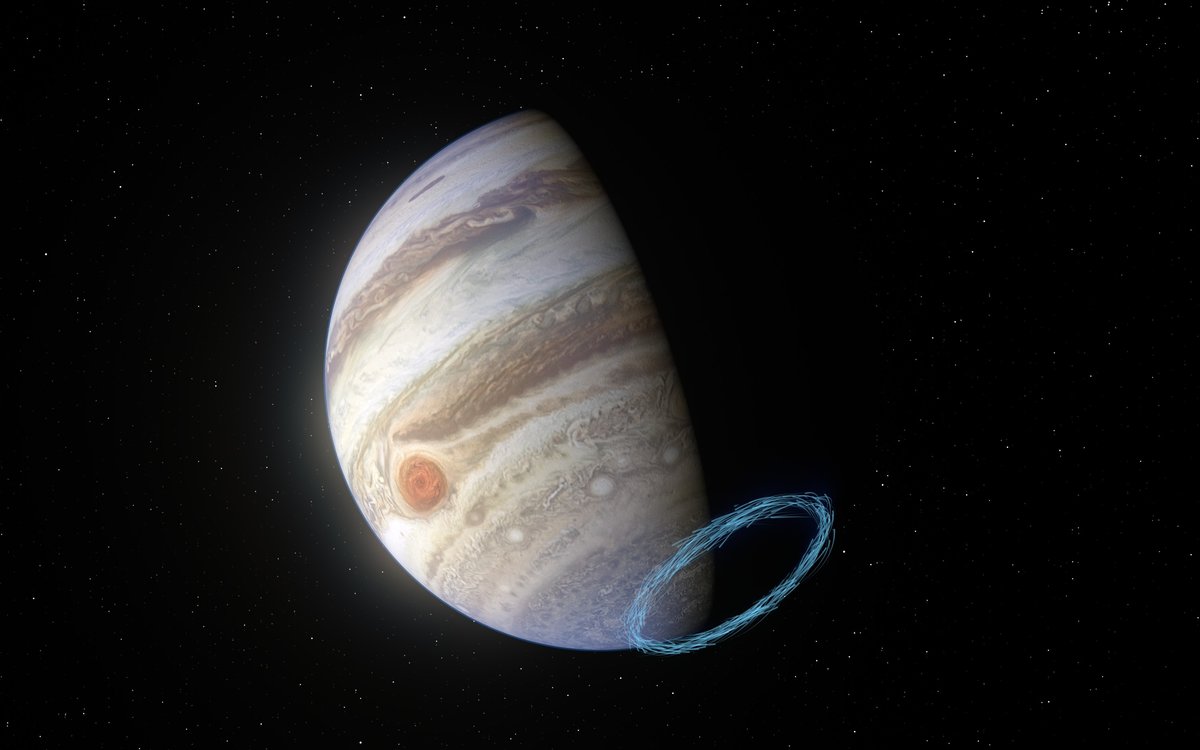
A recent study published in Nature Astronomy on November 26 proposes that magnetic vortices descending from Jupiter’s ionosphere into its deep atmosphere may be the driving force behind the planet’s Earth-sized ultraviolet-absorbing storms. These dark, anticyclonic storms, which appear as dark ovals, are observed primarily in Jupiter’s polar regions. Spanning the size of Earth, the storms were first detected in the 1990s through ultraviolet (UV) light by the Hubble Space Telescope and were later confirmed by NASA’s Cassini spacecraft in 2000, sparking interest in understanding their origin.

The research, led by undergraduate researcher Troy Tsubota from the University of California, Berkeley, in collaboration with Michael Wong of UC Berkeley and Amy Simon from NASA’s Goddard Space Flight Center, investigates the mysterious dynamics behind these massive storms. According to their findings, the formation of these dark ovals is closely linked to magnetic tornadoes on Jupiter. These tornadoes arise due to friction between Jupiter’s powerful magnetic field lines and those in the planet’s ionosphere, generating swirling vortexes that reach deep into the atmosphere.

These magnetic tornadoes appear to stir the planet’s aerosols, causing dense layers of ultraviolet-absorbing haze to form in Jupiter’s stratosphere. This phenomenon leads to the creation of the dark, storm-like features observed on the planet’s surface. By shedding light on the complex interactions between Jupiter’s magnetic field and atmosphere, the study provides new insights into the dynamics of these gigantic storms.

Understanding the formation of these storms could offer broader implications for atmospheric science, not just on Jupiter but for other planets with strong magnetic fields. The study enhances our knowledge of planetary weather systems and the role of magnetic forces in shaping the environments of distant worlds. As researchers continue to investigate Jupiter’s atmospheric phenomena, this study marks a significant step toward unraveling the mysteries of the gas giant’s tumultuous weather.