Yazılar

Solar Storm Creates Stunning Northern Lights Display Across the Western Hemisphere on New Year’s Eve

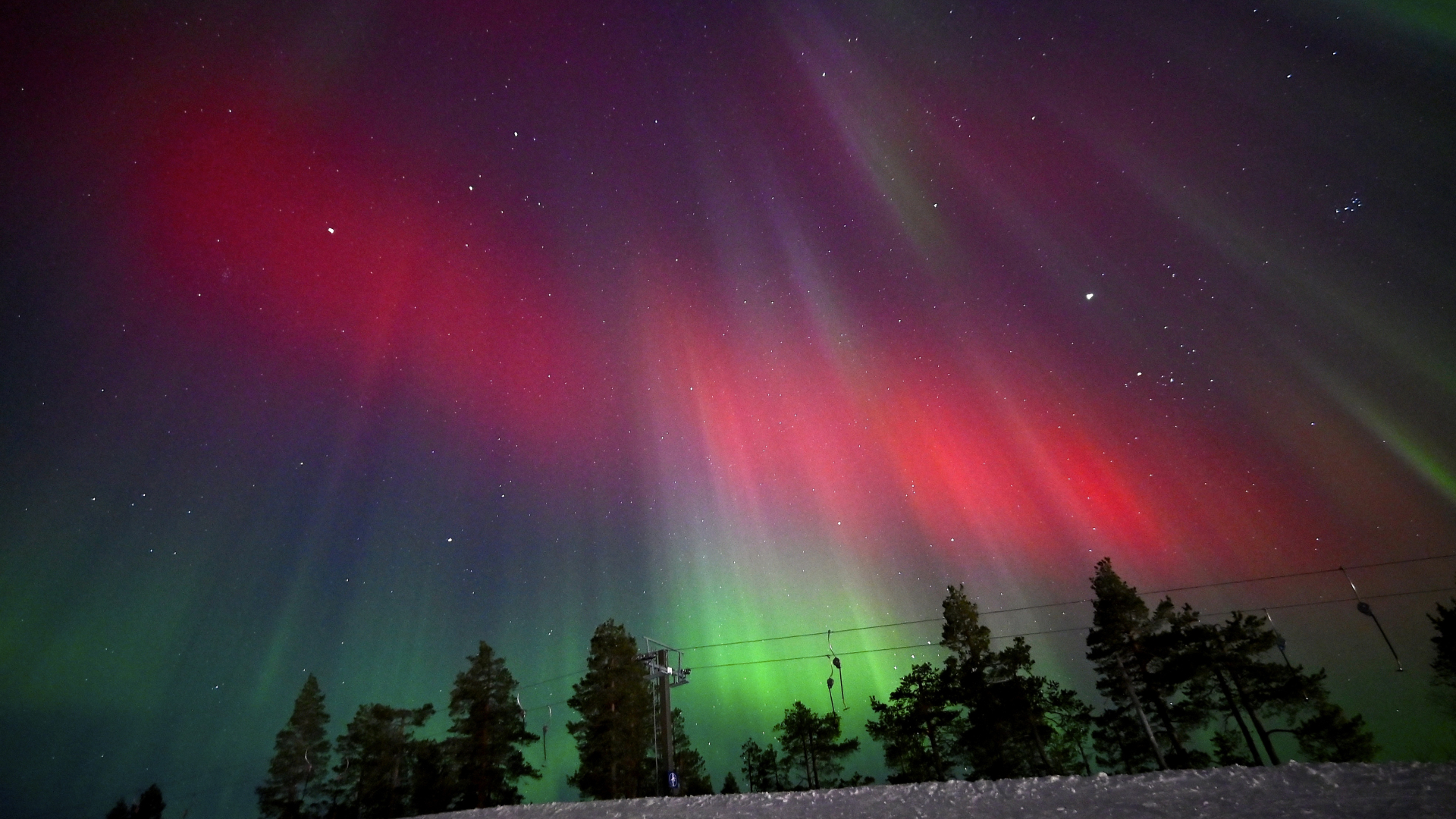
A stunning display of the northern lights illuminated the night skies as the world welcomed the New Year. This breathtaking auroral event, triggered by powerful solar storms, captivated observers from the central United States to Europe. The vibrant ribbons and pillars of green and red light painted the skies, with the aurora visible as far south as California in the United States and Austria and Germany in Europe. The spectacle lasted into the early hours of January 1, drawing stargazers and photographers eager to capture the celestial show.

The spectacular display was a result of intense geomagnetic activity caused by solar storms on New Year’s Eve. The solar events, linked to coronal mass ejections (CMEs) from the Sun, collided with Earth’s magnetic field, producing the auroral phenomenon. These CMEs released high-energy particles that traveled toward Earth, triggering geomagnetic storms. According to the National Oceanic and Atmospheric Administration (NOAA), the storms began at a G1-level intensity but intensified to G3-level disturbances by January 1, making the northern lights more visible across various regions.

The interaction between the solar particles and Earth’s magnetosphere caused atmospheric gases to ionize, releasing energy in the form of light. This energy emitted as colorful glows in the sky, with green and red being the most prominent hues in the northern lights. While this phenomenon, known as the aurora borealis, typically occurs in the Northern Hemisphere, a similar light show, called the aurora australis, can be seen in the Southern Hemisphere.

This celestial event served as a reminder of the dynamic relationship between the Earth and the Sun. While such solar storms can sometimes disrupt satellite communication or power grids, their ability to create awe-inspiring natural light displays is a beautiful byproduct of solar activity. As scientists continue to study these phenomena, public interest in space weather and its effects on Earth only grows, with events like the New Year’s Eve aurora offering a visual spectacle for people around the world.

NASA’s Parker Solar Probe Makes Closest-Ever Approach to the Sun

NASA’s Parker Solar Probe is embarking on a historic mission, attempting the closest-ever approach to the Sun. The spacecraft is plunging into the Sun’s outer atmosphere, known as the corona, enduring extreme temperatures and radiation in a bid to unlock the mysteries of our star.

This daring fly-by will leave the probe out of communication for several days. Scientists will anxiously await a signal, expected at 05:00 GMT on 28 December, to confirm whether the probe has survived the intense conditions. The goal is to deepen our understanding of the Sun’s behavior and how it affects the solar system.

Dr. Nicola Fox, NASA’s head of science, emphasized the importance of firsthand exploration: “For centuries, people have studied the Sun, but you don’t experience the atmosphere of a place until you actually go visit it. And so we can’t really experience the atmosphere of our star unless we fly through it.”

Launched in 2018, the Parker Solar Probe has already completed 21 orbits around the Sun, gradually getting closer with each pass. The Christmas Eve mission is a groundbreaking moment, bringing the probe within 3.8 million miles (6.2 million km) of the Sun’s surface. Though this distance may seem vast, Fox puts it into perspective: “We are 93 million miles away from the Sun, so if I put the Sun and the Earth one metre apart, Parker Solar Probe is just four centimetres from the Sun.”

During its approach, the spacecraft will endure temperatures of 1,400°C (2,552°F) and radiation strong enough to damage its electronics. To protect it, the probe is shielded by a 11.5cm-thick (4.5 inches) carbon-composite heat shield. The spacecraft’s strategy is to fly in and out quickly, racing at an astonishing speed of 430,000 mph (700,000 km/h) — faster than any man-made object in history.

The Parker Solar Probe’s primary mission is to investigate the Sun’s corona, which remains an enigma for scientists. Dr. Jenifer Millard, an astronomer, explains, “The surface of the Sun is about 6,000°C, but the corona reaches millions of degrees — and it’s farther from the Sun. How is the outer atmosphere getting hotter?”

The probe’s journey will also help scientists study solar wind, the constant flow of charged particles from the corona. This space weather can lead to phenomena like auroras, but it can also disrupt power grids, communication systems, and electronics on Earth. “Understanding the Sun and its activity is so important to our everyday lives on Earth,” says Dr. Millard.

As the spacecraft is out of contact with Earth, NASA scientists are anxiously awaiting the return of a signal. Fox admitted to feeling nervous about the probe’s audacious attempt but remains confident in its design. “We really have designed it to withstand all of these brutal conditions. It’s a tough, tough little spacecraft,” she says.

If successful, the Parker Solar Probe will continue its groundbreaking mission, providing valuable insights into the Sun’s behavior and its impact on space weather for years to come.


Study Suggests Jupiter’s Earth-Sized Storms May Be Driven by Magnetic Tornadoes

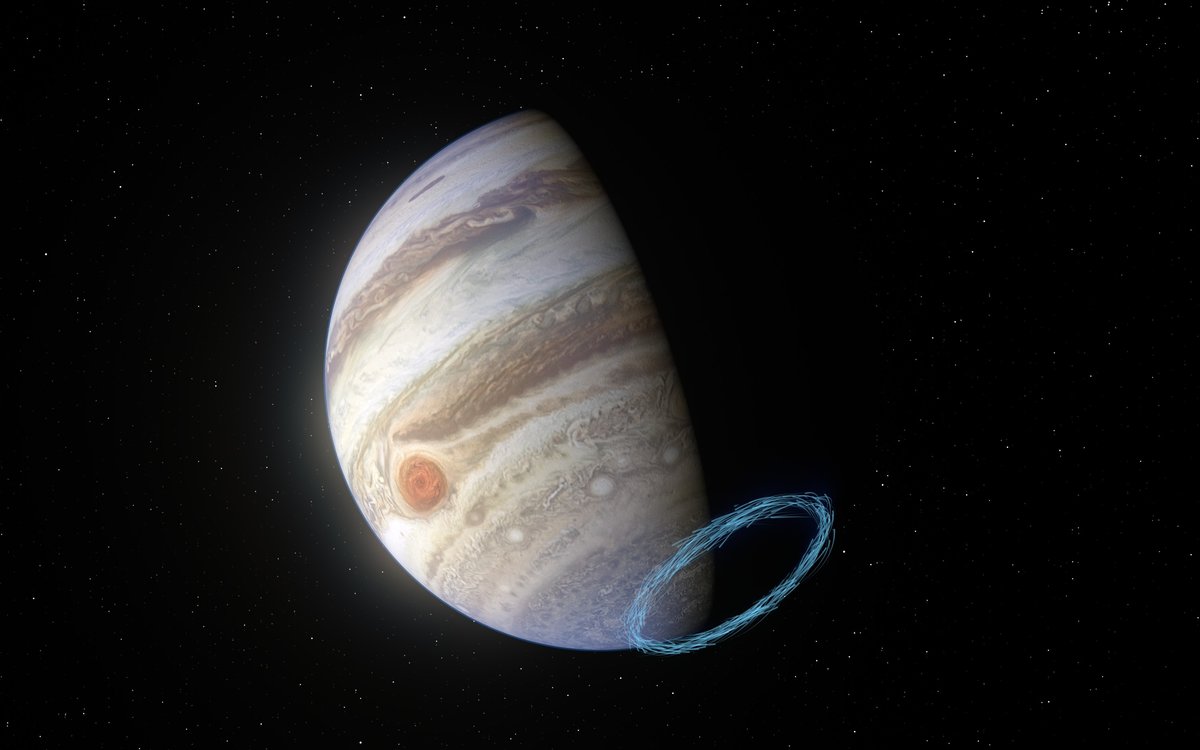
A recent study published in Nature Astronomy on November 26 proposes that magnetic vortices descending from Jupiter’s ionosphere into its deep atmosphere may be the driving force behind the planet’s Earth-sized ultraviolet-absorbing storms. These dark, anticyclonic storms, which appear as dark ovals, are observed primarily in Jupiter’s polar regions. Spanning the size of Earth, the storms were first detected in the 1990s through ultraviolet (UV) light by the Hubble Space Telescope and were later confirmed by NASA’s Cassini spacecraft in 2000, sparking interest in understanding their origin.

The research, led by undergraduate researcher Troy Tsubota from the University of California, Berkeley, in collaboration with Michael Wong of UC Berkeley and Amy Simon from NASA’s Goddard Space Flight Center, investigates the mysterious dynamics behind these massive storms. According to their findings, the formation of these dark ovals is closely linked to magnetic tornadoes on Jupiter. These tornadoes arise due to friction between Jupiter’s powerful magnetic field lines and those in the planet’s ionosphere, generating swirling vortexes that reach deep into the atmosphere.

These magnetic tornadoes appear to stir the planet’s aerosols, causing dense layers of ultraviolet-absorbing haze to form in Jupiter’s stratosphere. This phenomenon leads to the creation of the dark, storm-like features observed on the planet’s surface. By shedding light on the complex interactions between Jupiter’s magnetic field and atmosphere, the study provides new insights into the dynamics of these gigantic storms.

Understanding the formation of these storms could offer broader implications for atmospheric science, not just on Jupiter but for other planets with strong magnetic fields. The study enhances our knowledge of planetary weather systems and the role of magnetic forces in shaping the environments of distant worlds. As researchers continue to investigate Jupiter’s atmospheric phenomena, this study marks a significant step toward unraveling the mysteries of the gas giant’s tumultuous weather.