Yazılar

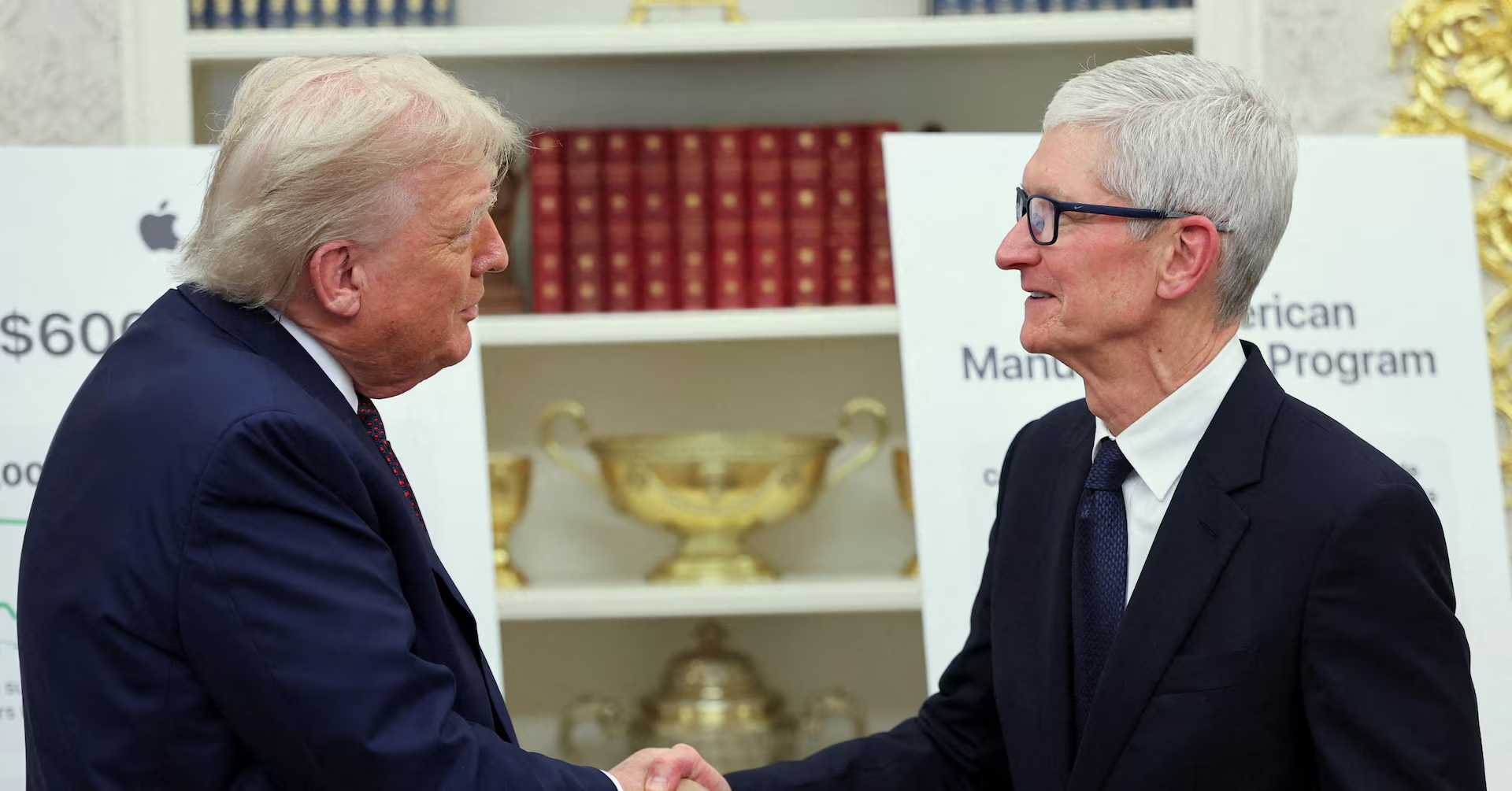
Trump Announces $100 Billion New Apple Investment Pledge to Boost U.S. Manufacturing

President Donald Trump announced on Wednesday that Apple will invest an additional $100 billion in the United States over the next four years, raising its total U.S. investment commitment to $600 billion. This move aims to expand Apple’s domestic supply chain and advanced manufacturing footprint, potentially helping the company avoid U.S. tariffs on imported iPhones.

Trump emphasized that companies like Apple are “coming home,” framing the investment as a step toward his goal of ensuring iPhones sold in America are also made domestically. Apple CEO Tim Cook acknowledged that while many components such as semiconductors, glass, and Face ID modules are already produced in the U.S., final assembly of iPhones will continue overseas “for a while.”

Despite the significance of the pledge, analysts note it aligns with Apple’s typical spending patterns and echoes similar commitments made under both the Biden administration and Trump’s previous term. In May, Trump had threatened Apple with a 25% tariff on products manufactured abroad—a policy reversal that cost Apple $800 million in the recent quarter.

Apple’s history with U.S. manufacturing investments has been mixed. For example, a Texas factory touted in 2019 as a new site had been producing Apple computers since 2013 and later shifted production overseas. Most Apple products, including iPhones and iPads, continue to be manufactured mainly in Asia, although some production has moved to Vietnam, Thailand, and India.

Experts agree that full iPhone assembly in the U.S. is unrealistic due to high labor costs and complex global supply chains. Nancy Tengler, CEO of Laffer Tengler Investments, called the announcement “a savvy solution” to the president’s demand for domestic production.

Apple’s U.S. investment partners include specialty glass maker Corning, semiconductor equipment supplier Applied Materials, and chipmakers Texas Instruments, GlobalFoundries, Broadcom, and Samsung. Notably, Samsung will supply chips made at its Texas plant for Apple devices, while GlobalWafers will provide silicon wafers from its Texas facility.

Following the announcement, Apple shares rose 5%, Corning shares increased nearly 4%, and Applied Materials gained almost 2% in after-hours trading.

Zebra Technologies to Acquire Elo Touch Solutions for $1.3 Billion, Raises Full-Year Forecasts

Barcode scanner and handheld device maker Zebra Technologies (ZBRA.O) announced a $1.3 billion all-cash deal to acquire Elo Touch Solutions, a touchscreen system maker, as it expands its retail-focused offerings. The acquisition follows strong second-quarter results driven by rising demand for Zebra’s devices and a recent acquisition of 3D imaging firm Photoneo.

Zebra’s shares jumped nearly 7% in premarket trading following the announcement and an upward revision of its annual revenue and profit guidance. The company benefits from increased digitization in retail and logistics, with its products aiding inventory management, warehouse operations, and shipment tracking.

The Elo Touch acquisition, expected to close in 2025, will add self-service kiosks, payment terminals, and touchscreen systems to Zebra’s portfolio, enabling frontline workers to better serve customers. CEO Bill Burns described the deal as a “next step” to accelerate frontline connectivity and estimated it expands Zebra’s addressable market by $8 billion.

Elo Touch, serving clients including JCPenney, has annual sales near $400 million. The acquisition is expected to be immediately accretive to earnings and to generate around $25 million in additional core profit three years after closing.

Zebra’s Q2 performance also benefited from lower tariffs than anticipated, with supply chain diversification across China, Vietnam, Malaysia, and Mexico helping manage costs. In April, Zebra raised prices on most North American products to offset tariff-related pressures.

For the full year, Zebra now expects sales growth between 5% and 7%, up from a prior range of 3% to 7%. Adjusted earnings per share guidance has been raised to $15.25–$15.75 from $13.75–$14.75.

In Q2, sales rose 6.2% to $1.29 billion, meeting estimates, while adjusted EPS of $3.61 exceeded expectations of $3.32.

Chinese Bitcoin Mining Hardware Giants Establish U.S. Production to Circumvent Tariffs

The world’s top three manufacturers of bitcoin mining machines — Bitmain, Canaan, and MicroBT — are setting up production bases in the United States as part of a strategic response to President Donald Trump’s tariff policies. These firms, all originally Chinese, dominate over 90% of the global market for mining rigs, specialized computers essential for bitcoin mining.

The move aims to avoid hefty U.S. tariffs imposed amid escalating trade tensions, while potentially easing geopolitical concerns related to China’s influence over critical tech infrastructure. Guang Yang, CTO of Conflux Network, highlighted that the trade war is triggering deep structural changes in bitcoin’s supply chain, pushing U.S. companies toward sourcing hardware from politically acceptable locations.

Bitmain, the largest by sales, began U.S. production in December 2023, shortly after Trump’s re-election. Canaan started trial U.S. production after Trump announced new tariffs on April 2, seeking to shield itself from duties. MicroBT is actively pursuing localization in the U.S. to reduce tariff impacts.

This sector, valued by analysts at around $12 billion by 2028, includes upstream mining rig production, energy-heavy bitcoin mining, IT infrastructure, and trading platforms. U.S. rival Auradine, backed by leading miner MARA Holdings, is lobbying to restrict Chinese equipment imports to boost competition in hardware.

Despite 30% of global bitcoin mining taking place in North America, more than 90% of mining hardware comes from China, creating an imbalance and raising security concerns. Auradine’s Sanjay Gupta warned of risks linked to “hundreds of thousands” of Chinese rigs connected to the U.S. grid. However, Canaan’s Leo Wang dismissed security threats from mining rigs, stating they are ineffective outside bitcoin mining, though he warned Chinese manufacturers could face collateral impacts from U.S. tech restrictions.

Bitmain’s AI arm, Sophgo, was recently blacklisted by the U.S. government over security concerns, illustrating rising scrutiny of Chinese tech firms.

Historically, China dominated bitcoin from hardware through mining and trading until 2021, when Beijing banned cryptocurrency activities citing financial risks. Miners and exchanges moved abroad, but Chinese manufacturers maintained dominance in hardware, leveraging their early lead in designing mining-specific chips.

Canaan has relocated its headquarters to Singapore and established a U.S. pilot production line, with the U.S. contributing 40% of its revenue last year. Wang emphasized the goal of reducing costs amid tariffs by exploring all alternatives.

The U.S. currently imposes a baseline 10% tariff on many imports and an additional 20% on Chinese goods, with potential further tariffs on Southeast Asian countries hosting Chinese assembly plants.

While Trump promotes crypto-friendly policies and has positioned himself as a “crypto president,” China’s dominance in bitcoin infrastructure remains a potential choke point. Legal expert John Deaton warned that China’s control could disrupt bitcoin network stability and impact U.S. users if exports are restricted.

Top U.S.-based miners, including MARA, Core Scientific, CleanSpark, and Riot Platforms, face risks from heavy reliance on Chinese hardware. Economist Ryan Yonk noted this dependence is “potentially problematic” despite Chinese rig makers’ efforts to establish a U.S. presence.

Kadan Stadlemann, CTO at Komodo, said U.S. miners will still buy rigs from China in the short term and face higher costs, but the tariff-driven shift aims to reshape the industry’s supply chain long term.