Yazılar

Taiwan Eyes More Chip Investment in Arizona to Deepen US Ties

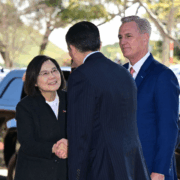
Taiwan is looking forward to further semiconductor investment in Arizona to strengthen economic and strategic ties with the United States, President Lai Ching-te said during a meeting with U.S. Senator Ruben Gallego. Lai highlighted the growing role of Taiwanese firms, led by TSMC, in boosting U.S. chip manufacturing capacity.

TSMC is investing $165 billion in the Phoenix area to build advanced fabrication plants producing chips used in artificial intelligence, marking one of the largest foreign investments in U.S. manufacturing. Lai said Taiwan hopes to see additional manufacturing, research and development facilities established in Arizona, further reinforcing bilateral cooperation.

The comments come shortly after Taiwan and the United States agreed to cut U.S. tariffs on Taiwanese exports to 15% from 20%. Under the deal, Taiwanese companies will invest $250 billion in U.S. semiconductors, energy and AI, alongside $250 billion in credit guarantees to support future projects.

Senator Gallego said Arizona had become a hub for Taiwanese investment and expressed optimism that the partnership would continue to expand.

ASML Tops $500 Billion Market Value on TSMC Spending Boost

Shares of ASML pushed the company’s market capitalisation past $500 billion for the first time on Thursday, after key customer TSMC announced a much larger-than-expected increase in capital spending to meet surging demand for AI chips.

TSMC said it plans to spend between $52 billion and $56 billion in 2026, well above analysts’ expectations of about $46 billion. The higher budget implies significantly more spending on advanced chipmaking tools, benefiting ASML, the world’s only supplier of extreme ultraviolet (EUV) lithography machines.

ASML shares rose 5.4% by mid-day trading, extending their January gains to around 24% and cementing the company’s position as Europe’s most valuable listed firm. Analysts say ASML stands out as a major winner from the AI investment cycle, alongside memory chipmakers such as Samsung Electronics and SK Hynix.

TSMC’s stepped-up investment also reflects strong demand from clients including Nvidia and Apple. While ASML has forecast only modest growth for 2026 due to the slow pace of new fab construction, analysts say TSMC’s plans improve visibility for stronger growth into 2027 and beyond.

Taiwan Seeks Strategic AI Partnership With U.S. After Tariff Deal

Taiwan aims to position itself as a close strategic partner of the United States in artificial intelligence following a trade deal that cuts tariffs and encourages large-scale Taiwanese investment in the U.S., Vice Premier Cheng Li-chiun said on Friday.

Speaking at a press conference in Washington, Cheng said the negotiations promoted two-way high-tech investment and laid the groundwork for deeper cooperation in AI. The talks come as the administration of U.S. President Donald Trump presses major semiconductor producers to expand manufacturing in the United States, particularly for chips that power AI systems.

Cheng led the negotiations that resulted in Thursday’s agreement, which reduces tariffs on many Taiwanese exports and channels new investment into the U.S. technology sector. While the deal strengthens Taiwan–U.S. ties, it risks angering China, which claims democratically governed Taiwan as its territory—claims Taipei firmly rejects.

U.S. Commerce Secretary Howard Lutnick said Taiwanese companies would invest about $250 billion in the United States across semiconductors, energy and AI. That figure includes $100 billion already committed in 2025 by TSMC, the world’s leading producer of advanced AI chips, with additional investment expected. Taiwan will also guarantee another $250 billion in credit to support further projects, according to the Trump administration.

Cheng described the agreement as “win-win,” saying it would also attract more U.S. investment into Taiwan. She stressed that the expansion is company-led rather than government-directed and does not mean abandoning domestic production. “This is not about ‘moving’ but about ‘building,’” she said, calling the U.S. expansion an extension of Taiwan’s technology ecosystem.

Taiwan Economy Minister Kung Ming-hsin said investments would also cover AI servers and energy infrastructure, though companies would disclose chip-related figures themselves. Taiwan’s benchmark stock index closed at a record high on Friday, buoyed by strong TSMC earnings and investor optimism over the deal.

Chang Chien-yi, president of the Taiwan Institute of Economic Research, said the agreement underscores Washington’s view of Taiwan as a key strategic partner in semiconductors, noting it was the first country to receive preferential treatment for chips and related products.

In a statement, TSMC welcomed the prospect of robust U.S.–Taiwan trade ties, reiterating that its investment decisions are driven by market demand. The deal must still be ratified by Taiwan’s parliament, where opposition lawmakers have raised concerns about the risk of hollowing out the island’s critical chip industry.

Lutnick said the objective was to bring 40% of Taiwan’s chip supply chain to the United States, warning that production not built on U.S. soil could face tariffs of up to 100%. Kung said Taiwan estimates that by 2036 the production split for advanced chips would be closer to 80% in Taiwan and 20% in the United States.

Taiwan Vice President Hsiao Bi-khim said the agreement demonstrated Taiwan’s importance in global trade. “Taiwan may not be large in area, but we are agile and innovative—and an indispensable force in the global supply chain,” she said.