Yazılar

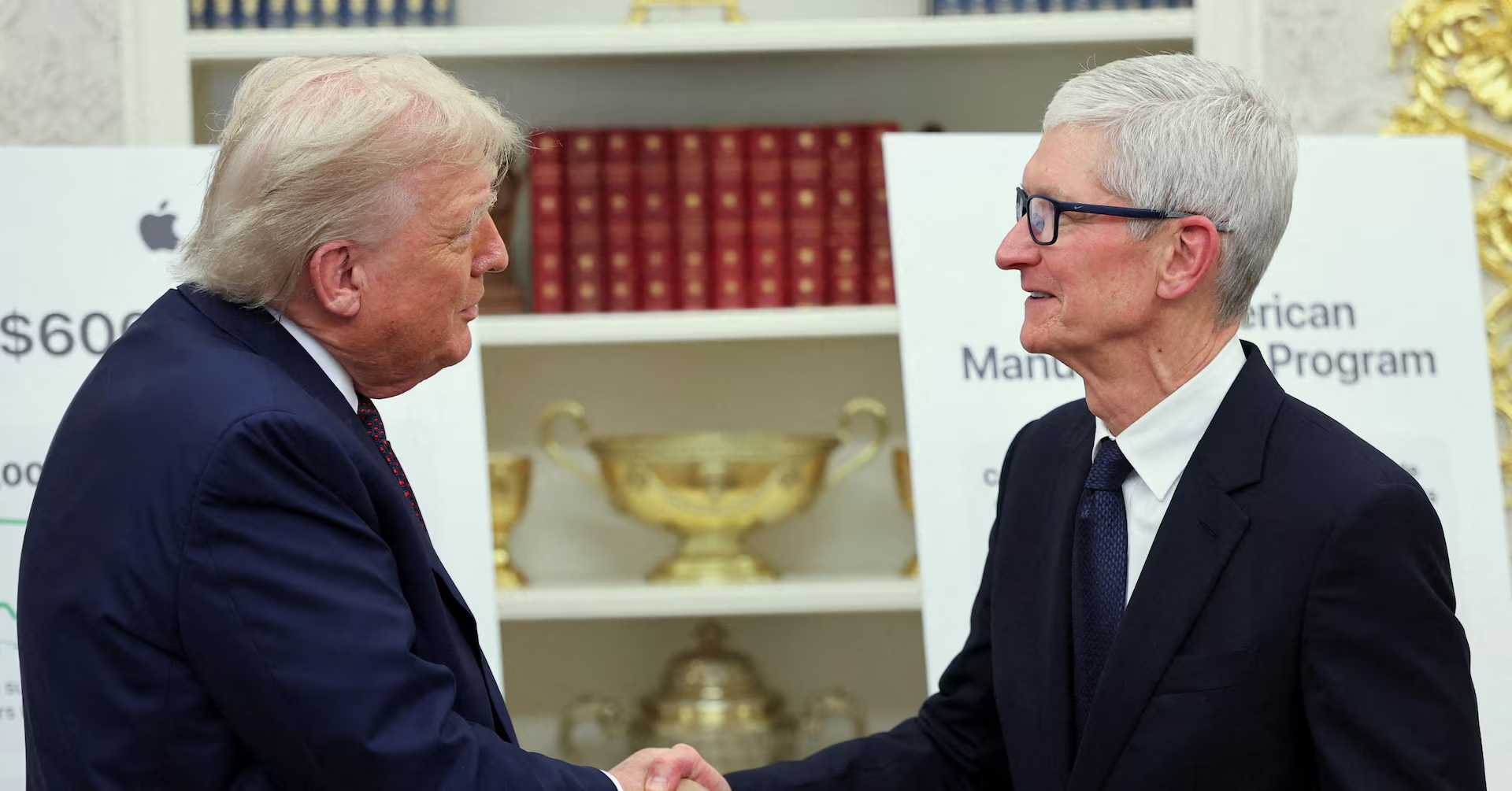
Trump Announces $100 Billion New Apple Investment Pledge to Boost U.S. Manufacturing

President Donald Trump announced on Wednesday that Apple will invest an additional $100 billion in the United States over the next four years, raising its total U.S. investment commitment to $600 billion. This move aims to expand Apple’s domestic supply chain and advanced manufacturing footprint, potentially helping the company avoid U.S. tariffs on imported iPhones.

Trump emphasized that companies like Apple are “coming home,” framing the investment as a step toward his goal of ensuring iPhones sold in America are also made domestically. Apple CEO Tim Cook acknowledged that while many components such as semiconductors, glass, and Face ID modules are already produced in the U.S., final assembly of iPhones will continue overseas “for a while.”

Despite the significance of the pledge, analysts note it aligns with Apple’s typical spending patterns and echoes similar commitments made under both the Biden administration and Trump’s previous term. In May, Trump had threatened Apple with a 25% tariff on products manufactured abroad—a policy reversal that cost Apple $800 million in the recent quarter.

Apple’s history with U.S. manufacturing investments has been mixed. For example, a Texas factory touted in 2019 as a new site had been producing Apple computers since 2013 and later shifted production overseas. Most Apple products, including iPhones and iPads, continue to be manufactured mainly in Asia, although some production has moved to Vietnam, Thailand, and India.

Experts agree that full iPhone assembly in the U.S. is unrealistic due to high labor costs and complex global supply chains. Nancy Tengler, CEO of Laffer Tengler Investments, called the announcement “a savvy solution” to the president’s demand for domestic production.

Apple’s U.S. investment partners include specialty glass maker Corning, semiconductor equipment supplier Applied Materials, and chipmakers Texas Instruments, GlobalFoundries, Broadcom, and Samsung. Notably, Samsung will supply chips made at its Texas plant for Apple devices, while GlobalWafers will provide silicon wafers from its Texas facility.

Following the announcement, Apple shares rose 5%, Corning shares increased nearly 4%, and Applied Materials gained almost 2% in after-hours trading.
Micron Expands US Investment by $30 Billion Amid Trump’s Onshoring Push

Micron Technology announced on Thursday a significant expansion of its U.S. investment plans, adding $30 billion to its existing commitments as President Donald Trump intensifies efforts to bring semiconductor manufacturing back to American soil. The memory chip maker now projects total investments of $200 billion, up from previous plans of approximately $125 billion.

The new funding will support the construction of a second cutting-edge memory fabrication facility in Boise, Idaho, and the expansion of its manufacturing site in Manassas, Virginia. “These investments are designed to allow Micron to meet expected market demand, maintain share and support Micron’s goal of producing 40% of its DRAM in the U.S.,” the company stated.

Micron’s DRAM chips are widely used in personal computers, automotive systems, industrial equipment, wireless communications, and artificial intelligence. The company’s High-Bandwidth Memory (HBM) products are seen as essential for powering next-generation AI models. About $50 billion of Micron’s total investment will be dedicated to research and development.

President Trump’s administration has pushed hard for semiconductor onshoring, with Trump threatening new tariffs on chip imports and reconsidering previous subsidies granted under former President Joe Biden. In December, Micron secured nearly $6.2 billion in government subsidies through Biden’s $52.7 billion 2022 CHIPS and Science Act. Trump’s administration is now renegotiating some of those grants, according to Commerce Secretary Howard Lutnick.

The expansion aligns with broader trends in the U.S. semiconductor industry. Nvidia, a key customer of Micron, announced plans in April to build AI servers worth up to $500 billion in the U.S. over the next four years, in partnership with firms such as Taiwan’s TSMC. “Micron’s investment in advanced memory manufacturing and HBM capabilities in the U.S., with support from (the) Trump administration, is an important step forward for the AI ecosystem,” said Nvidia CEO Jensen Huang.

Micron also finalized a $275 million direct funding award under the CHIPS Act to further support its Manassas facility expansion.

Trump Administration Renegotiates Biden-Era Chips Act Grants, Says Commerce Secretary Lutnick

The Trump administration is actively renegotiating semiconductor manufacturing grants originally awarded under the Biden-era CHIPS and Science Act, according to U.S. Commerce Secretary Howard Lutnick. Speaking before the Senate Appropriations Committee on Wednesday, Lutnick indicated that some of these awards may be significantly altered or even cancelled as part of efforts to secure better terms for U.S. taxpayers.

“Some of the Biden-era grants just seemed overly generous, and we’ve been able to renegotiate them,” Lutnick told lawmakers, emphasizing that the renegotiations aim to deliver greater value to the American public. “All the deals are getting better, and the only deals that are not getting done are deals that should have never been done in the first place.”

$52.7 Billion CHIPS Act Under Review

The $52.7 billion CHIPS and Science Act, signed by President Biden in 2022, was designed to bolster domestic semiconductor manufacturing and reduce reliance on Asia, particularly Taiwan and South Korea. Under the program, billions of dollars in grants were awarded to both U.S. and foreign chipmakers, including Taiwan’s TSMC, South Korea’s Samsung and SK Hynix, as well as U.S.-based Intel and Micron.

Though many of these awards were signed before Biden left office, most of the funds have yet to be fully disbursed. The grant payments are generally structured to be released as companies meet specific production and investment milestones tied to their U.S. plant expansions.

TSMC Award Revised Amid Expanding U.S. Investment

Lutnick cited Taiwan Semiconductor Manufacturing Co. (TSMC) as an example of successful renegotiation. Under the original agreement, TSMC was awarded $6 billion to support its U.S. manufacturing expansion. Lutnick revealed that TSMC subsequently increased its planned investment from $65 billion to $165 billion, while still receiving the same $6 billion in federal funds.

Although TSMC confirmed in March that it would invest an additional $100 billion in the U.S., the company has not commented on whether the new investment was directly tied to renegotiated CHIPS Act terms.

White House Seeking Delays and New Terms

The renegotiation efforts are not new. In February, Reuters reported that the White House was already seeking to renegotiate several awards and delay some upcoming disbursements to ensure better returns on government spending.

Lutnick’s comments suggest that the Trump administration intends to continue scrutinizing past agreements to maximize taxpayer value and may block deals it deems wasteful or excessive.

AI Computing Capacity Also a Focus

During the hearing, Lutnick also addressed concerns about the global race for artificial intelligence computing capacity. He emphasized the administration’s commitment to ensuring that over 50% of global AI compute power remains based in the United States. This statement comes amid criticism of a Trump administration deal allowing the United Arab Emirates to purchase advanced American AI chips, raising fears about exporting critical technology.