Yazılar

Global Smartphone Shipments Rise 2.3% YoY in Q4 2025 Despite Memory Shortages, Boosting Apple LED Market (IDC)

idc q4 2025 Smartphone MarkeT

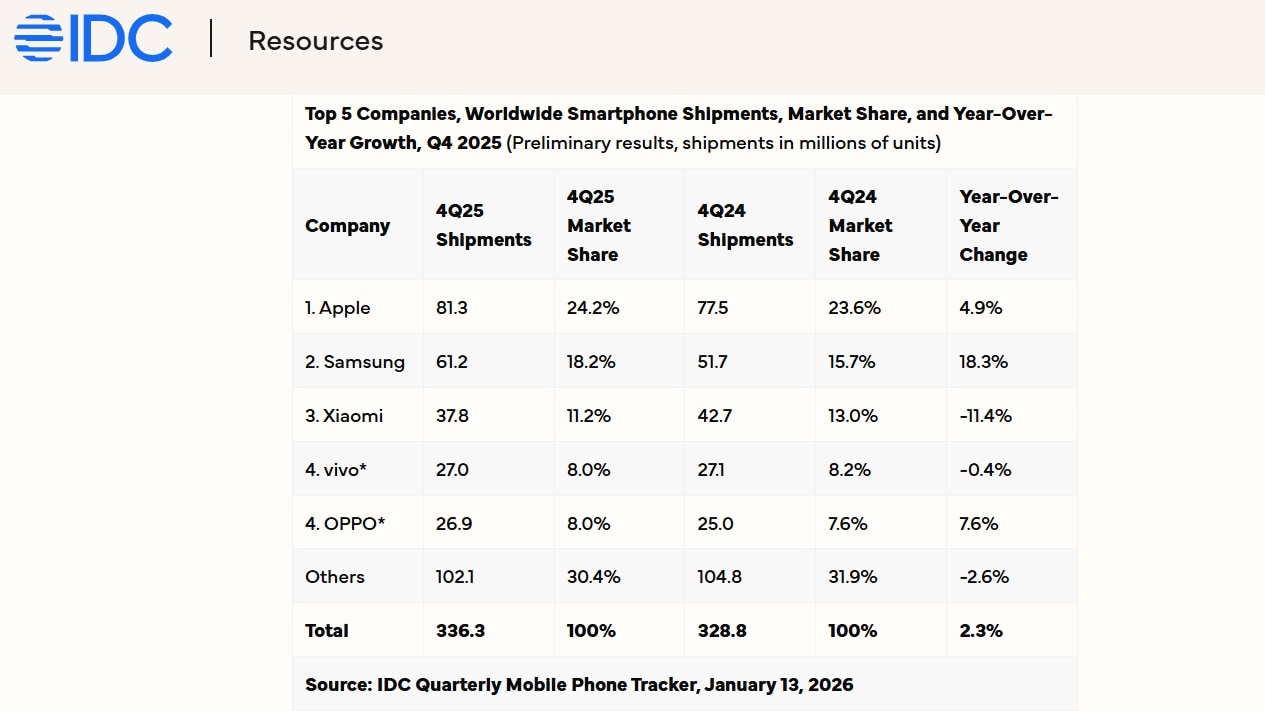
Global smartphone shipments recorded modest but meaningful growth in the fourth quarter of 2025, rising 2.3 percent year-over-year despite ongoing supply-side pressures, according to International Data Corporation (IDC). The market showed resilience in the face of a persistent memory chip shortage, logistical constraints, and cautious consumer spending in several regions. For the full year 2025, worldwide smartphone shipments reached 1.26 billion units, signaling a gradual recovery after periods of stagnation.

Premium devices played a major role in driving this growth, as consumers continued to prioritize high-end features and longer replacement cycles. Foldable smartphones gained wider acceptance, contributing to higher average selling prices and renewed interest in flagship models. Additionally, accelerated purchasing activity ahead of expected price increases helped lift shipments toward the end of the year, particularly in developed markets.

Apple and Samsung emerged as the strongest performers during the quarter, recording the highest growth rates among the top five smartphone brands. Apple led the global market for the third consecutive year, shipping 81.3 million units in Q4 2025 and capturing a 24.2 percent market share. The strong performance was fueled by demand for the iPhone 17 series and solid sales momentum in China and other key regions.

Samsung followed closely, shipping 61.2 million units and securing an 18.2 percent share of the global market, supported by a broad portfolio spanning premium and mid-range devices. Chinese manufacturers Xiaomi, Vivo, and Oppo rounded out the top five, maintaining competitive positions through aggressive pricing and strong distribution networks, particularly in emerging markets.

Apple Tops Global Smartphone Market With 20% Share in 2025, Counterpoint Says

Apple led the global smartphone market in 2025 with a 20% share, as worldwide shipments grew 2% year-on-year, driven by stronger demand and improving economic momentum in emerging markets, according to data released by Counterpoint Research on Monday.

Apple’s performance was supported by solid demand across emerging and mid-sized markets, alongside strong sales of its latest iPhone 17 series, said Counterpoint analyst Varun Mishra. The company claimed the largest market share among the world’s top five smartphone brands during the year.

Counterpoint noted that smartphone manufacturers front-loaded shipments earlier in 2025 to get ahead of potential tariff impacts. However, this effect faded as the year progressed, leaving shipment volumes in the second half of the year largely unchanged.

Samsung ranked second globally with a 19% market share, posting modest shipment growth. Xiaomi followed in third place with a 13% share, buoyed by steady demand in emerging markets, the research firm said.

Looking ahead, Counterpoint warned that the global smartphone market could face headwinds in 2026. Research director Tarun Pathak said shipments are expected to soften due to chip shortages and rising component costs, as semiconductor manufacturers increasingly prioritize supplying processors for AI data centres over smartphones.

Xiaomi 17 Ultra Appears on 3C Listing, Hints at Faster 120W Charging Support

Xiaomi 17 Ultra, the next high-end addition to Xiaomi’s flagship lineup, has surfaced on China’s 3C certification website — a strong indication that its official launch may be just around the corner. The upcoming device is expected to take the mantle as the top-tier variant in the Xiaomi 17 series, boasting several hardware upgrades and new connectivity features.

The 3C listing suggests that the Xiaomi 17 Ultra will arrive with significantly improved charging capabilities over its predecessor. The device is reportedly compatible with a new charging adapter capable of delivering up to 120W of wired fast charging. This marks an upgrade from the Xiaomi 16 Ultra, which supported 90W charging, hinting at reduced charging times for the new flagship.

Interestingly, the certification also mentions support for satellite communication — a feature that has been gradually gaining traction among premium smartphones. This addition would make the Xiaomi 17 Ultra capable of sending and receiving messages in remote areas without traditional network coverage, putting it in competition with recent models from Huawei and Apple that offer similar capabilities.

The Xiaomi 17 Ultra is expected to share the Snapdragon 8 Elite Gen 5 chipset with the rest of the Xiaomi 17 series, which launched in China earlier this year. However, it is likely to differentiate itself with an upgraded camera system, possibly featuring Leica optics, as well as a larger battery and improved display technology. With its certification now complete, an official announcement from Xiaomi could follow within the next few weeks.