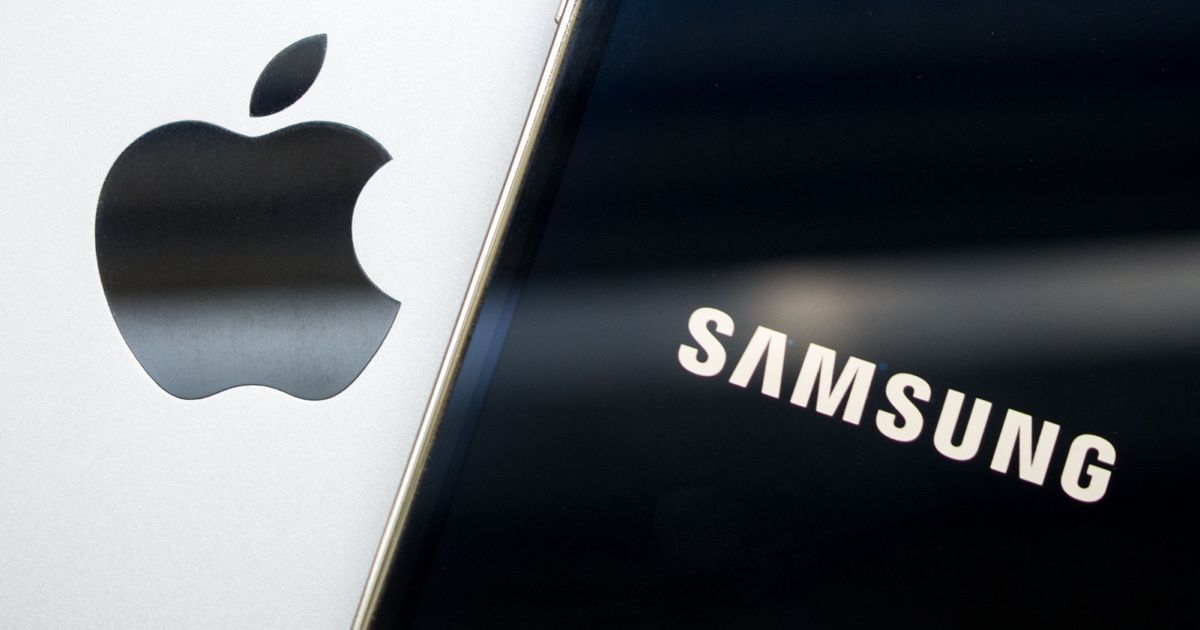
Apple to Source Chips from Samsung’s Texas Factory for iPhones

Apple announced on Wednesday that Samsung Electronics will supply chips from its Austin, Texas production facility for Apple products, including iPhones. Apple stated the facility will produce chips optimized for power efficiency and performance specifically tailored to Apple devices.

The announcement accompanies Apple’s broader pledge to invest an additional $100 billion in the U.S., bringing its total domestic investment to $600 billion over four years.

Industry analysts highlight that Samsung will take over some image sensor volumes that Apple previously sourced from Sony, which manufactures its sensors exclusively in Japan. This shift diversifies Apple’s supply chain and supports the company’s strategy to localize production within the United States.

“While Sony still dominates the high-end image sensor market, Apple’s move reduces its reliance on a single vendor and bolsters U.S.-based sourcing,” said NH Investment & Securities analyst Ryu Young-ho.

Samsung recently secured a $16.5 billion contract to supply chips for Tesla, whose CEO Elon Musk confirmed that Samsung’s Texas plant will produce Tesla’s next-generation AI6 chip.

Analysts expect Samsung’s chip manufacturing business to reduce losses by winning new orders for iPhone 18 image sensors and Tesla chips in 2026, according to Kiwoom Securities’ Pak Yuak.

EPAM Systems Raises 2025 Revenue and Profit Forecasts on Strong AI-Driven Demand

EPAM Systems boosted its annual revenue and profit outlook on Thursday, driven by robust demand for its software services as companies continue heavy investments in artificial intelligence technologies. The company also exceeded second-quarter earnings expectations, pushing its shares up over 5% in premarket trading.

The software provider, known for its consulting, cloud, AI transformation, and engineering services, reported broad-based revenue growth across key industry sectors including financial services, healthcare, software, and consumer goods, as well as across global regions.

“As our clients prioritize their AI-readiness and preparatory actions, they are increasingly turning to us to build out their data and AI foundation,” said Chief Revenue Officer Balazs Fejes, who is set to become CEO in September.

EPAM now projects 2025 annual revenue growth between 13% and 15%, revised upward from a previous range of 11.5% to 14.5%. Analysts had expected 13.4%, according to LSEG data. The company also raised its adjusted earnings per share forecast to between $10.96 and $11.12, surpassing the prior guidance of $10.70 to $10.95 and analysts’ estimate of $10.85.

For the third quarter, EPAM anticipates revenue of $1.37 billion to $1.38 billion and adjusted earnings per share between $2.98 and $3.06, both above market expectations.

In Q2, the company posted revenue of $1.35 billion, an 18% increase year-over-year that beat estimates of $1.33 billion. Adjusted earnings per share of $2.77 also surpassed the forecast of $2.61.

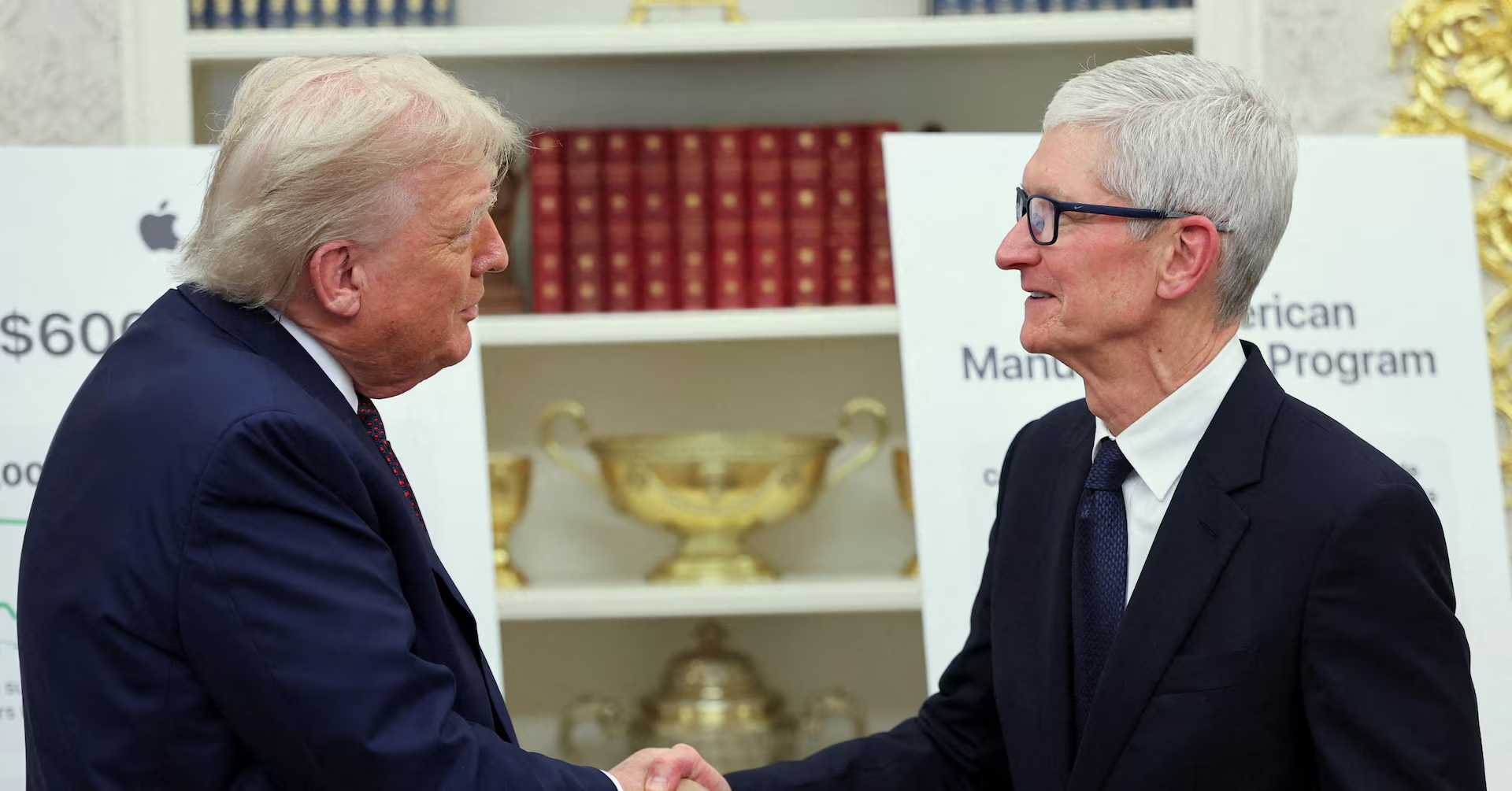
Trump Announces $100 Billion New Apple Investment Pledge to Boost U.S. Manufacturing

President Donald Trump announced on Wednesday that Apple will invest an additional $100 billion in the United States over the next four years, raising its total U.S. investment commitment to $600 billion. This move aims to expand Apple’s domestic supply chain and advanced manufacturing footprint, potentially helping the company avoid U.S. tariffs on imported iPhones.

Trump emphasized that companies like Apple are “coming home,” framing the investment as a step toward his goal of ensuring iPhones sold in America are also made domestically. Apple CEO Tim Cook acknowledged that while many components such as semiconductors, glass, and Face ID modules are already produced in the U.S., final assembly of iPhones will continue overseas “for a while.”

Despite the significance of the pledge, analysts note it aligns with Apple’s typical spending patterns and echoes similar commitments made under both the Biden administration and Trump’s previous term. In May, Trump had threatened Apple with a 25% tariff on products manufactured abroad—a policy reversal that cost Apple $800 million in the recent quarter.

Apple’s history with U.S. manufacturing investments has been mixed. For example, a Texas factory touted in 2019 as a new site had been producing Apple computers since 2013 and later shifted production overseas. Most Apple products, including iPhones and iPads, continue to be manufactured mainly in Asia, although some production has moved to Vietnam, Thailand, and India.

Experts agree that full iPhone assembly in the U.S. is unrealistic due to high labor costs and complex global supply chains. Nancy Tengler, CEO of Laffer Tengler Investments, called the announcement “a savvy solution” to the president’s demand for domestic production.

Apple’s U.S. investment partners include specialty glass maker Corning, semiconductor equipment supplier Applied Materials, and chipmakers Texas Instruments, GlobalFoundries, Broadcom, and Samsung. Notably, Samsung will supply chips made at its Texas plant for Apple devices, while GlobalWafers will provide silicon wafers from its Texas facility.

Following the announcement, Apple shares rose 5%, Corning shares increased nearly 4%, and Applied Materials gained almost 2% in after-hours trading.