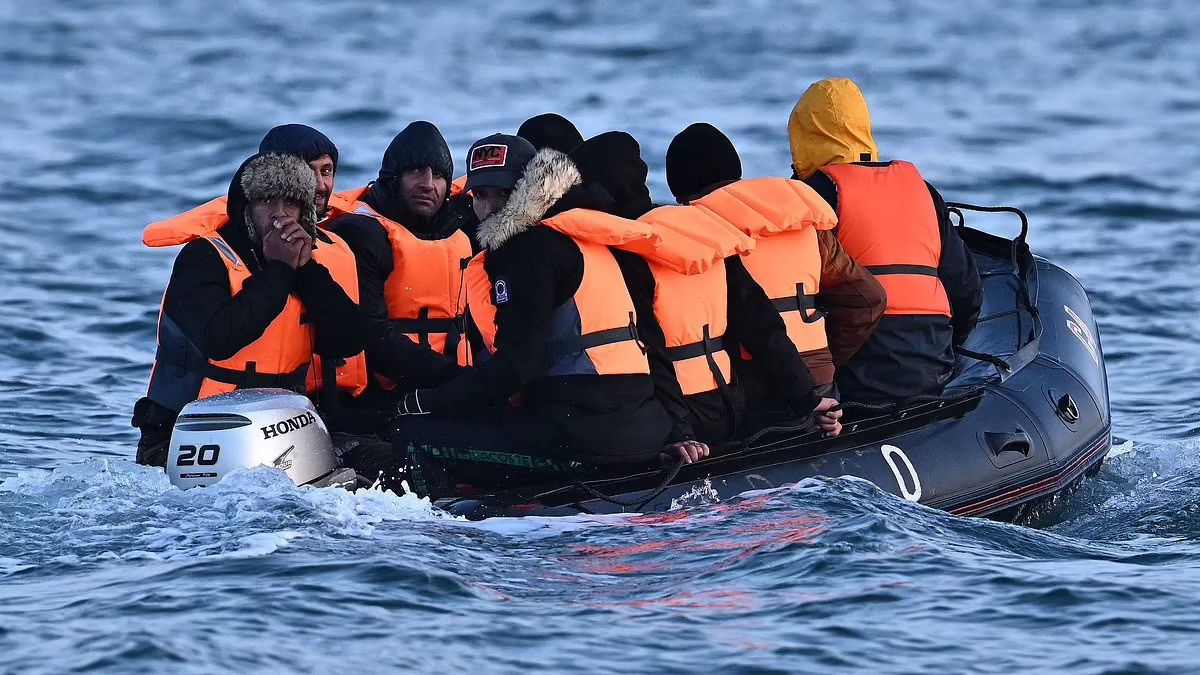
Undercover Investigation Reveals German Connection to Dangerous Channel Smuggling

An undercover investigation by the BBC has uncovered a troubling network of human smugglers operating in Essen, Germany, who are providing migrants with dangerous inflatable boats for crossing the English Channel. The investigation reveals a troubling connection between Germany and the booming smuggling trade, despite the UK government’s efforts to combat it.

REWRITTEN TEXT

In a hidden meeting in Essen, a western German city with a significant migrant population, undercover BBC reporters posing as Middle Eastern migrants were offered a “package” deal for an inflatable dinghy, complete with an outboard motor and life jackets, for €15,000 (£12,500). This revelation highlights a critical German link to the perilous smuggling operations across the English Channel, which have become increasingly lethal this year, with over 28,000 migrants attempting the journey in small, overcrowded boats.

The investigation comes amid renewed UK government pledges to dismantle smuggling gangs. However, according to Britain’s National Crime Agency, Germany has emerged as a vital location for the storage and distribution of boats and engines destined for illegal crossings.

During the covert operation, the undercover reporter, identified as “Hamza,” met with a smuggler known as Abu Sahar. Despite expressing a desire to avoid previous negative experiences with smugglers in Calais, Hamza sought Sahar’s assistance to manage his own crossing. Sahar provided assurances of availability and quality for the dinghy stored in a nearby warehouse.

Sahar explained that the boats were strategically kept in Essen to ensure quick access to Calais while avoiding more heavily policed areas. Although facilitating smuggling to a non-EU country like the UK is not illegal in Germany, there is increasing frustration among UK officials regarding Germany’s legal framework, which allows such activities to flourish.

At a cafe meeting, a figure referred to as “al-Khal,” who commands respect in the smuggling community, confirmed their operation’s scale and hinted at the presence of multiple warehouses in Essen to evade police detection. The smugglers suggested they could transport boats to Calais within hours, emphasizing the efficiency of their operation.

The BBC investigation uncovered that boats often originate from China, moving through Turkey before reaching Europe. As the pressure mounts from strict anti-smuggling controls in France, smugglers have increasingly turned to Germany, where they believe law enforcement is less engaged with the issue.

The smugglers discussed various options for Hamza, with the “package” deal including not just the boat but also life jackets and other equipment. They hinted at a “new crossing point,” suggesting they had found routes less monitored by authorities, further endangering migrants.

Despite the significant risks associated with such crossings, the smugglers downplayed the dangers, while independent experts condemned the vessels as “death traps.” Neil Dalton, Chair of the National Independent Lifeboat Association, emphasized the extreme dangers of overcrowding flimsy dinghies for such treacherous waters.

In response to the investigation, UK authorities are intensifying collaboration with Germany to tackle the smuggling networks. They aim to enhance enforcement strategies and address the evolving threats posed by these criminal organizations. While previous raids in Germany have resulted in arrests, the challenge remains daunting as smugglers adapt and continue to exploit legal loopholes.

The investigation sheds light on the grim reality faced by many desperate migrants, drawn into a perilous trade that exploits their hopes for a better life. Abandoned dinghies littering the northern French shores serve as grim reminders of the dangerous journey and the lives at stake in this ongoing crisis.


Iceland’s Shorter Work Week Proves Successful for Economy and Workers

Iceland’s implementation of a shorter work week, featuring no loss in pay, has yielded positive outcomes for its economy and workforce, according to a recent study released on Friday. Between 2020 and 2022, more than half of the country’s workforce participated in this initiative, including adopting four-day work weeks.

Positive Economic Indicators

The research, conducted by the Autonomy Institute in the UK and Iceland’s Association for Sustainability and Democracy (Alda), reveals that Iceland’s economic performance has surpassed many of its European counterparts. In 2022, the country recorded economic growth faster than most of Europe, alongside one of the lowest unemployment rates in the region. “This study shows a real success story: shorter working hours have become widespread in Iceland… and the economy is strong across a number of indicators,” said Gudmundur D. Haraldsson, a researcher at Alda.

The foundation of this initiative was laid during two large-scale trials conducted from 2015 to 2019, where public sector employees worked 35-36 hours a week without a pay cut. These trials, which involved around 2,500 individuals, aimed to maintain or enhance productivity while improving work-life balance. Findings indicated that productivity either remained constant or improved in most workplaces, while participants reported significant improvements in their overall well-being, including reduced stress and burnout.

Expansion of Reduced Hours

Following the successful trials, Icelandic trade unions negotiated reductions in working hours for tens of thousands of workers nationwide. As a result, the trend towards shorter working hours has gained momentum, with participation likely exceeding the initial 51% reported.

Economic Growth and Challenges Ahead

In 2023, Iceland’s economy grew by 5%, a figure that positions it second only to Malta among wealthy European nations, as per the International Monetary Fund’s World Economic Outlook. This growth is notably higher than the country’s average rate of nearly 2% recorded from 2006 to 2015. Despite this success, the IMF anticipates a slowdown in growth due to softening domestic demand and declining tourism spending, which has been a cornerstone of Iceland’s economy.

Unemployment Rate and Economic Vitality

Iceland’s low unemployment rate, which stood at 3.4% last year, is regarded as a strong indicator of the country’s economic vitality. This rate is significantly lower than the average for advanced European economies. However, the IMF expects it to rise slightly to 3.8% in the upcoming years.

Globally, there have been various experiments with the four-day work week, including a successful trial in 2022 involving 33 companies in the US and Ireland, showcasing a growing interest in alternative work arrangements that prioritize employee well-being alongside economic performance.

Conclusion: A Model for Work-Life Balance

Iceland’s experience with a shorter work week highlights a promising model for balancing work and life while fostering economic growth. As other nations explore similar initiatives, the findings from Iceland’s trials may serve as a valuable reference for improving worker satisfaction and enhancing overall productivity without sacrificing economic success.

Over 130 Israeli Reservists Refuse to Serve in Gaza and Lebanon

In a significant act of dissent, more than 130 Israeli reservists, including Yotam Vilk, have signed an open letter expressing their refusal to serve in military operations in Gaza and Lebanon unless a peace deal is reached to end the ongoing conflict and secure the return of hostages held by Hamas.

Personal Accounts of Dissent

Yotam Vilk, who voluntarily joined the military effort after the October 7 attack by Hamas, has spent over 230 days serving in Gaza. Despite his earlier commitment, he has now reached a point of moral conflict regarding his continued service. “On October 7, I didn’t hesitate… because my people were murdered… but now I see the Israeli government’s lack of urgency to resolve the situation,” Vilk told CNN. After completing two rounds of reserve duty in Gaza, he resolved not to return, believing military action should only serve as a means to achieve diplomatic solutions.

Vilk’s letter, addressed to Prime Minister Benjamin Netanyahu and Defense Minister Yoav Gallant, articulates a shared sentiment among the reservists: “For some of us, the red line has already been crossed… we will stop reporting for service.” This highlights a deep disillusionment with the Israeli government’s approach to the conflict, particularly its perceived failure to seek peaceful resolutions and the ongoing hardships faced by both Palestinians and Israeli hostages.

The Broader Context of Resistance

Max Kresch, another reservist who served on Israel’s border with Lebanon, echoed similar sentiments. He described the militaristic atmosphere during his service as deeply uncomfortable, particularly with comrades who held extreme views about the conflict. “It was very difficult for me… to hear soldiers express a religious duty to kill Palestinians,” he recounted.

The term “forever war” has emerged among critics of Netanyahu, symbolizing their fears that the conflict may be perpetuated for political gain. Kresch pointed out that, despite initial support for military action, he now views the continuation of hostilities as politically motivated rather than strategically necessary.

Call for Accountability

The reservists’ letter comes in the wake of rising tensions and ongoing military actions in both Gaza and Lebanon. The Israeli government has faced calls to address the dissenting voices within its ranks. Transportation Minister Miri Regev stated that there is “no place for refusals in the army,” emphasizing the government’s stance against dissent.

In the days following the letter’s publication, Kresch and Vilk received phone calls from military officials urging them to retract their statements, highlighting the pressure faced by those who dare to dissent. Despite this, both men remain steadfast in their convictions, prioritizing their moral choices and the need for a meaningful resolution to the conflict.

Conclusion: A Defining Moment in Military Service

The refusal of over 130 reservists to serve in ongoing military operations marks a critical moment in the Israeli military landscape. As they grapple with the implications of their decisions, the reservists are pushing for a reevaluation of military actions and advocating for a shift towards diplomacy and peace. Their actions reflect a growing movement within Israeli society questioning the direction of the conflict and the government’s strategies.