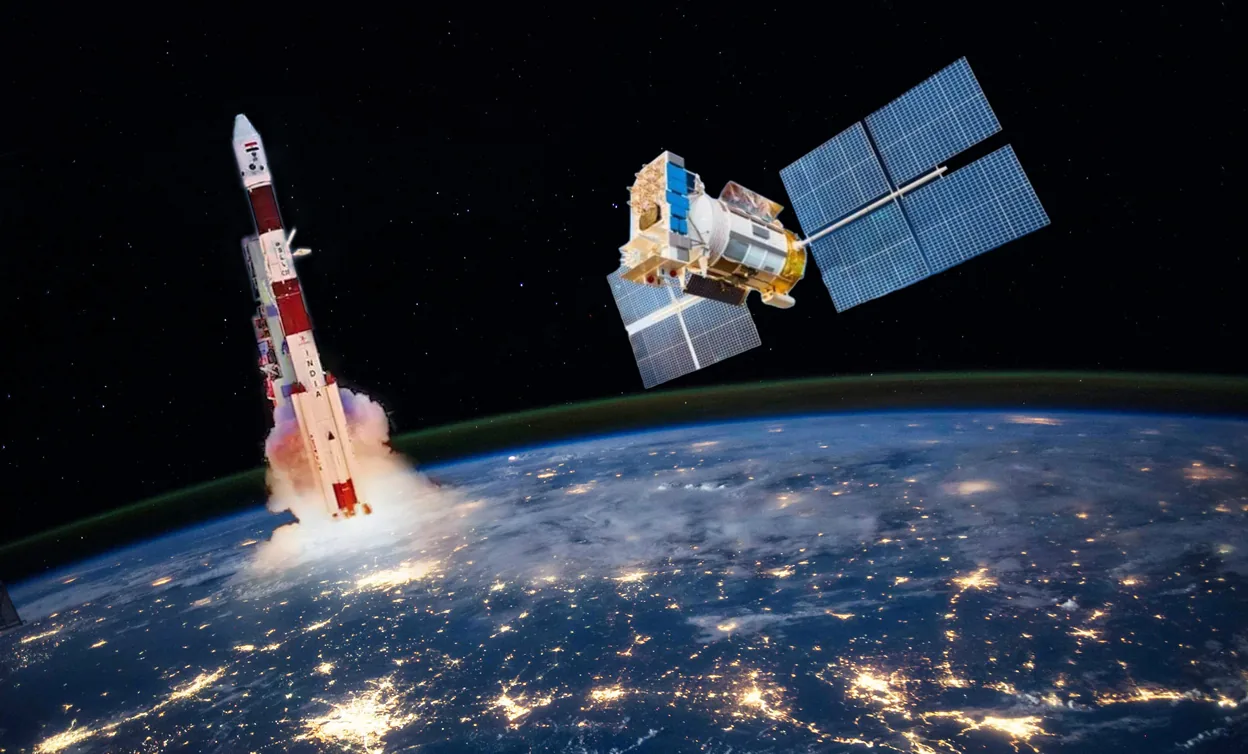
India’s Push for Home-Grown Satellite Constellation Attracts 30 Aspirants

India’s initiative to develop home-grown Earth observation (EO) satellite constellations has received a strong response, with 30 companies applying for a role in the project. This effort, managed by the Indian National Space Promotion and Authorisation Centre (IN-SPACe), is part of India’s strategy to reduce its dependence on foreign satellite data for critical sectors like defense, infrastructure management, and mapping.

Pawan Goenka, Chairman of IN-SPACe, announced that nine applications had been received, each representing a consortium of companies. These applicants include a mix of startups, such as Google-backed Pixxel and Baring Private Equity-backed SatSure, as well as larger entities like Tata Group’s Tata Advanced Systems. The project aims to establish satellite constellations that provide crucial data for various industries, including telecoms and climate monitoring. The satellite data market is expected to reach $45 billion by 2030, making it a significant global opportunity.

IN-SPACe issued a call for “expressions of interest” (EoI) in July to develop these homegrown satellite constellations. The initiative is part of India’s broader strategy to commercialize its space sector and ensure data sovereignty. The space regulator set eligibility criteria for the applicants, requiring them to invest at least 850 million rupees ($10 million) in space activities, have a company valuation of 8.5 billion rupees, or a turnover of 2 billion rupees in the last three years. Applicants must also establish spacecraft control centers in India or partner with ground station providers.

The evaluation of technical proposals is expected to be completed by the end of January, with a tender to determine the winning bidder to follow shortly thereafter. The government plans to provide a loan of up to 3.5 billion rupees to the winning company, with private entities expected to cover the rest of the costs. Additionally, India has set up a 10-billion-rupee venture fund to support space startups since the sector was opened to private players in February.

Although India currently relies on foreign EO data from entities like the European Space Agency (ESA) and the Indian Space Research Organisation (ISRO), the country is now focused on expanding its space capabilities and reducing its dependence on external sources.

 

Mathematician Resolves Longstanding Sofa Problem with Breakthrough Discoveries

The “sofa problem,” a perplexing mathematical challenge that has stumped experts for decades, may have finally found its resolution. First posed in 1966 by Austrian-Canadian mathematician Leo Moser, the problem asks for the largest possible area of a shape that can navigate a right-angled corner in a hallway of unit width. Despite its seemingly straightforward nature, the puzzle has remained unsolved for more than 50 years, with mathematicians struggling to determine the optimal shape and size.

Jineon Baek, a postdoctoral researcher at Yonsei University in South Korea, has reportedly made a significant breakthrough in solving the problem. In a study shared on the preprint site ArXiv on December 2, Baek demonstrated that the maximum area of the hypothetical “sofa” is 2.2195 square units. This finding refines the earlier established range for the sofa’s area, which had been between 2.2195 and 2.37 square units. While the solution is still awaiting peer review, mathematicians are optimistic that Baek’s work will withstand scrutiny and become the definitive answer to the long-standing question.

The origins of the sofa problem date back to Moser’s original conceptualization in 1966, but it was not until 1992 that notable progress was made. Joseph Gerver, an emeritus professor at Rutgers University, proposed a U-shaped solution that comprised 18 curves. His calculations suggested a lower bound of 2.2195 units for the area, sparking further debate about the possibility of a larger shape. In 2018, a computer-assisted analysis suggested an upper bound of 2.37 units, but the question of whether a larger sofa could exist remained unresolved.

Baek’s recent contribution has brought the sofa problem closer to a resolution, as his findings narrow the possible range and refine our understanding of the mathematical limits of the shape. As experts continue to examine and verify the proof, it is expected that Baek’s work will become a significant milestone in the field of geometry and mathematical problem-solving, finally providing clarity on a question that has baffled mathematicians for over five decades.

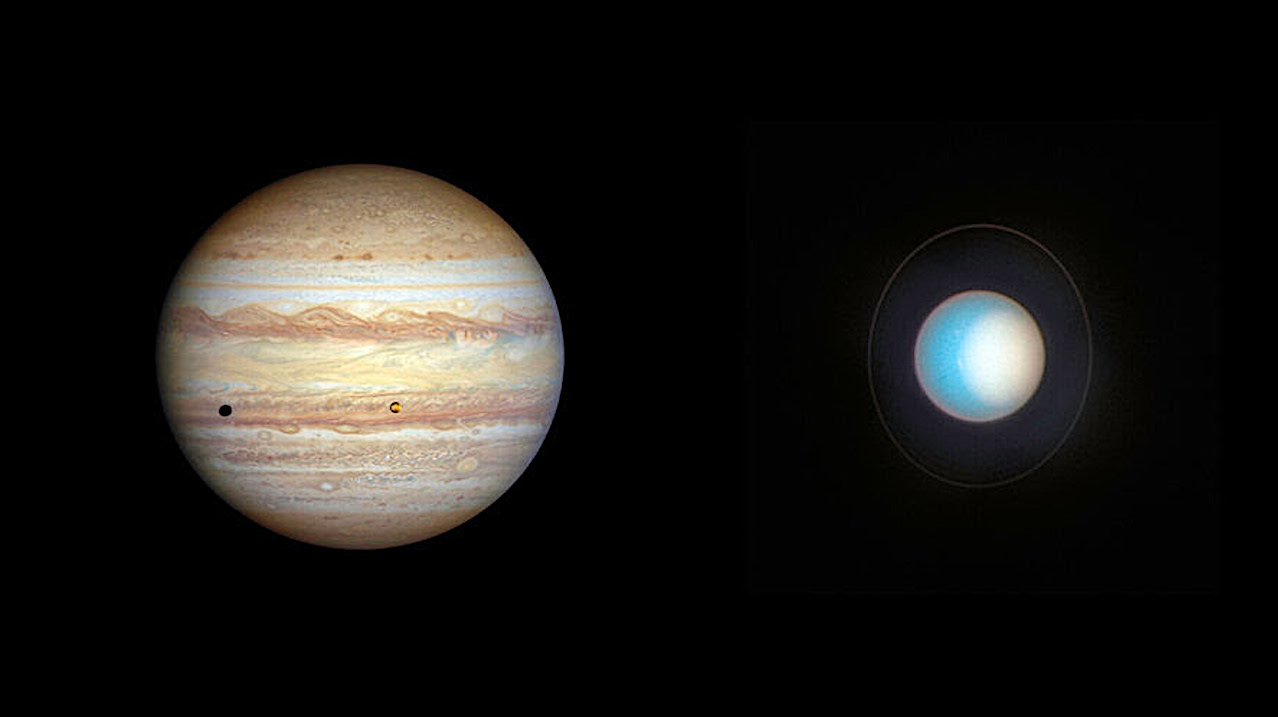
Intense Thunderstorms on Jupiter May Alter Its Colour and Visual Features

Newly captured images of Jupiter have revealed two enormous thunderstorms brewing within the planet’s Southern Equatorial Belt (SEB). These massive storms are expected to produce green lightning, a rare phenomenon on the gas giant, and may lead to significant changes in the belt’s distinctive reddish-brown colour. Observers speculate that the intensity of these storms could alter the visual appearance of Jupiter’s surface, adding to the already dynamic and ever-changing features of the planet. This latest discovery has sparked great interest among astronomers and space enthusiasts alike, as the effects of these storms unfold.

The images, taken by astrophotographer Michael Karrer on November 30 using an 8-inch Celestron telescope, offer a striking view of two prominent white patches within the SEB. These patches, identified as massive thunderstorms, have been the subject of discussion by John Rogers, an astronomer with the British Astronomical Association. According to Rogers, similar storms were observed on Jupiter between 2016 and 2017, but this new occurrence appears to be much larger in scale, making it a noteworthy event for planetary scientists.

The thunderstorms, which are believed to extend nearly 100 kilometers beneath Jupiter’s thick atmosphere, are among the largest and most intense ever recorded on the planet. While their exact size is still being studied, it is estimated that the storms’ widths are likely greater than the entire diameter of Earth. The storms not only bring extreme weather but also produce green lightning, a striking contrast to the blue lightning seen on Earth. This unusual lightning colour is a result of atmospheric ammonia on Jupiter, as opposed to the water vapour responsible for Earth’s blue lightning. NASA research has previously documented this phenomenon, further supporting its presence on the gas giant.

As the storms continue to rage within Jupiter’s atmosphere, their long-term effects on the planet’s appearance remain uncertain. The potential for the SEB’s reddish-brown hue to be diluted could lead to dramatic visual changes that would alter how we view the planet. With further observation and study, scientists hope to gain a deeper understanding of these storms and their broader implications for the atmospheric dynamics of Jupiter, a planet known for its fierce weather patterns and ever-shifting appearance.