Yazılar

India Launches AI Governance Framework Outlining Principles and Future Roadmap

The Ministry of Electronics and Information Technology (MeitY) has officially released India’s Artificial Intelligence (AI) Governance Framework, providing a comprehensive set of guidelines and recommendations for regulators, policymakers, and stakeholders. The framework was formally unveiled by Professor Ajay Kumar Sood, Principal Scientific Adviser to the Government of India, along with other senior officials, signaling the government’s commitment to building a structured approach toward AI adoption and oversight. Among its key proposals are the establishment of new regulatory bodies, updates to existing laws, and amendments to relevant legal provisions to address the unique challenges posed by AI technologies.

The 68-page report emphasizes foundational principles that should guide AI development and deployment across India. Central to the framework are respect for human rights, non-discrimination, safety, transparency, and fairness. MeitY underscores the importance of ensuring AI systems are trustworthy and inclusive, benefiting a broad spectrum of communities, especially those historically underserved or marginalized. The framework aims to strike a balance between encouraging innovation and safeguarding public interest.

Rather than imposing blanket prohibitions, the framework advocates a risk-based approach to AI governance. This means the level of scrutiny and oversight would be proportional to the potential harm and societal impact associated with a given AI system. Systems with higher risk profiles would be subject to stricter regulatory requirements, while low-risk applications could operate with lighter oversight, allowing for greater flexibility and innovation.

To facilitate practical adoption, the guidelines propose a phased implementation model. This includes pilot projects, iterative evaluations, and stakeholder consultations to refine and improve regulatory mechanisms over time. The framework also encourages collaboration between government agencies, industry, academia, and civil society to ensure that India’s AI ecosystem develops responsibly, ethically, and competitively on a global scale.
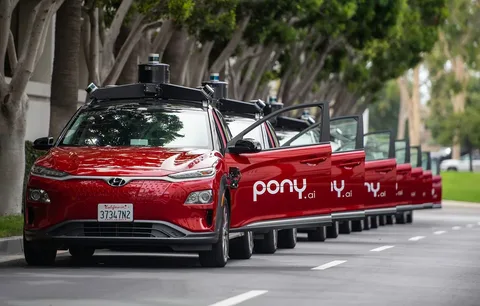
Pony.ai Shares Fall 12% in Hong Kong Debut as Autonomous Rivals WeRide Also Slide

China’s leading autonomous driving startup Pony.ai saw its shares drop more than 12% on Thursday in its Hong Kong debut, while rival WeRide fell nearly 13%, reflecting investor caution toward the fast-evolving self-driving sector.

Pony.ai raised HK$6.71 billion (about $860 million) and WeRide HK$2.39 billion through their initial public offerings, both of which come as Chinese tech firms increasingly seek dual listings in Hong Kong amid geopolitical uncertainty and stricter U.S. regulations.

Both Guangzhou-based firms are investing heavily in Level 4 autonomous driving — vehicles that can operate without human intervention under specific conditions. Pony.ai CEO James Peng said proceeds would help expand autonomous parking and charging infrastructure, while WeRide’s CEO Tony Xu Han said funds would support AI development and data center expansion.

The companies have already launched robotaxi services in several Chinese cities and plan to expand to new regions including the Middle East, Europe, and Singapore, though full regulatory approvals remain pending.

The listings come at a delicate time for Chinese tech firms facing mounting U.S. restrictions. A new rule effectively bans Chinese technology in connected vehicles, complicating Pony.ai and WeRide’s ambitions to partner with Uber for robotaxi operations in the U.S.

“The dual listings are about risk mitigation,” said Tu Le, managing director at Sino Auto Insights. “They acknowledge it will take significant capital — and a market outside the U.S. — for these firms to succeed.”

The weak debut mirrored declines in New York, where WeRide shares dropped 5.2% and Pony.ai fell 2% the previous day. Still, analysts said the Hong Kong listings will help both companies secure Asia-based funding and reinforce the city’s growing image as a tech hub.

Motion Picture Association Orders Meta to Drop “PG-13” Label from Instagram Teen Filters

The Motion Picture Association (MPA) has issued a cease-and-desist letter to Meta, accusing the social media giant of misleadingly using the film industry’s “PG-13” rating in its new content filters for teen users on Instagram. The group said Meta’s claim that its filters are modeled on the movie rating system is “literally false and highly misleading.”

Meta announced last month that it would restrict what users under 18 see on Instagram by applying filters “inspired by the PG-13 rating system.” The MPA, however, says the comparison is inappropriate, emphasizing that its rating process involves a curated, consensus-driven assessment by human reviewers — not automated algorithms.

In an October 28 letter to Meta Chief Legal Officer Jennifer Newstead, the MPA demanded that the company immediately stop using the “PG-13” mark and disassociate its Teen Accounts and AI moderation tools from the film rating system, warning that unauthorized use could undermine public trust in movie ratings. The association asked Meta to resolve the issue by November 3.

A Meta spokesperson said the company had no intention of implying a partnership with the MPA and hopes to “work constructively” with the association to address concerns. Meta said the filter initiative was designed to give parents greater control over what teenagers see on its platforms.

The dispute comes as Meta faces growing scrutiny from regulators and advocacy groups over the safety of its younger users. The company has also faced lawsuits alleging that its social platforms expose minors to harmful content.