Yazılar

Scientists Detect Unprecedented Jet Behavior in 3I/ATLAS Using Hubble Data

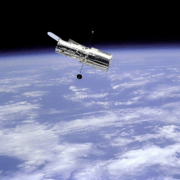
Scientists have identified a previously unseen astrophysical phenomenon in the object known as 3I/ATLAS, after analyzing new observations from the Hubble Space Telescope. The data reveal an unusual pattern of anti-correlated jet flipping, a behavior that challenges simpler models of how energetic outflows operate in space.

In most jet-producing systems, such as active galactic nuclei or X-ray binaries, twin jets emerging from opposite poles behave symmetrically. In 3I/ATLAS, however, researchers observed that changes in one jet are mirrored by opposite behavior in the other. When one jet shifts direction or intensity, the opposing jet responds inversely rather than in sync.

This phenomenon, described as a jet “flip” or oscillation, suggests a highly ordered and rotationally controlled system. Scientists say the effect points to a central engine governed by strong rotation, where angular momentum plays a key role in regulating how energy is released.

The precision of the jet behavior indicates the likely presence of a massive compact object — such as a black hole or neutron star — surrounded by an extremely active accretion disk. Interactions between gravity, spin and magnetic fields appear to generate a gyroscopic effect that stabilizes the jets despite underlying instabilities.

Researchers say the findings mark a significant advance in astrophysics, showing that jet dynamics can be highly structured rather than chaotic. By studying these oscillations, scientists can infer previously inaccessible parameters, including the system’s inclination angle and the precession speed of its rotational axis.

The discovery offers a new window into how energy propagates through galaxies and reinforces the idea that even in extreme cosmic environments, rotation and balance play a fundamental role in shaping the universe.
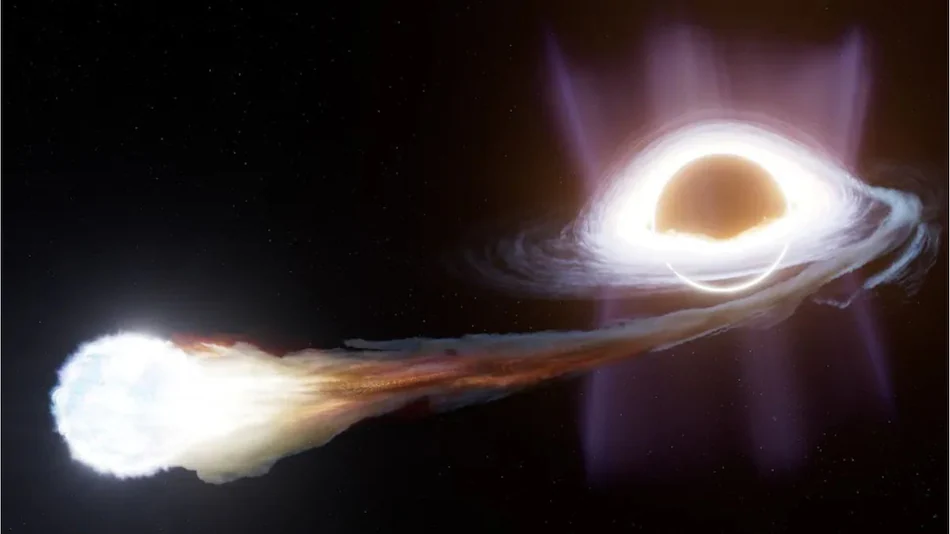
Black Hole Destroys Star, Emits Intense Flares Half a Year Later

Giant Black Hole Tears Star Apart, Triggers Delayed Flares Devamını Oku

Scientists Propose That Black Hole Singularities Might Not Exist

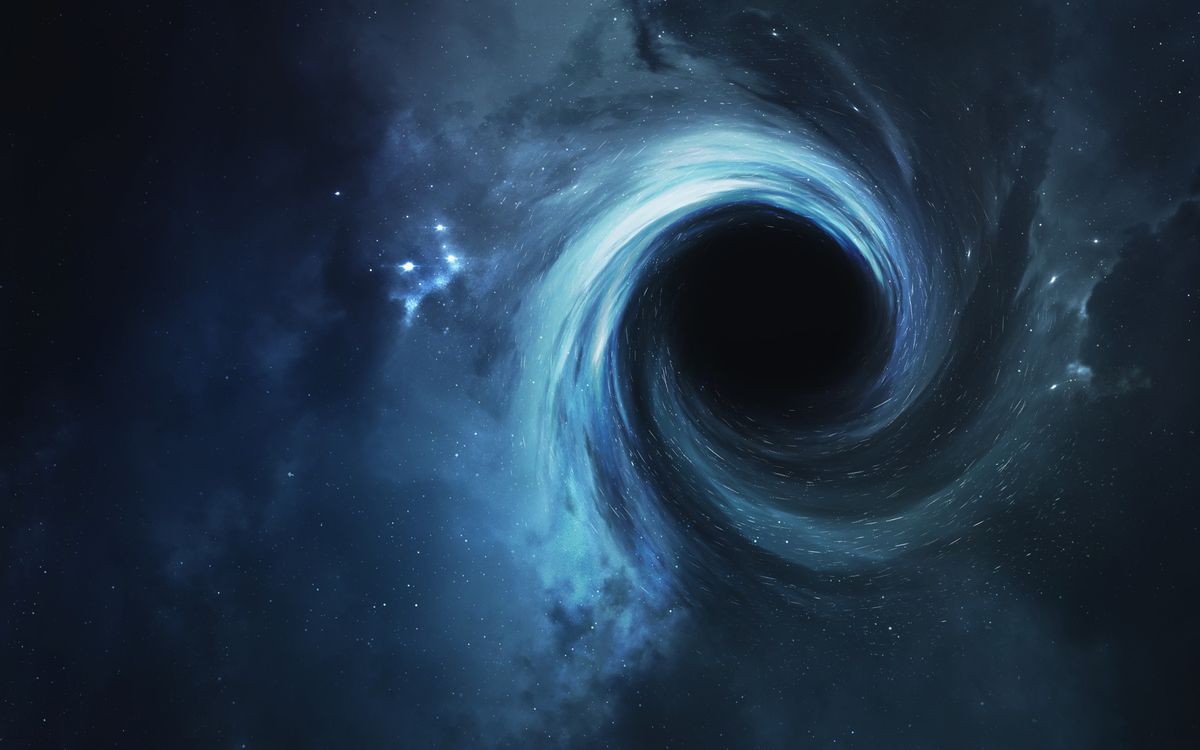
The concept of singularities at the core of black holes has long posed a paradox in physics, as these infinitely dense points challenge the fundamental principles of space, time, and matter. However, new research suggests that singularities may not exist at all. Physicists have proposed modifications to Einstein’s general relativity equations, offering an alternative view of black hole interiors. If these changes are correct, they could resolve one of the biggest inconsistencies between general relativity and quantum mechanics, restoring predictability to physical laws.

A study published in Physics Letters B introduces refinements to general relativity based on principles from quantum gravity. While Einstein’s theory has been remarkably successful in describing cosmic phenomena like black holes and neutron stars, it breaks down under extreme conditions. The incompatibility of singularities with quantum mechanics has long suggested that general relativity is incomplete. The new modifications aim to bridge this gap, potentially eliminating the need for singularities while maintaining the theory’s ability to describe gravitational systems accurately.

Robie Hennigar, a postdoctoral researcher at Durham University, explained in an interview with Live Science that singularities represent a fundamental problem in our understanding of the universe. He described them as regions where space, time, and matter are crushed into a state of nonexistence—something that most physicists see as a sign that a deeper theory is required. By adjusting general relativity with insights from quantum mechanics, researchers hope to develop a more complete framework for understanding black holes.

If singularities are indeed mathematical artifacts rather than physical realities, this could have profound implications for black hole physics and cosmology. Future advancements in observational technology, such as next-generation space telescopes and gravitational wave detectors, may provide further evidence to test these new models. As theoretical and experimental research progresses, the true nature of black hole interiors may soon be better understood, reshaping our understanding of the universe’s most mysterious objects.