Yazılar

Study Reveals China Has Lost 26 Percent of Its Glaciers Due to Global Warming

China has experienced a dramatic loss of glacier coverage over the past six decades, with new research revealing that nearly 26 percent of its glaciers have vanished since the 1960s. This significant reduction in glacier mass has been attributed to the rapid increase in global temperatures, which has accelerated the melting process. Official reports confirm that approximately 7,000 small glaciers have completely disappeared from the country’s landscape. With warming trends continuing to intensify, the retreat of glaciers has become a pressing concern, particularly in regions that rely on these ice masses for freshwater.

A study published by the Northwest Institute of Eco-Environment and Resources, part of the Chinese Academy of Sciences, tracked the decline in China’s glaciers. The research found that by 2020, China’s glacier area had shrunk to nearly 46,000 square kilometers, a sharp drop from around 59,000 square kilometers between 1960 and 1980. During the same period, the number of glaciers dropped from roughly 46,000 to 39,000, highlighting the dramatic changes in the region’s glacial landscape. This reduction in glacier mass is indicative of broader global warming patterns and underscores the environmental changes taking place in the region.

The impact of glacier loss extends beyond environmental changes; it has profound implications for water security, particularly in areas that rely on glacier-fed rivers for freshwater. As glaciers retreat, there is growing concern over future water shortages, with many regions facing increased competition for limited resources. The Tibetan Plateau, home to a large proportion of China’s glaciers, is particularly vulnerable. Often referred to as the “Third Pole” due to its vast ice reserves, the plateau plays a critical role in supplying water to millions of people. As the glaciers melt, the region’s ability to sustain water supplies could be jeopardized, affecting both local populations and ecosystems.

In response to the accelerating glacier melt, Chinese authorities have initiated several measures to slow the process. Technological interventions, such as artificial snow systems and snow blankets, have been deployed in certain areas in an attempt to protect the remaining glaciers and slow their retreat. While these efforts may offer some temporary relief, experts warn that more significant, long-term solutions are needed to address the root causes of glacier loss and mitigate the broader impacts of climate change. The ongoing decline of glaciers in China serves as a stark reminder of the urgent need for global action to combat warming and protect critical natural resources.

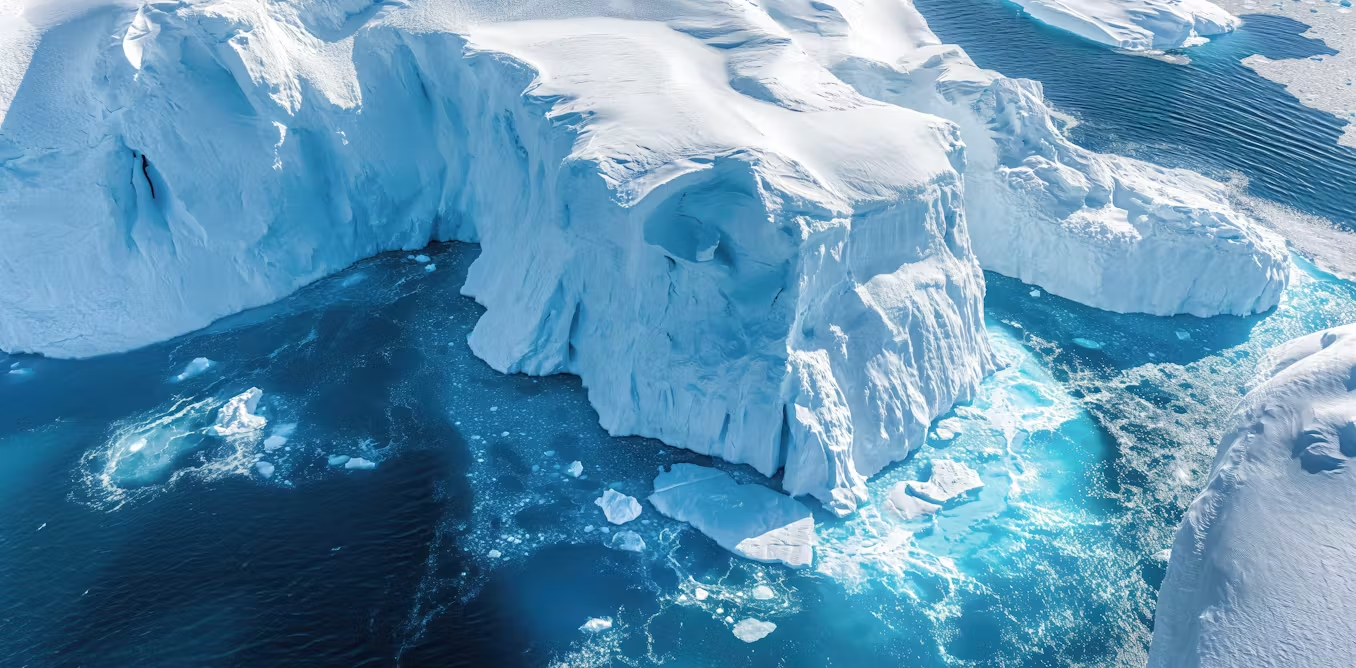
Greenland’s Glaciers Shrink, Revealing 1,620 km of New Coastline Since 2000

Greenland’s rapidly melting glaciers have revealed an astounding 1,620 kilometers of previously ice-covered coastline over the past two decades. As Arctic marine-terminating glaciers continue to retreat, satellite imagery from 2000 to 2020 has documented this significant shift, showcasing the broader impacts of global warming on the region’s geography. These changes not only highlight the shrinking ice flows but also bring forth newly exposed land that is now open to environmental shifts. The newly uncovered areas are likely to face various ecological challenges, including shifts in local ecosystems and sediment movement, while simultaneously presenting opportunities for further scientific exploration.

A study published in Nature Climate Change examined satellite images to track the changes in glacier coverage across the northern hemisphere. The results showed that over the past 20 years, 2,466 kilometers of Arctic coastline have been revealed by glacial retreat, with Greenland accounting for approximately 66 percent of that total. One of the most striking examples of this phenomenon is the Zachariae Isstrom glacier, where 81 kilometers of coastline have been exposed, marking the most significant glacial retreat in the Arctic—twice the amount of any other glacier in the region.

In addition to the coastline, the melting glaciers have led to the discovery of new islands, some of which were previously hidden beneath the ice. The study found that 35 islands larger than 0.5 square kilometers have emerged as a result of the ice retreat, with 29 of these islands located in Greenland. Some of these newly uncovered islands have never been shown on any maps, raising concerns over potential territorial claims. As nations vie for control over these newly exposed lands, there are concerns about the rush to stake claims due to the region’s natural resources.

The emergence of these islands is not only a matter of political interest but also scientific curiosity. Researchers highlight the significant potential for studying the Arctic’s unique geology and marine ecosystems, with the newly exposed areas providing fresh insights into the region’s environmental history and biodiversity. These shifting landscapes offer an unprecedented opportunity for understanding the Arctic’s rapidly changing environment, but they also underscore the larger consequences of climate change on global ecosystems and geopolitical dynamics.

Antarctic Ice Melt Slows Earth’s Strongest Ocean Current, Disrupting Global Circulation

The Antarctic Circumpolar Current (ACC), one of the planet’s most powerful ocean currents, is reportedly losing strength due to the increasing influx of cold meltwater from Antarctica. This weakening of the ACC could have profound consequences for global ocean circulation, with scientists predicting it could slow by as much as 20 percent by 2050. The ACC plays a crucial role in regulating heat exchange between the oceans and influencing global climate patterns. As it weakens, it could trigger a series of changes, affecting sea levels, ocean temperatures, and marine ecosystems across the globe.

A recent study published in Environmental Research Letters sheds light on how the Antarctic ice melt is influencing the ACC. Led by Bishakhdatta Gayen, a fluid mechanist at the University of Melbourne, the research utilized one of Australia’s most advanced climate simulators to examine the complex interactions between the ice sheet and the surrounding ocean waters. The study found that the addition of fresh, cold meltwater into the ocean disrupts the density of the water, weakening the convection processes that typically drive deep ocean circulation. This alteration reduces the efficiency of the ACC, leading to a slowdown in its overall movement.

The consequences of a slower ACC could be far-reaching. One major concern is that as convection weakens, warm ocean water could travel deeper into Antarctic waters, accelerating ice melt and contributing to the rising sea levels. This process would exacerbate the impacts of climate change, as rising sea levels pose a direct threat to coastal communities and ecosystems worldwide. Moreover, the weakening current could allow invasive species to penetrate the Antarctic coastline, disrupting delicate marine ecosystems. Gayen likened the change to a “merry-go-round,” suggesting that slower currents could enable faster migration of marine organisms toward Antarctica, further altering the region’s biodiversity.

As scientists continue to monitor the changes in the ACC, it is becoming clear that the impact of this shift will extend beyond Antarctica. The weakening current is expected to affect global ocean circulation patterns, potentially altering weather systems, nutrient flows, and marine life distributions across the planet. Long-term monitoring and further research will be essential to understanding the full scope of these changes, as scientists are only beginning to study the detailed behavior of the ACC and its role in Earth’s climate system. The disruption of this powerful ocean current could be one of the more significant challenges in understanding how global climate change will unfold in the coming decades.