Yazılar

Scientists Detect Unprecedented Jet Behavior in 3I/ATLAS Using Hubble Data

Scientists have identified a previously unseen astrophysical phenomenon in the object known as 3I/ATLAS, after analyzing new observations from the Hubble Space Telescope. The data reveal an unusual pattern of anti-correlated jet flipping, a behavior that challenges simpler models of how energetic outflows operate in space.

In most jet-producing systems, such as active galactic nuclei or X-ray binaries, twin jets emerging from opposite poles behave symmetrically. In 3I/ATLAS, however, researchers observed that changes in one jet are mirrored by opposite behavior in the other. When one jet shifts direction or intensity, the opposing jet responds inversely rather than in sync.

This phenomenon, described as a jet “flip” or oscillation, suggests a highly ordered and rotationally controlled system. Scientists say the effect points to a central engine governed by strong rotation, where angular momentum plays a key role in regulating how energy is released.

The precision of the jet behavior indicates the likely presence of a massive compact object — such as a black hole or neutron star — surrounded by an extremely active accretion disk. Interactions between gravity, spin and magnetic fields appear to generate a gyroscopic effect that stabilizes the jets despite underlying instabilities.

Researchers say the findings mark a significant advance in astrophysics, showing that jet dynamics can be highly structured rather than chaotic. By studying these oscillations, scientists can infer previously inaccessible parameters, including the system’s inclination angle and the precession speed of its rotational axis.

The discovery offers a new window into how energy propagates through galaxies and reinforces the idea that even in extreme cosmic environments, rotation and balance play a fundamental role in shaping the universe.
NASA Telescopes Spot First Known Companion Star Orbiting Red Supergiant Betelgeuse

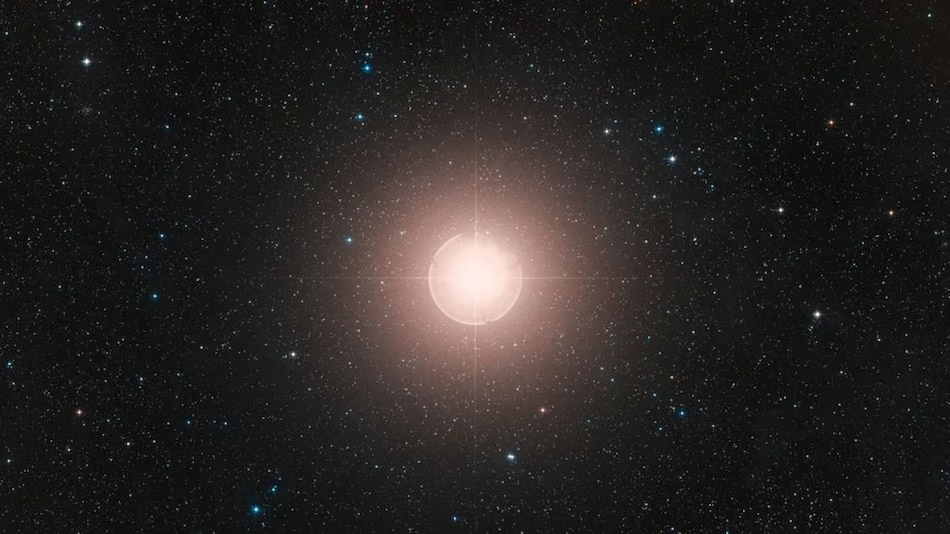
Astronomers have for the first time directly observed a companion star orbiting the massive red supergiant Betelgeuse, shedding new light on the dynamics of such extreme binary systems. Using NASA’s Chandra X-ray Observatory and the Hubble Space Telescope, researchers from Carnegie Mellon University (CMU) captured the faint companion at its maximum distance from the bright giant. Betelgeuse itself is an enormous evolved star, over 700 times the size of the Sun and thousands of times more luminous, making this observation particularly challenging due to the glare of the primary star. Devamını Oku

NASA’s Hubble Space Telescope Observes Neutron Star with Unexplained Origins

NASA’s Hubble Space Telescope has made an intriguing discovery, tracking a rogue magnetar known as SGR 0501+4516 as it roams through our galaxy. This magnetar was first detected in 2008 by NASA’s Swift Observatory, which identified intense gamma-ray flashes emanating from a distant region of the Milky Way. The unusual behavior of this magnetar suggests that not all magnetars within the galaxy may have been formed through the typical process of supernovae, leading scientists to reconsider their understanding of these extreme celestial objects. This finding could provide important clues about the enigmatic phenomenon of fast radio bursts, which have puzzled astronomers for years.

Magnetars, which are composed entirely of neutrons, are the remnants of massive stars that have exhausted their nuclear fuel and collapsed under their own gravity. What sets magnetars apart from other neutron stars is their incredibly strong magnetic fields, which can be a trillion times more intense than Earth’s magnetic field. Lead author of the study, Ashley Chrimes, explained that the magnetic forces of a magnetar are so powerful that they could potentially erase data on a credit card from a distance half the way between Earth and the Moon. If a person were to approach within 600 miles of a magnetar, the intense magnetic field could tear apart the atoms of their body.

Initially, scientists believed that SGR 0501+4516 had originated from the remnants of a nearby supernova, specifically one known as HB9. However, further observations using Hubble’s sensitive instruments, combined with data from ESA’s Gaia spacecraft, raised questions about this origin theory. Hubble’s long-term tracking of the magnetar’s movement revealed that it did not come from a supernova remnant or any star cluster. This unexpected finding has left researchers rethinking the creation process of this wandering magnetar and suggests that it may have a completely different origin.

The discovery of this rogue magnetar is particularly significant for understanding fast radio bursts (FRBs), high-energy astrophysical phenomena whose origins are still not fully understood. NASA researchers believe that the magnetar’s formation could provide insight into the nature of FRBs, which are thought to come from ancient stellar populations. To further explore this mystery, the research team plans to continue observing the magnetar with Hubble, aiming to uncover more about how magnetars form and how they might be linked to these mysterious cosmic bursts. The ongoing study could shed light on some of the most extreme and unexplained aspects of the universe.