Yazılar

South Korea’s Samsung and SK Hynix Exempt from 100% U.S. Chip Tariffs

South Korea’s top trade official, Yeo Han-koo, announced that Samsung Electronics and SK Hynix will not face the proposed 100% U.S. tariffs on semiconductor imports, benefiting from favorable tariff terms under a trade agreement between the U.S. and South Korea.

This comes after U.S. President Donald Trump indicated plans to impose steep tariffs on semiconductor imports from countries without U.S.-based production commitments. However, companies with active or planned manufacturing facilities in the U.S. would be exempt.

Samsung has invested in two chip fabrication plants in Texas, located in Austin and Taylor, while SK Hynix plans to build an advanced chip packaging and AI R&D facility in Indiana. Analysts suggest that Samsung’s broader U.S. investments and its inclusion in Apple’s supply chain give it a stronger exemption position compared to SK Hynix, whose packaging plant alone might not fully qualify for tariff relief.

Apple recently confirmed that Samsung’s Texas plant will supply chips for its iPhones and other products, further strengthening Samsung’s U.S. manufacturing footprint. Following these developments, Samsung’s shares rose 2.6%, while SK Hynix’s shares gained 0.6%, mirroring broader market trends.

Neither company commented on the tariff discussion.

Samsung unveils slimmer foldable phones to counter Chinese rivals and boost AI leadership

Samsung Electronics on Wednesday revealed thinner and lighter foldable smartphones as it seeks to defend its premium segment against growing Chinese competition from Huawei and Honor, while Apple has yet to enter this niche market.

Having lost its global smartphone crown to Apple in 2023, Samsung is pushing to regain momentum by integrating AI features into its foldable devices. Mobile President and COO Choi Won-joon highlighted foldables combined with AI as poised to go mainstream, offering users a unique and differentiated experience. Samsung aims to lead in AI-powered smartphones by collaborating with partners like Google, contrasting Apple’s in-house AI approach that has faced delays.

Alongside the foldables, Samsung launched its first smartwatches featuring Google’s AI voice assistant Gemini, which offers personalized recommendations such as running locations.

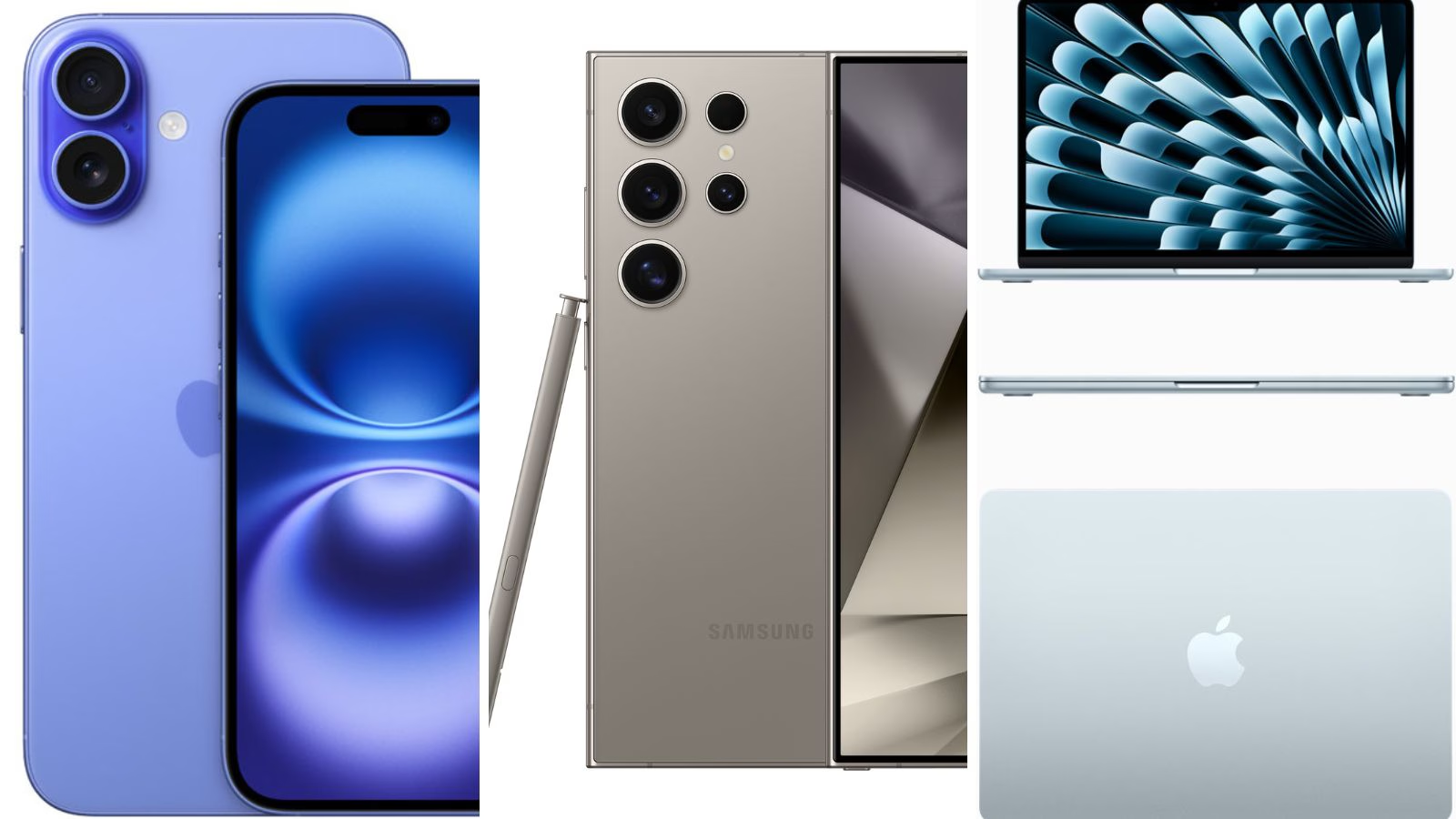
Samsung’s premium strategy continues amid U.S. tariffs that could raise costs. The new Galaxy Z Fold 7 is 10% lighter and 26% thinner than the Fold 6 and priced 5% higher at $1,999. The Galaxy Z Flip 7 FE offers a more affordable option at $899. The Fold 7 uses Qualcomm’s Snapdragon 8 Elite chip, while the Flip 7 runs on Samsung’s own Exynos processors.

Analysts say the new models address bulkiness concerns and strengthen Samsung’s premium brand image. However, foldables remain niche with just 1.5% market share globally. Research firm Canalys expects foldable shipments to stay flat or slightly decline in 2025, with Samsung’s foldables accounting for 4% of total phone sales but 16% of sales over $800. Samsung’s dominance is challenged by strong Chinese sales, especially in China.

Samsung will focus foldable sales on the U.S., Europe, and South Korea. The company is also developing a tri-fold phone to launch by year-end, allowing users to fold the device three ways.

To prepare for U.S. tariffs, Samsung accelerated production and shipments destined for the U.S., manufacturing primarily in Vietnam, South Korea, and India. It is also mitigating China’s rare earth export restrictions by diversifying suppliers and increasing internal stockpiles.

Samsung to Acquire U.S. Healthcare Platform Xealth to Boost Mobile Health Business

Samsung Electronics announced on Tuesday it has signed an agreement to acquire Xealth, a U.S.-based digital healthcare platform, aiming to expand its mobile healthcare services. The financial terms of the deal were not disclosed.

Samsung said the acquisition is intended to create synergy by combining its advanced wearable technology with Xealth’s platform, which manages digital health programs and connects care providers—including over 500 U.S. hospitals—with patients through data integration.

This move aligns with Samsung’s broader strategy to diversify beyond its traditional semiconductor and smartphone operations. The company is increasingly investing in growth areas such as medical technology, consumer audio, climate control systems, and robotics.

Earlier this year, Samsung agreed to acquire Germany’s FlaktGroup for €1.5 billion ($1.68 billion), targeting the booming demand for data center cooling, driven by AI projects. At a March shareholder meeting, Chairman Jay Y. Lee emphasized Samsung’s focus on “meaningful” acquisitions to drive growth, especially after falling behind rivals in the AI chip market led by Nvidia.

Notably, on the same day as the Xealth announcement, Samsung forecasted a sharp 56% decline in its second-quarter operating profit, mainly due to weak AI chip sales—raising investor concerns about the company’s semiconductor business recovery.