Yazılar

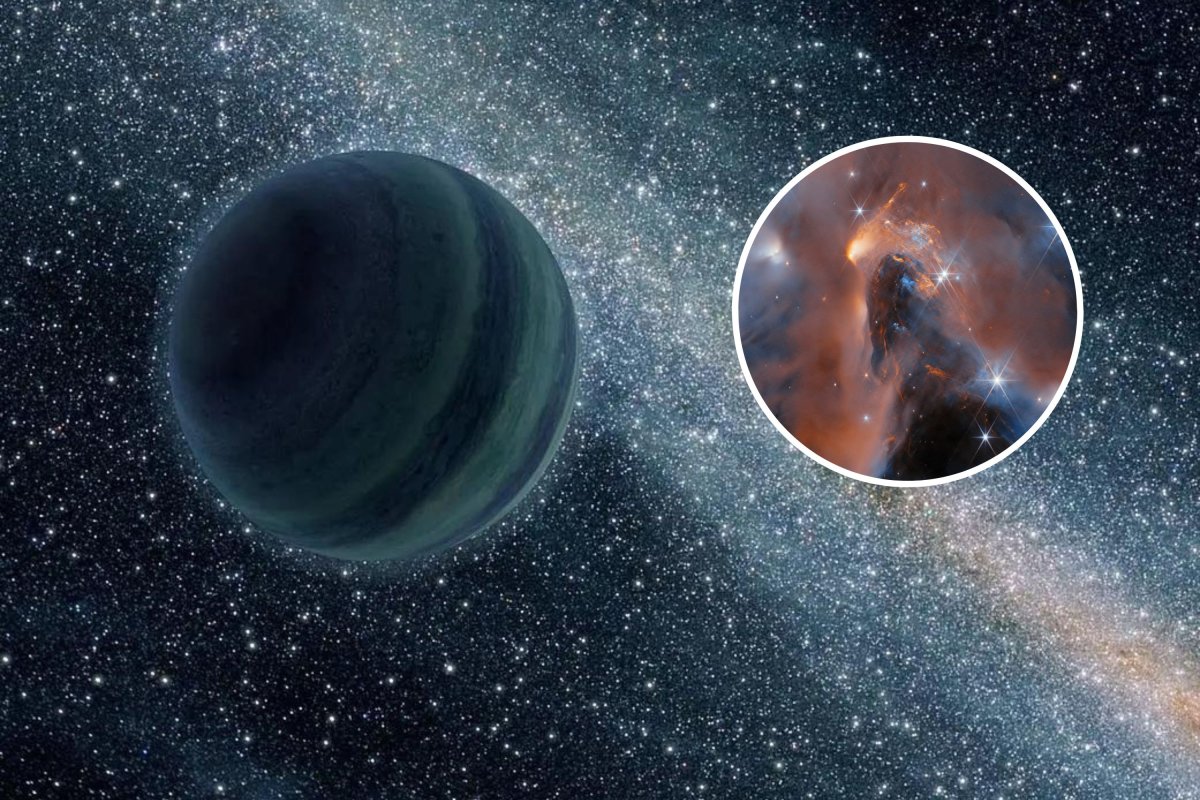
James Webb Space Telescope Spots Enigmatic Planetary-Mass Object Drifting in Space

A recent study using the James Webb Space Telescope (JWST) has provided new insights into SIMP 0136, an intriguing planetary-mass object located roughly 20 light-years from Earth. This mysterious celestial body, which drifts freely in space without orbiting a star, blurs the line between planets and failed stars. With an estimated mass around 13 times that of Jupiter but a similar size, SIMP 0136 challenges conventional classifications. Adding to its uniqueness, the object rotates rapidly, completing a full spin in just 2.4 Earth hours, making it one of the fastest-rotating planetary-mass objects ever observed.

The study, published in The Astrophysical Journal Letters, explores whether SIMP 0136 should be categorized as a rogue planet or a brown dwarf. Brown dwarfs are objects that form like stars but lack the necessary mass to sustain hydrogen fusion, leaving them in a transitional state between planets and stars. JWST’s advanced instruments captured data over two full rotations, allowing scientists to analyze the object’s atmosphere in unprecedented detail.

Led by Allison McCarthy from Boston University, the research team focused on detecting variations in brightness, which suggested complex atmospheric activity. By utilizing JWST’s Near-Infrared Spectrograph (NIRSpec) and Mid-Infrared Instrument (MIRI), scientists were able to capture infrared light curves, mapping changes in brightness across different wavelengths. This data revealed fluctuations in atmospheric layers, hinting at dynamic weather patterns, including potential cloud formations and temperature shifts.

The findings from JWST’s observations could provide deeper insights into the atmospheres of both rogue planets and brown dwarfs, helping astronomers refine their understanding of planetary evolution. As researchers continue to analyze SIMP 0136, future studies may uncover more about the nature of these isolated objects and their role in the broader cosmic landscape.
NASA Announces New Missions to Explore and Map the Sun and the Universe

NASA is set to launch two groundbreaking missions aimed at expanding our understanding of space and the universe. Scheduled for March 2, 2025, the PUNCH and SPHEREx spacecraft will be launched aboard a SpaceX Falcon 9 rocket from Vandenberg Space Force Base in California. These missions, designed with separate but complementary scientific goals, will provide valuable insights into solar dynamics and the broader universe. The dual launch, part of NASA’s Launch Services Program, is expected to significantly enhance our knowledge of both solar activity and cosmic phenomena.

The PUNCH mission, short for Polarimeter to Unify the Corona and Heliosphere, will focus on the Sun’s corona and solar wind. This mission is designed to provide a detailed look at the Sun’s outer atmosphere by using four small satellites equipped to capture three-dimensional images. By employing polarized light, PUNCH will track solar events like coronal mass ejections (CMEs), which can affect space weather on Earth. These observations will help scientists understand solar wind dynamics and improve space weather predictions, which are crucial for protecting communication satellites and power grids on Earth.

In contrast, the SPHEREx mission will survey the universe using infrared observations, aiming to map the entire sky every six months. Unlike missions like the James Webb Space Telescope, which focus on capturing detailed images of specific regions, SPHEREx is designed to create broad cosmic maps in 102 different wavelengths. This approach will help scientists investigate the history of the universe, the formation of galaxies, and the role of water in planetary systems. Phil Korngut, an instrument scientist on the SPHEREx mission, highlighted that the data gathered will contribute to a deeper understanding of cosmic inflation and the origins of life-sustaining elements in the universe.

Together, these missions will provide valuable complementary data, with PUNCH offering a closer look at our Sun and SPHEREx expanding our understanding of the cosmos. Both missions promise to contribute significantly to the fields of heliophysics and cosmology, offering new insights that could shape future space exploration and deepen our understanding of the universe.

Intuitive Machines’ Stock Drops After Second Sideways Moon Landing

Intuitive Machines’ stock took a sharp 23% dive on Friday after confirming that its second moon lander, Athena, had landed on its side, much like the company’s first lunar attempt last year. The six-legged Athena lander had touched down approximately 100 miles (160 km) from the moon’s south pole, but the mission was declared a failure due to the spacecraft’s tilted position. The company cited the challenges of the lander’s orientation, the impact of the sun’s direction on the solar panels, and the extremely cold temperatures in the crater, which prevented the craft from recharging.

As a result, Intuitive Machines’ stock experienced its most significant drop in over a year. Shares had already fallen 20% the previous day, but the company had seen a considerable rise in value over the past 12 months prior to this setback.

Athena was carrying 11 scientific payloads, including tools for water ice exploration, lunar soil analysis, and the first data center and cellular network on the moon. Despite the failure, the company remains involved in NASA’s plans to reduce the cost of lunar exploration, with Intuitive Machines among the private companies leading the U.S. return to the moon.

Meanwhile, SpaceX’s Starship rocket also faced a setback, exploding minutes after its launch on Thursday. Despite these challenges, industry analysts believe that Intuitive Machines, though impacted by the recent failure, is still well-positioned to capitalize on the growing space exploration industry.

Andres Sheppard, senior analyst at Cantor Fitzgerald, remarked that while the sideways landing might affect the company’s credibility, it doesn’t signal a dire situation for Intuitive Machines. “We still think they are one of the better-positioned companies in the space exploration industry.”