Yazılar

Moon’s Deepest Canyons Carved in Minutes by High-Velocity Impact Debris

Scientists have discovered that two enormous lunar canyons, deeper than the Grand Canyon, were formed in a matter of minutes due to the rapid movement of high-speed impact debris. The canyons, known as Vallis Schrödinger and Vallis Planck, stretch for 270 and 280 kilometers, respectively, with depths reaching up to 3.5 kilometers. In comparison, the Grand Canyon on Earth has a maximum depth of about 1.9 kilometers. These lunar formations are located near the Schrödinger impact basin in the moon’s south polar region, an area dominated by rugged mountains and deep craters.

A study published in Nature Communications suggests that these canyons, along with several other valleys, resulted from material ejected during the impact that created the Schrödinger basin. This massive crater, measuring 320 kilometers across, formed approximately 3.81 billion years ago. It lies on the outskirts of the South Pole–Aitken basin, the moon’s largest and oldest known impact structure, which dates back more than 4.2 billion years.

The study also highlights the astonishing energy involved in carving these canyons. Scientists estimate that rock debris from the impact moved at speeds between 3,420 and 4,600 kilometers per hour—far surpassing the velocity of a 9mm bullet, which travels at about 2,200 kilometers per hour. The force generated by this event is believed to have been more than 130 times greater than the combined energy of all nuclear weapons currently in existence on Earth.

These findings provide new insights into the moon’s violent geological history and the powerful processes that shaped its surface. Understanding these rapid transformations could also help scientists refine models of planetary formation and impact dynamics across the solar system.
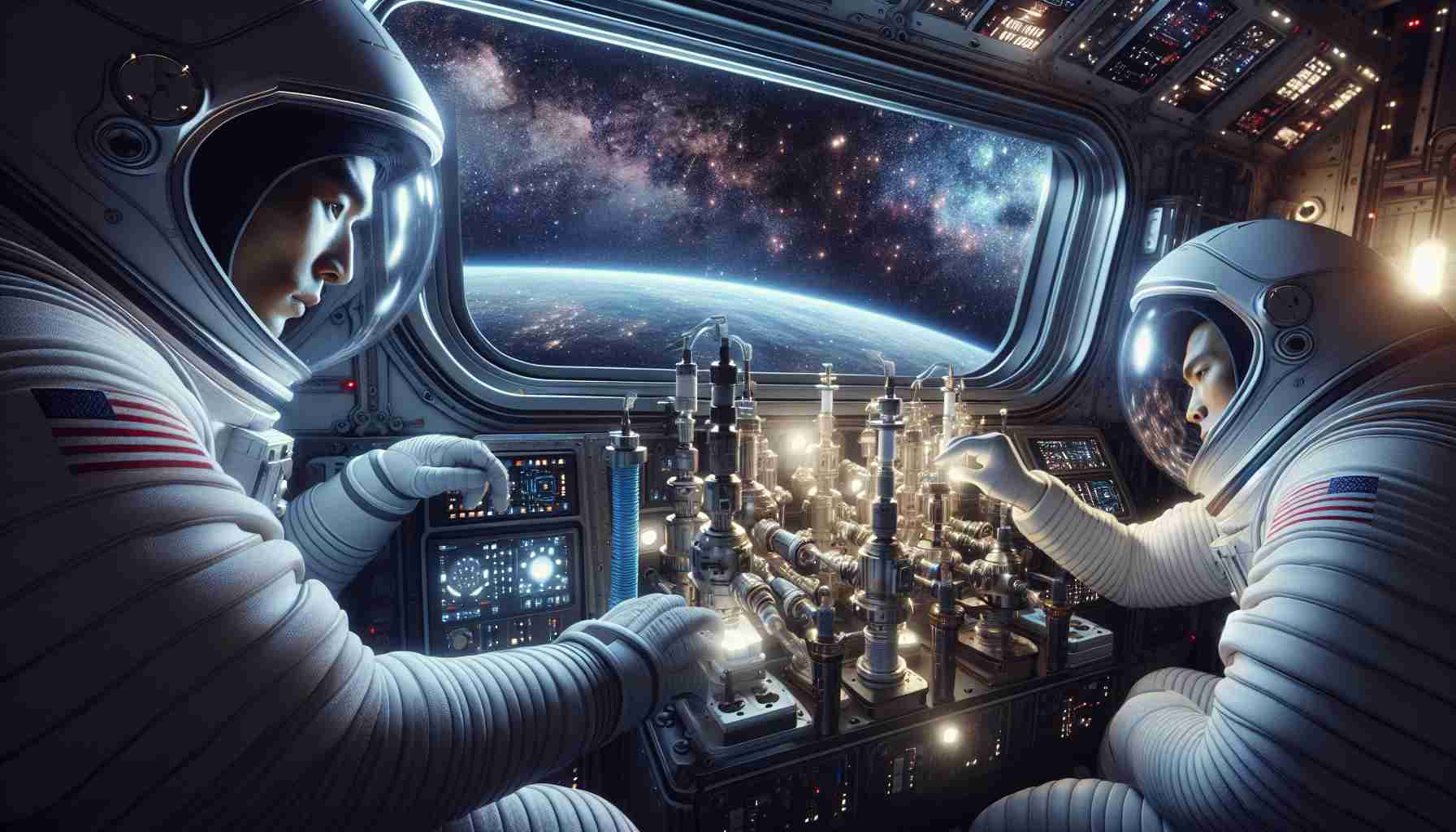
Chinese Astronauts Achieve Breakthrough in Space by Producing Oxygen and Rocket Fuel via Artificial Photosynthesis

Chinese astronauts aboard the Tiangong space station have made a significant advancement by successfully producing oxygen and rocket fuel using artificial photosynthesis. This achievement marks a pivotal moment in space exploration, as it offers a potential solution for sustainable resource generation during long-term missions. By utilizing water and carbon dioxide, the astronauts were able to simulate the natural photosynthesis process, producing not only breathable oxygen but also hydrocarbon fuel components. This breakthrough could be particularly beneficial for China’s ambitious plans to establish a lunar base, as it would reduce reliance on Earth-based supplies, enabling astronauts to generate essential resources directly on the Moon.

The experiment, carried out by the Shenzhou-19 crew, employed a system that mimics the photosynthesis process found in plants, with the aid of a semiconductor catalyst. The compact apparatus, designed like a drawer, facilitated the conversion of carbon dioxide and water into oxygen and fuel. This artificial photosynthesis method is a step forward in creating self-sustaining habitats for space travelers, where resources like oxygen and fuel can be generated locally, thus reducing the challenges and costs associated with transporting them from Earth.

One of the most notable aspects of this experiment is its energy efficiency. The artificial photosynthesis system requires significantly less energy compared to the electrolysis method currently used on the International Space Station (ISS) to generate oxygen. Electrolysis, while effective, can consume up to a third of the ISS’s power supply, a considerable amount for long-term space missions. The new method developed by the Chinese astronauts offers a more energy-efficient alternative, potentially making future space explorations more sustainable and cost-effective.

Looking ahead, the implications of this technology could extend beyond the Tiangong space station. Researchers believe that by adjusting the catalyst used in the reaction, this artificial photosynthesis system could be fine-tuned to produce different types of fuel, such as methane or formic acid. These fuels could play a vital role in supporting missions to the Moon, Mars, and beyond, contributing to the development of space stations, lunar bases, and interplanetary travel, all while minimizing the need for supply shipments from Earth.

Tesla Roadster Confused for Near-Earth Asteroid in Space Tracking Error

Tesla Roadster Mistaken for Near-Earth Asteroid in Tracking Mix-Up

A recently identified near-Earth object initially classified as an asteroid has been revealed to be none other than Elon Musk’s Tesla Roadster, launched into space in 2018 aboard a SpaceX Falcon Heavy rocket. The object was mistakenly listed as a new near-Earth asteroid by the International Astronomical Union’s Minor Planet Center (MPC) on January 2. However, within hours, the classification was withdrawn after further analysis. The mistake, made by an amateur astronomer in Turkey using publicly available tracking data, highlights the growing challenges of distinguishing between natural celestial bodies and artificial space debris.

How the Misclassification Happened

According to Astronomy.com, the object was temporarily designated as 2018 CN41 in the MPC’s database. The classification relied on past orbital tracking data, but upon closer examination, it became clear that the object was not an asteroid. Within 17 hours, the MPC rescinded the classification. The amateur astronomer who made the initial report quickly acknowledged the error, demonstrating the importance of thorough verification in astronomical observations.

The Roadster’s Unusual Journey

The Tesla Roadster was launched on February 6, 2018, as a test payload for the inaugural flight of SpaceX’s Falcon Heavy. Seated behind the wheel was “Starman,” a mannequin dressed in a SpaceX spacesuit. While the vehicle was initially intended to enter a stable orbit around Mars, it instead settled into a heliocentric trajectory, periodically passing near Earth and Mars. Over time, its orbit continues to evolve, and its visibility to astronomers varies depending on its position relative to Earth.

Challenges in Space Object Identification

This misclassification underscores the difficulties in tracking artificial objects in space, especially as more satellites and debris accumulate in Earth’s vicinity. With thousands of objects, both natural and human-made, orbiting the Sun, astronomers rely on precise tracking systems to differentiate between asteroids, comets, and space debris. As space exploration and commercial space activities continue to expand, improved monitoring and classification methods will be essential to avoid similar identification errors in the future.