Yazılar

Chinese Factory Adapts to Tariffs, Keeps Core in China

A Chinese electronics manufacturer has demonstrated how firms are adapting to geopolitical shocks, showing resilience despite tariffs introduced during the Donald Trump administration.

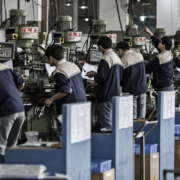
Agilian Technology, a mid-sized exporter based in Dongguan, faced severe disruption in 2025 when U.S. tariffs caused clients—many of whom account for over half its revenue—to freeze orders and push for production relocation outside China. At the peak of tensions, tariffs between the U.S. and China exceeded 100%, effectively halting trade flows.

Despite this, the company ultimately reaffirmed China as its core manufacturing base. Executives cited the country’s unmatched supply chain integration, production speed and component availability as factors that are difficult to replicate elsewhere.

Attempts to diversify production revealed structural challenges. Expansion efforts in India were slowed by regulatory delays and operational inefficiencies, while Malaysia offered a more viable alternative but still lagged behind China in execution speed. Even relocating to the U.S. proved impractical due to higher labor costs and reliance on Chinese-made components.

Meanwhile, China’s countermeasures—including export controls on critical minerals—highlighted Western dependence on its industrial ecosystem. Combined with partial tariff rollbacks following negotiations between Washington and Beijing, these factors helped revive manufacturing activity.

By the second half of 2025, Agilian reported a 29% increase in production hours, marking its busiest period on record. Orders resumed as clients adjusted to a “new normal” of elevated but manageable tariffs.

The case reflects a broader trend: rather than fully exiting China, companies are adopting a “China-plus-one” strategy—maintaining core operations domestically while building secondary capacity abroad as a hedge against future disruptions.

Economists note that tariffs have reshaped global supply chains but have not fundamentally weakened China’s manufacturing dominance. Instead, they have accelerated diversification while reinforcing the country’s central role in global production networks.


Sony Lifts Profit Forecast by 8%, Citing Lower Tariff Impact and Strong Anime Performance

Sony has raised its operating profit forecast for the fiscal year ending March 2026 by 8% to 1.43 trillion yen ($9.5 billion), crediting a lower-than-expected impact from U.S. tariffs and strong results from its entertainment and semiconductor divisions.

In the July–September quarter, operating profit climbed 10% to 429 billion yen, driven by robust sales in its music and chip businesses. Sony highlighted the success of its animated hit “Demon Slayer: Kimetsu no Yaiba – Infinity Castle” as a key contributor to the performance.

Once best known for electronics, Sony has steadily evolved into an entertainment powerhouse, with anime now one of its most profitable sectors.

However, its gaming division reported weaker results after recording impairment losses tied to “Destiny 2,” developed by its studio Bungie. Chief Financial Officer Lin Tao said user engagement had fallen short of expectations following the acquisition.

Sony sold 3.9 million PlayStation 5 consoles during the quarter, slightly above last year’s figure, and aims to grow its player base during the holiday season while maintaining profitability. The company’s recently launched game “Ghost of Yotei” sold 3.3 million copies, receiving strong critical and commercial response.

Meanwhile, the global gaming landscape continues to evolve: Take-Two Interactive has once again delayed “Grand Theft Auto VI” to November next year, while Nintendo has raised its forecast for the Switch 2 to 19 million units amid high demand.

Sony’s chip business also saw gains from increased sales of large image sensors used in smartphones, with some clients reportedly accelerating purchases ahead of tariffs. The company now expects a 50 billion yen tariff impact, lower than its earlier estimate of 70 billion yen.

To reward shareholders, Sony announced a share buyback program of up to 35 million shares worth around 100 billion yen. Following the news, Sony’s stock rose 5.5%.

Pinterest Shares Plunge 18% as Ad Competition and Tariff Pressures Hit Growth Outlook

Pinterest shares tumbled 18% on Wednesday after the company issued a weaker-than-expected revenue forecast, raising concerns that the image-sharing platform is losing ground to larger digital advertising rivals amid growing tariff-related pressures. If losses hold, the drop would wipe about $4.36 billion off Pinterest’s market value.

The sharp decline contrasts with strong third-quarter results from advertising heavyweights Alphabet, Meta, and Reddit, all of which reported robust ad spending fueled by AI-powered targeting and larger global reach. Analysts said Pinterest’s smaller scale and slower innovation pace are limiting its ability to compete effectively.

Chief Financial Officer Julia Donnelly cited weaker ad spending in the United States and Canada — Pinterest’s biggest markets — as retailers face thinner margins due to new tariffs. “Larger U.S. retailers are navigating tariff-related margin pressure,” Donnelly said, adding that China-based e-commerce giants such as Temu and Shein have also reduced marketing budgets after the removal of the “de minimis” import exemption.

Pinterest now expects revenue between $1.31 billion and $1.34 billion for the current quarter, with the midpoint slightly below analyst expectations of $1.34 billion, according to LSEG data.

“Performance has been fine, but we struggle to see a catalyst for growth,” said analysts at Piper Sandler. Morgan Stanley added that Pinterest “failed to deliver” in a market increasingly rewarding innovation and upward earnings revisions.

Despite Wednesday’s steep loss, Pinterest shares remain up 13.6% for the year — outpacing Meta’s 7.2% gain over the same period.