Yazılar

NASA’s Hubble and New Horizons Team Up to Enhance Understanding of Uranus and Exoplanets

NASA’s Hubble Space Telescope and the New Horizons spacecraft have recently collaborated to explore Uranus, a planet renowned for its enigmatic atmosphere and striking features. Positioned in low-Earth orbit, Hubble was able to capture intricate images of Uranus, revealing details about its clouds and storm patterns. In contrast, New Horizons, situated approximately 6.5 billion miles away, provided a more distant perspective, showing Uranus as a mere dot against the vast backdrop of space. This joint effort not only enhances our understanding of Uranus but also serves as a vital reference point for astronomers studying exoplanets orbiting other stars.

The collaboration between Hubble and New Horizons is particularly significant for exoplanet imaging. According to lead author Samantha Hasler from the Massachusetts Institute of Technology, this partnership acts as a practical test case for observing exoplanets at considerable distances. By comparing Hubble’s detailed observations with New Horizons’ broad view, researchers can better understand how gas giants like Uranus would appear from light-years away. This understanding is crucial as astronomers strive to detect and characterize exoplanets that share similar traits to those found within our own solar system.

One of the noteworthy discoveries from this mission was that Uranus appeared dimmer than anticipated based on New Horizons’ observations. This finding has important implications for our understanding of light reflection on planetary atmospheres at various angles. By clarifying how light interacts with Uranus, scientists gain insights that are directly applicable to future missions, such as NASA’s Nancy Grace Roman Space Telescope and the Habitable Worlds Observatory. Both of these upcoming projects are designed to focus on exoplanets and their atmospheric characteristics, making this research especially timely and relevant.

As astronomers continue to analyze the data collected from this collaboration, they are paving the way for future exploration of not only Uranus but also other distant worlds beyond our solar system. Alan Stern, Principal Investigator for New Horizons at the Southwest Research Institute, emphasized the significance of these findings in understanding planetary atmospheres and preparing for missions aimed at identifying potentially habitable worlds. This collaboration between Hubble and New Horizons exemplifies how teamwork and technology in space exploration can yield valuable knowledge, enhancing our understanding of the universe and its myriad celestial bodies
NASA’s Curiosity Rover Faces Wheel Damage but Continues to Thrive on Mars

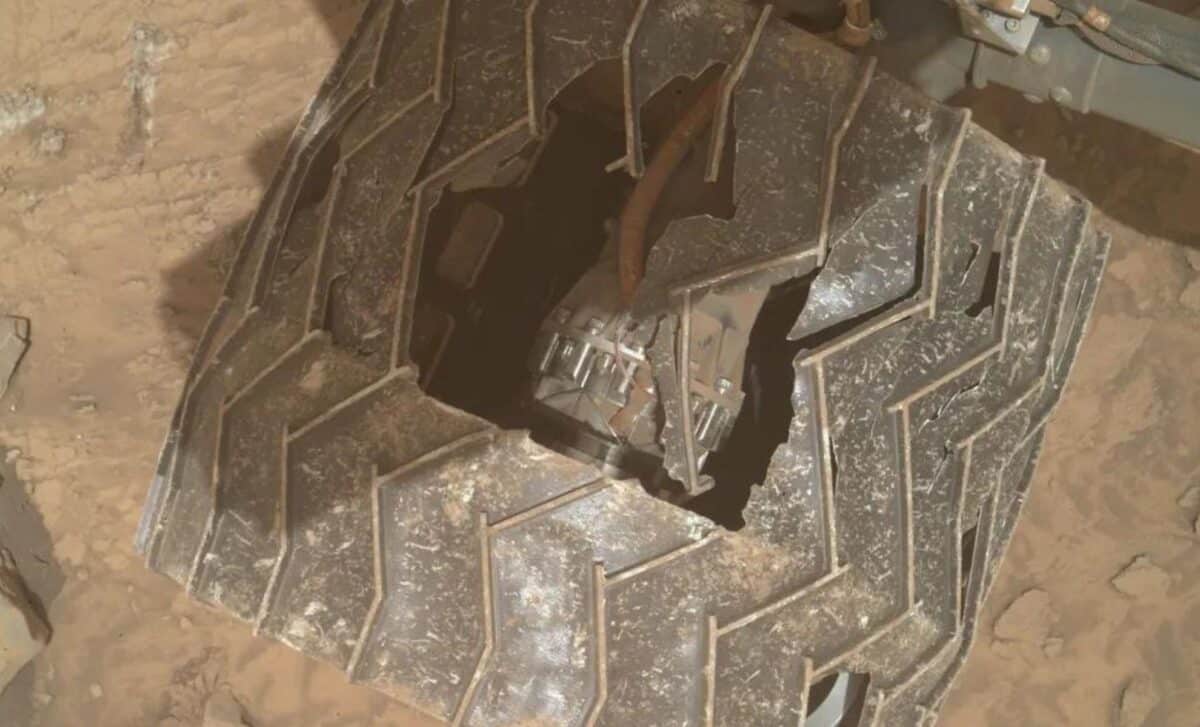
After over a decade of exploring the Martian surface, NASA’s Curiosity rover is beginning to exhibit signs of wear and tear on its wheels. Since its landing in Gale Crater in 2012, the rover has traveled approximately 20 miles (32 kilometers) across challenging and rugged terrain, leading to visible deterioration of its six wheels. Recent images captured by the rover’s Mars Hand Lens Imager (MAHLI) on September 22, 2024, showcase various forms of damage, ranging from minor dents to more severe gashes, illustrating the tough conditions Curiosity has endured on Mars.

Despite the extensive wear, Ashley Stroupe, a Mission Operations Engineer at NASA’s Jet Propulsion Laboratory (JPL), has reassured the public that the wheels remain operational. The rover’s wheel deterioration has been an ongoing issue, with signs of wear first detected as early as 2013. Given the nature of the Martian landscape, which is often filled with sharp rocks and uneven surfaces, some degree of damage was anticipated. In response to this, the Curiosity team has instituted regular inspections to monitor the wheels’ condition closely, ensuring the rover can continue its mission effectively.

To extend the lifespan of the wheels, the mission team has implemented several strategies. On occasion, they have redirected Curiosity away from particularly treacherous terrains that could exacerbate the damage. Moreover, in 2017, JPL engineers uploaded new software that allows the rover to adjust the speed of each individual wheel. This software enables Curiosity to minimize the pressure exerted on its wheels while traversing rocky landscapes, helping to mitigate further wear and tear.

The resilience of Curiosity’s wheels is a testament to both the engineering that went into the rover’s design and the proactive measures taken by the mission team. As Curiosity continues to explore the Martian surface, the insights gained from its performance and the wear on its wheels will contribute valuable knowledge to future missions. The ongoing success of Curiosity serves as a reminder of human ingenuity and the drive to understand our neighboring planet, despite the challenges presented by its environment.

NASA’s Europa Clipper Mission Ready to Explore Potentially Habitable Ocean World

NASA’s Europa Clipper spacecraft is poised for launch, set to embark on a mission to explore Jupiter’s moon Europa, one of the most promising candidates in the solar system for supporting life. The spacecraft is scheduled to lift off on Monday at 12:06 p.m. ET from NASA’s Kennedy Space Center in Florida aboard a SpaceX Falcon Heavy rocket. This marks the start of a mission aimed at investigating whether Europa’s subsurface ocean could harbor the conditions necessary for life.

Weather conditions are 95% favorable for launch, with backup launch opportunities extending through November 6.

Mission Overview

Europa Clipper is the first spacecraft designed specifically to study an ice-covered ocean world, with a focus on determining whether Europa’s subsurface ocean, estimated to contain twice the volume of Earth’s oceans, could support life. The mission will deploy nine instruments, including cameras, spectrometers, and a magnetometer, to gather data on Europa’s ice shell, ocean depth, and geological activity.

This $5.2 billion mission has faced challenges, including concerns over radiation from Jupiter’s powerful magnetic field, which could damage the spacecraft. However, a specially designed titanium and aluminum vault will shield Europa Clipper’s sensitive electronics, allowing it to withstand the harsh environment during 49 planned flybys of the moon.

Scientific Goals and Instrumentation

Europa Clipper will use its suite of instruments to explore Europa’s ocean and its interaction with the moon’s ice shell. Key questions include the thickness of the ice, the ocean’s composition, and whether plumes of water observed venting through cracks in the ice could indicate habitable conditions.

  • Cameras and spectrometers will capture high-resolution images of the surface and atmosphere.
  • Ice-penetrating radar will study the ice’s thickness and detect subsurface water.
  • Mass spectrometer and dust analyzer will investigate the composition of the ocean by “sniffing” particles from plumes.
  • Magnetometer will assess the ocean’s depth and salinity.

Long Journey and Coordination with Other Missions

After launch, Europa Clipper will travel 1.8 billion miles and is expected to reach Jupiter in April 2030. Along the way, it will perform flybys of Mars and Earth to gain speed and conserve fuel. The mission will work in tandem with Juice, the European Space Agency’s Jupiter Icy Moons Explorer, which launched in April 2023 and will arrive in July 2031.

Once at Europa, Clipper will execute flybys every two to three weeks, collecting data to help scientists understand the moon’s potential habitability.

Future Implications

While not designed to detect life directly, Europa Clipper will pave the way for future missions. Robert Pappalardo, the project scientist, hopes the spacecraft will find evidence of organics and warm, liquid water just below the surface. Such findings could inspire NASA to send a future lander to search for signs of life beneath Europa’s icy crust.