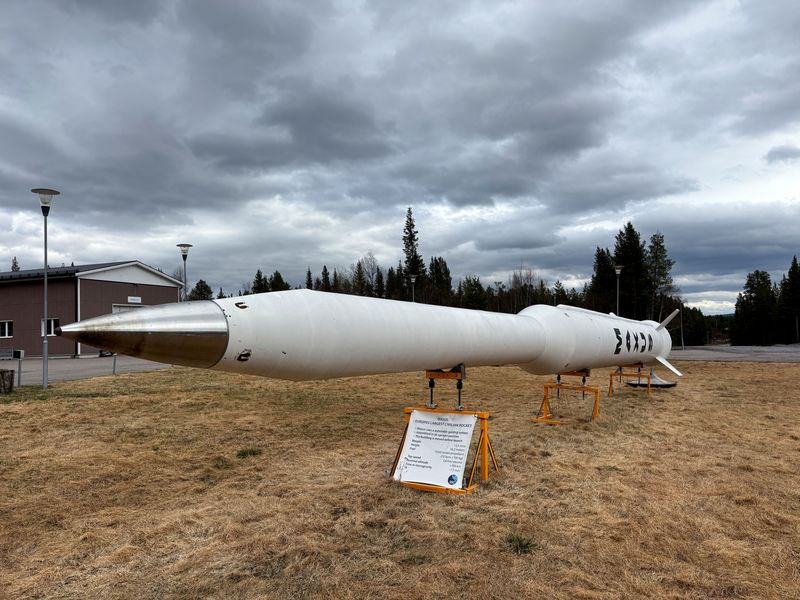
Nordic spaceports poised to boost Europe’s launch autonomy amid US tech dominance
Two remote spaceports in Sweden and Norway are emerging as Europe’s top hopes for reducing dependence on U.S.-based space technology, as the continent struggles to establish sovereign access to orbit amid global tensions and rapid technological shifts.
The Esrange Space Center in northern Sweden and the Andøya Spaceport in northern Norway are racing to become the first mainland European sites to launch satellites into orbit. Their development comes amid fears over potential access limits to SpaceX’s Starlink network, which has proven critical to Ukraine’s war effort — and as European officials worry about geopolitical risks tied to U.S. tech dominance.
“We’ve lost competition to Elon Musk… we need autonomous launch capabilities,” said Andrius Kubilius, European Commissioner for Defence and Space.
Massive launch gap
The urgency is underscored by the scale of the gap: U.S. space launches hit 154 in 2024, while Europe managed just three. Europe accounted for only 10% of global public space investment ($143 billion) last year, according to an EU study.
This disparity is especially critical in the era of low Earth orbit (LEO) satellites, which are cheaper and offer superior connectivity, but must be deployed in massive numbers. Goldman Sachs predicts 70,000 LEO satellites will be launched globally in the next five years.
Europe’s lone spaceport can’t keep pace
Currently, Europe’s only launch facility is in French Guiana, 7,000 km from Paris. It successfully launched the long-delayed Ariane 6 rocket earlier this year — over five years behind schedule. But the Ariane 6 is not reusable, has a higher per-launch cost than SpaceX’s Falcon 9, and lacks capacity for Europe’s growing commercial and defense needs.
Nordic alternatives offer rare geographic advantages
Located above the Arctic Circle, Esrange offers 5,200 km² of uninhabited land, ideal for launch recovery and safety. It’s surrounded by reindeer pastures, mountains, and bogland, and has nearby rail and airport access via Kiruna, a mining town.
Meanwhile, Andøya — an island base partially owned by Norwegian defense contractor Kongsberg — already conducted a successful test flight with German startup ISAR Aerospace. Although the rocket only flew for 30 seconds before splashing into the sea, it was considered a promising start.
ISAR has seen a surge in demand from European defense ministries, which CEO Daniel Metzler links directly to Donald Trump’s re-election bid:
“Trump probably did more for European defence than any European politician… it created a huge sense of urgency.”
ISAR’s first commercial launches are expected in 2025, with Esrange providing additional test capacity for its partially reusable rockets.
Aggressive expansion planned
-
Esrange has partnered with U.S.-based Firefly and South Korea’s Perigee, diversifying its launch options.
-
Firefly offers 24-hour launch readiness for rapid satellite replacement — a capacity NATO officials say Europe must emulate.
A NATO delegation recently visited Andøya, which has already secured a 30-launch-per-year license. Esrange has yet to set a cap but is expected to match or exceed that number in the coming years.
“Europe needs more aggressive timelines,” one anonymous NATO official told Reuters.
Still a long road ahead
Despite progress, major technical and infrastructure work remains before full orbital capability is achieved.
“There’s a lot of testing and trialling to be done,” said Lennart Poromaa, head of Esrange. “Within a year, we’ll probably have the entire base ready.”
Europe’s space race is no longer a science experiment — it’s a geopolitical imperative, with the Arctic launch pads offering one of the continent’s best hopes of securing strategic autonomy in orbit.