
Close Menu
  • Home
  • Technology
  • Devices
  • Business
  • Science
  • Gadgets
  • Startups
Ayaksız
  • Home
  • Technology

    Lucid and Bolt Plan 25,000 Robotaxis for Europe

    Eylül 18, 2026

    AMD Gives PC Builders More Choice With New Ryzen 5 Desktop Chips

    Eylül 11, 2026

    Apple Expands Device Protection With a $49.99 Family Plan

    Eylül 11, 2026

    Snapdragon 8 Elite Extreme Gen 6 Reportedly Beats MediaTek’s Next Flagship Chipset

    Eylül 11, 2026

    Pinterest CFO Julia Donnelly to Step Down in October

    Ağustos 30, 2026
  • Devices

    Guest Wi-Fi: A Different Network Name Does Not Explain Its Access Rules

    Kasım 3, 2026

    Camera White Balance in Mixed Light: Fix the Lighting Before Chasing a Number

    Kasım 2, 2026

    Inkjet Print Problems: When to Check Nozzles and When to Check Alignment

    Kasım 2, 2026

    Camera Focus Peaking: Use the Highlight as a Clue, Then Inspect the Detail

    Ekim 31, 2026

    Searchable Scans: Check the Recognized Text as Carefully as the Image

    Ekim 30, 2026
  • Business

    Google Pixel 11 Pro Leaked Renders Indicate It Might Sport Thinner Bezels Than the Pixel 10 Pro

    Mart 30, 2026

    Motorola Edge 70 Debuts With Snapdragon 7 Gen 4, Ultra-Slim 5.99mm Body

    Kasım 5, 2025

    Samsung Galaxy S26 Series Could See Price Increase Amid Rising Component Costs: Report

    Kasım 4, 2025

    Amazon’s AWS Partners with NBA to Power New AI Basketball Platform

    Ekim 4, 2025

    Billionaire-Backed Bitcoin Firm OranjeBTC to List on Brazil’s B3 Exchange

    Ekim 4, 2025
  • Science

    Weather and Climate: Read the Time Scale Before Interpreting the Claim

    Kasım 3, 2026

    Meteoroid, Meteor, or Meteorite? Follow the Object Through Its Journey

    Kasım 3, 2026

    Why Earth Has Seasons: Follow the Tilt, Sunlight, and Length of the Day

    Kasım 2, 2026

    Relative Humidity Can Fall Even When the Air Has Not Lost Moisture

    Ekim 31, 2026

    Tides and Currents Describe Different Kinds of Ocean Change

    Ekim 30, 2026
  • Gadgets

    Audio Interface Direct Monitoring: Fix a Doubled Voice by Checking the Signal Path

    Kasım 3, 2026

    HDMI ARC, eARC, and CEC: Three Labels That Solve Different Problems

    Kasım 2, 2026

    ND Filters and Polarizers: Choose the Optical Effect Before the Accessory

    Ekim 31, 2026

    Mouse DPI and Polling Rate Change Different Parts of the Experience

    Ekim 30, 2026

    AirTag Location Updates: Read the Timestamp Before Following the Map

    Ekim 28, 2026
  • Startups

    Startup Health Checks: Decide Whether a Failure Should Stop Traffic or Restart the App

    Kasım 3, 2026

    Startup API Imports: A Successful First Page Is Not a Complete Dataset

    Kasım 2, 2026

    Architecture Decision Records: Help a Startup Remember Why It Chose a Design

    Ekim 31, 2026

    Startup Incident Updates: Give Customers Useful Information Before You Have Every Answer

    Ekim 31, 2026

    Startup Repository Access: Give Each Contributor a Defined Role

    Ekim 30, 2026
Ayaksız
Anasayfa » Blog » Moon Phases Are a Changing View of Sunlight
Science

Moon Phases Are a Changing View of Sunlight

By sevketayaksizEkim 30, 2026Yorum yapılmamış3 Mins Read
Facebook Twitter Pinterest LinkedIn Tumblr Email
Moon Phases Are a Changing View of Sunlight
Share
Facebook Twitter LinkedIn Pinterest Email

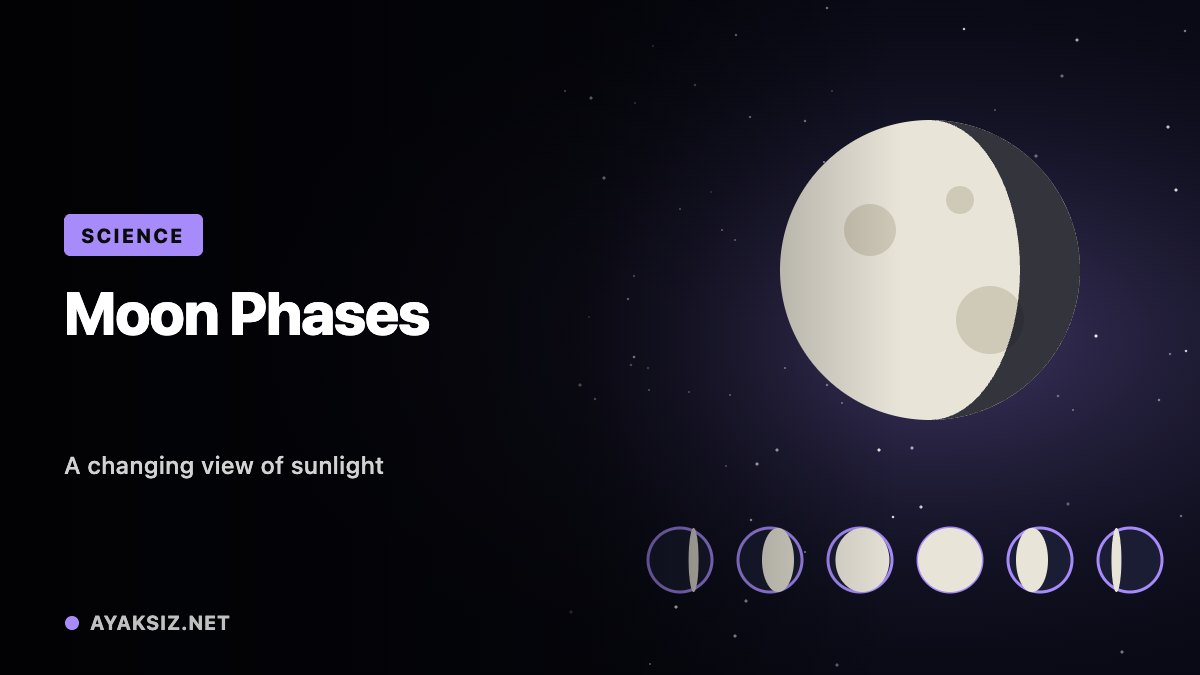
The Moon changes from a narrow crescent to a bright disk and back again. It is tempting to imagine Earth’s shadow gradually covering and uncovering it.

That is not the explanation for ordinary lunar phases.

The familiar monthly pattern comes from viewing different portions of the Moon’s sunlit half as the Moon moves around Earth. Understanding that geometry also makes it easier to distinguish a phase from a lunar eclipse.

Separate illumination from what we can see

NASA explains that sunlight illuminates roughly half of the Moon, while observers on Earth see a changing fraction of that illuminated half.

The sequence passes through new Moon, crescent, quarter, gibbous, and full Moon appearances before returning through the waning phases. The complete phase cycle takes about 29.5 days.

The Moon itself does not need to change shape.

What changes is the relationship between the illuminated surface and the observer’s viewing direction.

A photograph records the visible portion of that geometry from a particular place and time.

Understand the quarter-phase name

A first-quarter Moon can look like half a disk, which makes its name seem contradictory.

The name refers to its position approximately a quarter of the way through the phase cycle, rather than to the fraction of the visible disk that appears illuminated.

The same distinction applies to the third-quarter phase later in the cycle.

Keeping those two meanings separate prevents a common confusion: a phase name can describe progress through the cycle while the visible shape describes illumination from our perspective.

Compare phases with a simple model

A ball and a fixed lamp can help illustrate the principle.

Keep the lamp stationary and observe the ball from different positions relative to it. The lamp lights one side, but the visible proportion of that lit side changes with the viewing angle.

The model is useful for separating the source of illumination from the observer’s perspective.

It is not a scale model of the Earth–Moon system. Its purpose is to show why changing appearance does not require another object’s shadow to cover the ball.

Recognize what makes an eclipse different

NASA describes a lunar eclipse as an event in which Earth is positioned so that its shadow falls on the Moon. Lunar eclipses occur at full Moon, when the alignment is suitable.

During an ordinary full Moon, we see the Moon’s illuminated near side. During a lunar eclipse, Earth’s shadow changes the illumination reaching that surface.

These are different mechanisms.

The Moon’s orbital inclination helps explain why the required alignment does not occur at every full Moon. A monthly phase sequence should therefore not be described as a series of partial eclipses.

Observe the pattern over several evenings

Make a short observation record with the date, time, visible shape, and position relative to familiar landmarks.

Use consistent wording: waxing means the illuminated portion visible from Earth is increasing; waning means it is decreasing.

Avoid identifying the phase from a cropped photograph without considering its orientation and context.

Comparing several observations is more informative than memorizing one diagram. The changing appearance becomes a visible record of motion and perspective.

The key distinction is between sunlight illuminating the Moon and the portion of that illumination visible to us. Once that relationship is clear, the monthly sequence becomes much easier to understand.

Sources: NASA: Moon phases · NASA: Eclipses and the Moon

Share. Facebook Twitter Pinterest LinkedIn Tumblr Email
sevketayaksiz
  • Website

Related Posts

Weather and Climate: Read the Time Scale Before Interpreting the Claim

Kasım 3, 2026

Meteoroid, Meteor, or Meteorite? Follow the Object Through Its Journey

Kasım 3, 2026

Why Earth Has Seasons: Follow the Tilt, Sunlight, and Length of the Day

Kasım 2, 2026
Add A Comment

Comments are closed.

Recent Posts
  • Weather and Climate: Read the Time Scale Before Interpreting the Claim
  • Startup Health Checks: Decide Whether a Failure Should Stop Traffic or Restart the App
  • Audio Interface Direct Monitoring: Fix a Doubled Voice by Checking the Signal Path
  • Meteoroid, Meteor, or Meteorite? Follow the Object Through Its Journey
  • Guest Wi-Fi: A Different Network Name Does Not Explain Its Access Rules
Tags
AI AI Chips AI Infrastructure Amazon Android Apple Artificial Intelligence Bitcoin ChatGPT China Cryptocurrency Cybersecurity data centers DeepSeek Donald Trump Electric Vehicles Elon Musk Ether Generative AI Google Huawei India Investment Iphone Meta Microsoft NASA National Security Nvidia OnePlus OpenAI Oppo Realme Samsung semiconductor industry Social media Sony SpaceX Technology Tesla Tether TikTok Vivo WhatsApp Xiaomi
Ayaksız
Instagram
© 2026 Ayaksız.

Type above and press Enter to search. Press Esc to cancel.