Close Menu
  • Home
  • Technology
  • Devices
  • Business
  • Science
  • Gadgets
  • Startups
Ayaksız
  • Home
  • Technology

    Lucid and Bolt Plan 25,000 Robotaxis for Europe

    Eylül 18, 2026

    AMD Gives PC Builders More Choice With New Ryzen 5 Desktop Chips

    Eylül 11, 2026

    Apple Expands Device Protection With a $49.99 Family Plan

    Eylül 11, 2026

    Snapdragon 8 Elite Extreme Gen 6 Reportedly Beats MediaTek’s Next Flagship Chipset

    Eylül 11, 2026

    Pinterest CFO Julia Donnelly to Step Down in October

    Ağustos 30, 2026
  • Devices

    Guest Wi-Fi: A Different Network Name Does Not Explain Its Access Rules

    Kasım 3, 2026

    Camera White Balance in Mixed Light: Fix the Lighting Before Chasing a Number

    Kasım 2, 2026

    Inkjet Print Problems: When to Check Nozzles and When to Check Alignment

    Kasım 2, 2026

    Camera Focus Peaking: Use the Highlight as a Clue, Then Inspect the Detail

    Ekim 31, 2026

    Searchable Scans: Check the Recognized Text as Carefully as the Image

    Ekim 30, 2026
  • Business

    Google Pixel 11 Pro Leaked Renders Indicate It Might Sport Thinner Bezels Than the Pixel 10 Pro

    Mart 30, 2026

    Motorola Edge 70 Debuts With Snapdragon 7 Gen 4, Ultra-Slim 5.99mm Body

    Kasım 5, 2025

    Samsung Galaxy S26 Series Could See Price Increase Amid Rising Component Costs: Report

    Kasım 4, 2025

    Amazon’s AWS Partners with NBA to Power New AI Basketball Platform

    Ekim 4, 2025

    Billionaire-Backed Bitcoin Firm OranjeBTC to List on Brazil’s B3 Exchange

    Ekim 4, 2025
  • Science

    Weather and Climate: Read the Time Scale Before Interpreting the Claim

    Kasım 3, 2026

    Meteoroid, Meteor, or Meteorite? Follow the Object Through Its Journey

    Kasım 3, 2026

    Why Earth Has Seasons: Follow the Tilt, Sunlight, and Length of the Day

    Kasım 2, 2026

    Relative Humidity Can Fall Even When the Air Has Not Lost Moisture

    Ekim 31, 2026

    Tides and Currents Describe Different Kinds of Ocean Change

    Ekim 30, 2026
  • Gadgets

    Audio Interface Direct Monitoring: Fix a Doubled Voice by Checking the Signal Path

    Kasım 3, 2026

    HDMI ARC, eARC, and CEC: Three Labels That Solve Different Problems

    Kasım 2, 2026

    ND Filters and Polarizers: Choose the Optical Effect Before the Accessory

    Ekim 31, 2026

    Mouse DPI and Polling Rate Change Different Parts of the Experience

    Ekim 30, 2026

    AirTag Location Updates: Read the Timestamp Before Following the Map

    Ekim 28, 2026
  • Startups

    Startup Health Checks: Decide Whether a Failure Should Stop Traffic or Restart the App

    Kasım 3, 2026

    Startup API Imports: A Successful First Page Is Not a Complete Dataset

    Kasım 2, 2026

    Architecture Decision Records: Help a Startup Remember Why It Chose a Design

    Ekim 31, 2026

    Startup Incident Updates: Give Customers Useful Information Before You Have Every Answer

    Ekim 31, 2026

    Startup Repository Access: Give Each Contributor a Defined Role

    Ekim 30, 2026
Ayaksız
Anasayfa » Blog » How Argo Floats Measure the Ocean Below the Surface
Science

How Argo Floats Measure the Ocean Below the Surface

By sevketayaksizEkim 27, 2026Updated:Ekim 27, 2026Yorum yapılmamış3 Mins Read
Facebook Twitter Pinterest LinkedIn Tumblr Email
How Argo Floats Measure the Ocean Below the Surface
Share
Facebook Twitter LinkedIn Pinterest Email

The ocean’s surface is only the beginning of its story. Conditions can change with depth, and a measurement taken at the surface cannot describe the entire water column.

Argo addresses that problem with autonomous instruments that spend most of their lives below the waves. They drift, change depth, measure the surrounding water, and briefly return to the surface to send their observations.

The result is a repeating cycle of ocean profiles rather than a collection of isolated surface readings.

Follow a typical profiling cycle

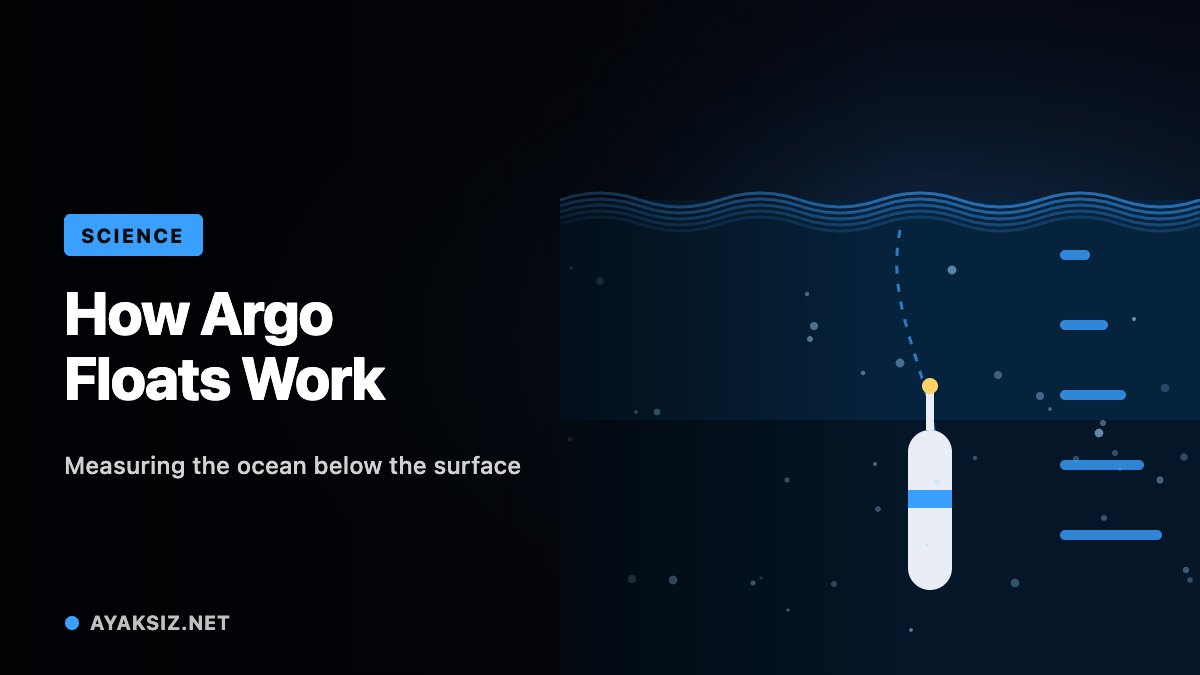
The Argo program describes a standard mission lasting about ten days. A float spends much of that time drifting around 1,000 meters below the surface.

Near the end of the cycle, it descends to roughly 2,000 meters and then rises while taking measurements. At the surface, it obtains a position and communicates with satellites before beginning another cycle.

These figures describe a standard mission, rather than every possible float configuration. Argo instruments and operating strategies can differ.

The timing reveals an important feature of the system: a float is not streaming a continuous live view from every depth. It collects observations according to a programmed sequence, then transmits the results.

When examining a profile, its time and location are therefore essential parts of the measurement.

Change depth by changing buoyancy

An Argo float does not need to swim like a conventional underwater vehicle.

Woods Hole Oceanographic Institution describes a system that moves oil between an internal reservoir and an external bladder. Expanding the bladder increases the float’s volume without increasing its mass, reducing its overall density and helping it rise. Reversing the process allows it to sink.

Batteries power the pump, sensors, controller, and communication equipment. The finite energy supply is a major constraint on operational life.

This is a compact engineering solution to a demanding scientific task. The instrument must repeat a useful measurement routine while conserving enough energy to continue operating far from routine maintenance.

The design illustrates why autonomy involves both decision-making and careful control of physical resources.

Measure a vertical structure

A typical float measures conductivity, temperature, and pressure. Salinity is calculated from these quantities, while pressure helps establish the measurement’s position in the water column.

A profile records how the measured conditions change as the float rises. Comparing only the shallowest reading would discard much of what makes the observation useful.

For example, two locations could have similar surface temperatures but different conditions below. A vertical profile allows researchers to examine that structure rather than assuming the surface represents the whole depth range.

NASA identifies Argo as a major component of the ocean-observing system and provides access to temperature and salinity datasets derived from its observations.

Read the network as a scientific system

An individual profile is valuable, but it is not a complete description of an ocean basin. The broader value comes from combining observations across locations and through time.

A sensible reading of an Argo-based result asks which period, region, depth range, and data product were used. A map assembled from many measurements answers a different question from a single float’s most recent profile.

Argo makes the interior ocean more observable through a repeated, shared measurement process. Its achievement is not one dramatic photograph, but the steady accumulation of information from places that are difficult to visit.

Share. Facebook Twitter Pinterest LinkedIn Tumblr Email
sevketayaksiz
  • Website

Related Posts

Weather and Climate: Read the Time Scale Before Interpreting the Claim

Kasım 3, 2026

Meteoroid, Meteor, or Meteorite? Follow the Object Through Its Journey

Kasım 3, 2026

Why Earth Has Seasons: Follow the Tilt, Sunlight, and Length of the Day

Kasım 2, 2026
Add A Comment

Comments are closed.

Recent Posts
  • Weather and Climate: Read the Time Scale Before Interpreting the Claim
  • Startup Health Checks: Decide Whether a Failure Should Stop Traffic or Restart the App
  • Audio Interface Direct Monitoring: Fix a Doubled Voice by Checking the Signal Path
  • Meteoroid, Meteor, or Meteorite? Follow the Object Through Its Journey
  • Guest Wi-Fi: A Different Network Name Does Not Explain Its Access Rules
Tags
AI AI Chips AI Infrastructure Amazon Android Apple Artificial Intelligence Bitcoin ChatGPT China Cryptocurrency Cybersecurity data centers DeepSeek Donald Trump Electric Vehicles Elon Musk Ether Generative AI Google Huawei India Investment Iphone Meta Microsoft NASA National Security Nvidia OnePlus OpenAI Oppo Realme Samsung semiconductor industry Social media Sony SpaceX Technology Tesla Tether TikTok Vivo WhatsApp Xiaomi
Ayaksız
Instagram
© 2026 Ayaksız.

Type above and press Enter to search. Press Esc to cancel.