
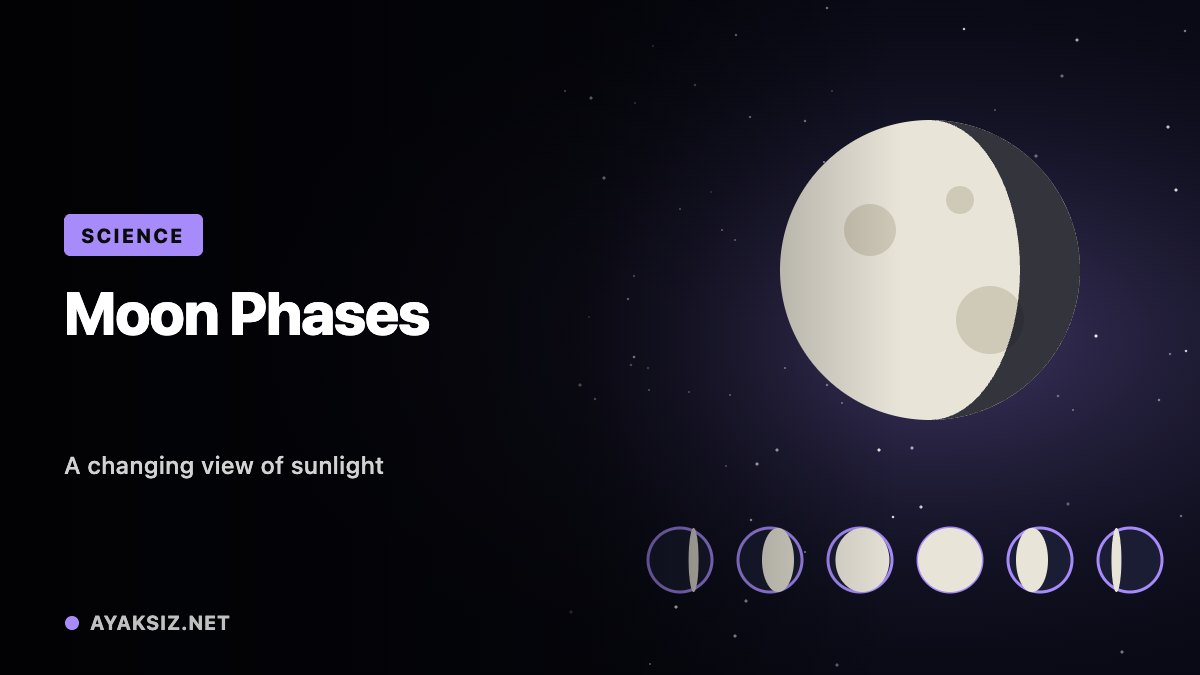
The Moon changes from a narrow crescent to a bright disk and back again. It is tempting to imagine Earth’s shadow gradually covering and uncovering it.
That is not the explanation for ordinary lunar phases.
The familiar monthly pattern comes from viewing different portions of the Moon’s sunlit half as the Moon moves around Earth. Understanding that geometry also makes it easier to distinguish a phase from a lunar eclipse.
Separate illumination from what we can see
NASA explains that sunlight illuminates roughly half of the Moon, while observers on Earth see a changing fraction of that illuminated half.
The sequence passes through new Moon, crescent, quarter, gibbous, and full Moon appearances before returning through the waning phases. The complete phase cycle takes about 29.5 days.
The Moon itself does not need to change shape.
What changes is the relationship between the illuminated surface and the observer’s viewing direction.
A photograph records the visible portion of that geometry from a particular place and time.
Understand the quarter-phase name
A first-quarter Moon can look like half a disk, which makes its name seem contradictory.
The name refers to its position approximately a quarter of the way through the phase cycle, rather than to the fraction of the visible disk that appears illuminated.
The same distinction applies to the third-quarter phase later in the cycle.
Keeping those two meanings separate prevents a common confusion: a phase name can describe progress through the cycle while the visible shape describes illumination from our perspective.
Compare phases with a simple model
A ball and a fixed lamp can help illustrate the principle.
Keep the lamp stationary and observe the ball from different positions relative to it. The lamp lights one side, but the visible proportion of that lit side changes with the viewing angle.
The model is useful for separating the source of illumination from the observer’s perspective.
It is not a scale model of the Earth–Moon system. Its purpose is to show why changing appearance does not require another object’s shadow to cover the ball.
Recognize what makes an eclipse different
NASA describes a lunar eclipse as an event in which Earth is positioned so that its shadow falls on the Moon. Lunar eclipses occur at full Moon, when the alignment is suitable.
During an ordinary full Moon, we see the Moon’s illuminated near side. During a lunar eclipse, Earth’s shadow changes the illumination reaching that surface.
These are different mechanisms.
The Moon’s orbital inclination helps explain why the required alignment does not occur at every full Moon. A monthly phase sequence should therefore not be described as a series of partial eclipses.
Observe the pattern over several evenings
Make a short observation record with the date, time, visible shape, and position relative to familiar landmarks.
Use consistent wording: waxing means the illuminated portion visible from Earth is increasing; waning means it is decreasing.
Avoid identifying the phase from a cropped photograph without considering its orientation and context.
Comparing several observations is more informative than memorizing one diagram. The changing appearance becomes a visible record of motion and perspective.
The key distinction is between sunlight illuminating the Moon and the portion of that illumination visible to us. Once that relationship is clear, the monthly sequence becomes much easier to understand.
Sources: NASA: Moon phases · NASA: Eclipses and the Moon