
Close Menu
  • Home
  • Technology
  • Devices
  • Business
  • Science
  • Gadgets
  • Startups
Ayaksız
  • Home
  • Technology

    Lucid and Bolt Plan 25,000 Robotaxis for Europe

    Eylül 18, 2026

    AMD Gives PC Builders More Choice With New Ryzen 5 Desktop Chips

    Eylül 11, 2026

    Apple Expands Device Protection With a $49.99 Family Plan

    Eylül 11, 2026

    Snapdragon 8 Elite Extreme Gen 6 Reportedly Beats MediaTek’s Next Flagship Chipset

    Eylül 11, 2026

    Pinterest CFO Julia Donnelly to Step Down in October

    Ağustos 30, 2026
  • Devices

    iQOO 16 Design and Colour Options Unveiled With Major Camera Upgrade Confirmed

    Eylül 11, 2026

    Lava Bold N4 Pro 5G India Launch Date, Design and Key Specs Confirmed

    Eylül 11, 2026

    Xiaomi 18 Pro Max Geekbench Listing Reveals Key Specifications

    Eylül 10, 2026

    Samsung Galaxy Tab S12 Ultra, Tab S12+ Design Leaks in New Renders

    Eylül 10, 2026

    Vivo X500 Series Designs Revealed Ahead of September Launch

    Eylül 10, 2026
  • Business

    Google Pixel 11 Pro Leaked Renders Indicate It Might Sport Thinner Bezels Than the Pixel 10 Pro

    Mart 30, 2026

    Motorola Edge 70 Debuts With Snapdragon 7 Gen 4, Ultra-Slim 5.99mm Body

    Kasım 5, 2025

    Samsung Galaxy S26 Series Could See Price Increase Amid Rising Component Costs: Report

    Kasım 4, 2025

    Amazon’s AWS Partners with NBA to Power New AI Basketball Platform

    Ekim 4, 2025

    Billionaire-Backed Bitcoin Firm OranjeBTC to List on Brazil’s B3 Exchange

    Ekim 4, 2025
  • Science

    SpaceX’s $1.75 Trillion Valuation Raises Questions Ahead of IPO

    Nisan 11, 2026

    US Moves to Ease Satellite Power Limits, Boosting Space Broadband

    Nisan 10, 2026

    iPhone 17 Pro Max NASA Approves iPhone 17 Pro Max for Use on Artemis 2 Deep Space Mission

    Nisan 6, 2026

    Spain’s First Private 5G Satellite Mission

    Şubat 17, 2026

    Eutelsat Signs Launch Deal With MaiaSpace for LEO Satellites

    Ocak 17, 2026
  • Gadgets

    Vivo Buds Debut in India With Up to 50-Hour Battery Life

    Eylül 10, 2026

    Moto Buds 2 Fusion India Launch Date Confirmed, Features Teased

    Eylül 10, 2026

    Sennheiser Unveils Accentum Clip Earbuds With Up to 36 Hours of Total Battery Life

    Temmuz 2, 2026

    Nothing Ear 3a and CMF Buds Neo Appear in Regulatory Filings, Hinting at Upcoming Launch

    Haziran 2, 2026

    OnePlus Watch 4 Leak Hints at Launch With Snapdragon W5 and OxygenOS Watch 8

    Nisan 22, 2026
  • Startups

    Glean Reaches $7.2 Billion Valuation Amid AI Investment Surge

    Haziran 15, 2025

    How I Built a $2 Billion Super App: The Journey of Grab’s Anthony Tan and ’20-Hour’ Workdays

    Ekim 7, 2024

    Tupperware Files for Bankruptcy as Demand Declines

    Eylül 18, 2024

    Wildfire Detection Device Wins UK James Dyson Award

    Eylül 12, 2024

    Japan and Tokyo Governments Eye $4.7 Billion Valuation for Tokyo Metro in Upcoming IPO

    Ağustos 19, 2024
Ayaksız
Anasayfa » Blog » ISRO Gears Up to Position Aditya-L1 Spacecraft in Its Ultimate Orbit: Here’s What You Need to Know
Science

ISRO Gears Up to Position Aditya-L1 Spacecraft in Its Ultimate Orbit: Here’s What You Need to Know

By ayaksızOcak 7, 2024Yorum yapılmamış3 Mins Read
Facebook Twitter Pinterest LinkedIn Tumblr Email
Share
Facebook Twitter LinkedIn Pinterest Email

ISRO to Execute Final Manoeuvre to Position Aditya-L1 Spacecraft in Its Ultimate Orbit at Approximately 4 PM on Saturday.

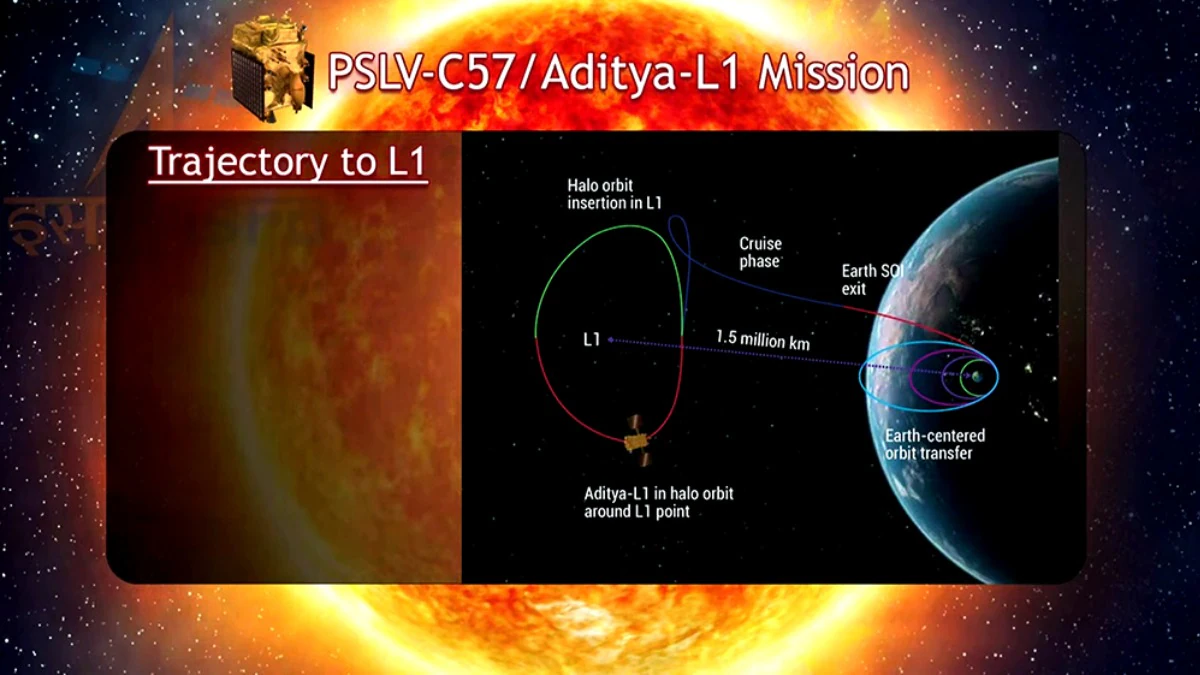
ISRO will perform the final manoeuvre on Saturday to inject Aditya-L1 spacecraft — the first space-based Indian observatory to study the Sun — into its final destination orbit, some 1.5 million kilometres from the Earth. According to ISRO officials, the spacecraft will be placed in a halo orbit around Lagrange point 1 (L1) of the Sun-Earth system, about 1.5 million km from the Earth. The L1 point is about one per cent of the total distance between the Earth and the Sun.

A satellite in a halo orbit around the L1 point has the major advantage of continuously viewing the Sun without any occultations/eclipses, they said, adding, this will provide a greater advantage in observing solar activities and its effect on space weather in real time.

“This manoeuvre (at around 4pm on Saturday) will bind the Aditya-L1 to a halo orbit around L1. If we don’t do this, there is a possibility that it will continue its journey, maybe towards the Sun,” an ISRO official told PTI on Friday.

The Polar Satellite Launch Vehicle (PSLV-C57) launched the Aditya-L1 spacecraft from the second launch pad of Satish Dhawan Space Centre (SDSC), Sriharikota, on September 2 last year.

After a flight duration of 63 minutes and 20 seconds, it was successfully injected into an elliptical orbit of 235×19500 km around the Earth.

The spacecraft underwent a series of manoeuvres thereafter and headed Sun-Earth Lagrange Point 1(L1), having escaped the Earth’s sphere of influence.

The spacecraft carries seven payloads to observe the photosphere, chromosphere and the outermost layers of the Sun (the corona) using electromagnetic and particle and magnetic field detectors.

“Using the special vantage point L1, four payloads directly view the Sun and the remaining three payloads carry out in-situ studies of particles and fields at the Lagrange point L1, thus providing important scientific studies of the propagatory effect of solar dynamics in the interplanetary medium,” according to the space agency.

The suits of Aditya L1 payloads are expected to provide the “most crucial information” to understand the problem of coronal heating, coronal mass ejection, pre-flare and flare activities and their characteristics, dynamics of space weather, and propagation of particles and fields, officials said.

Aditya-L1 Mission Objectives:

1. Investigate the dynamics of the solar upper atmosphere, including the chromosphere and corona.
2. Study chromospheric and coronal heating, exploring the physics of partially ionized plasma, and investigate the initiation of coronal mass ejections (CMEs) and solar flares.
3. Observe the in-situ particle and plasma environment to provide data for understanding particle dynamics emanating from the Sun.
4. Explore the physics of the solar corona and mechanisms involved in its heating.
5. Diagnose plasma in coronal loops, measuring temperature, velocity, and density.
6. Investigate the development, dynamics, and origins of coronal mass ejections (CMEs).
7. Identify the sequence of processes occurring at various layers (chromosphere, base, and extended corona) leading to solar eruptive events.
8. Study magnetic field topology and measure magnetic fields in the solar corona.
9. Explore the drivers for space weather, including the origin, composition, and dynamics of solar wind.

Aditya-L1 ISRO L1 Lagrange point 1 Sun
Share. Facebook Twitter Pinterest LinkedIn Tumblr Email
ayaksız
  • Website

Related Posts

SpaceX’s $1.75 Trillion Valuation Raises Questions Ahead of IPO

Nisan 11, 2026

US Moves to Ease Satellite Power Limits, Boosting Space Broadband

Nisan 10, 2026

iPhone 17 Pro Max NASA Approves iPhone 17 Pro Max for Use on Artemis 2 Deep Space Mission

Nisan 6, 2026
Add A Comment

Comments are closed.

Recent Posts
  • Lucid and Bolt Plan 25,000 Robotaxis for Europe
  • AMD Gives PC Builders More Choice With New Ryzen 5 Desktop Chips
  • Apple Expands Device Protection With a $49.99 Family Plan
  • Snapdragon 8 Elite Extreme Gen 6 Reportedly Beats MediaTek’s Next Flagship Chipset
  • iQOO 16 Design and Colour Options Unveiled With Major Camera Upgrade Confirmed
Tags
AI AI Chips AI Infrastructure Amazon Android Apple Artificial Intelligence Bitcoin ChatGPT China Cryptocurrency Cybersecurity data centers DeepSeek Donald Trump Electric Vehicles Elon Musk Ether Generative AI Google Huawei India Investment Iphone Meta Microsoft NASA National Security Nvidia OnePlus OpenAI Oppo Realme Samsung semiconductor industry Social media Sony SpaceX Technology Tesla Tether TikTok Vivo WhatsApp Xiaomi
Ayaksız
Instagram
© 2026 Ayaksız.

Type above and press Enter to search. Press Esc to cancel.