
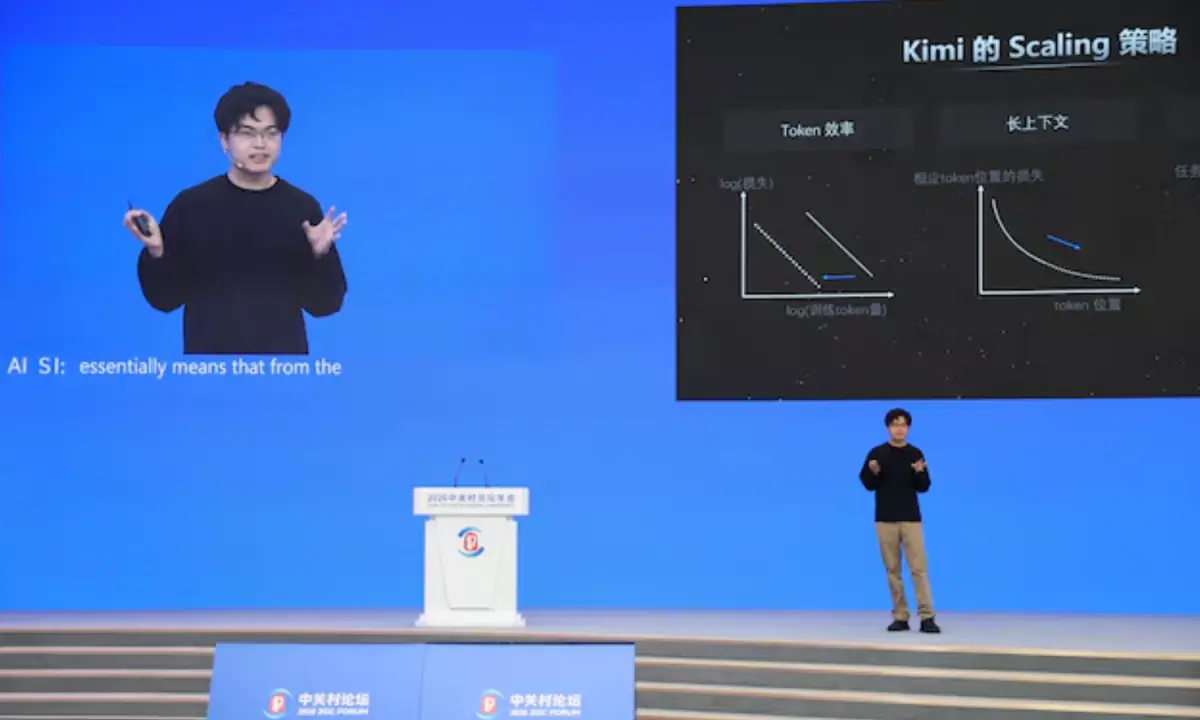
Chinese artificial intelligence startup Moonshot AI has introduced Kimi K3, a 2.8 trillion-parameter open-weight language model that the company says is the world’s largest publicly available AI model, marking another significant milestone in China’s rapidly advancing AI industry.
The release highlights the accelerating pace of AI development in China, where startups are increasingly challenging the technological leadership of U.S. companies by delivering powerful models at significantly lower operating costs.
Kimi K3 is designed for advanced reasoning, complex software development, and knowledge-intensive tasks. One of its most notable capabilities is its 1 million-token context window, allowing the model to process and retain substantially more information in a single conversation than previous generations, making it better suited for long documents, multi-step analysis, and large coding projects.
Unlike proprietary AI systems, Kimi K3 is released as an open-weight model, enabling researchers, enterprises, and developers to download, customize, and deploy the model within their own environments. This approach has become an increasingly important competitive advantage for Chinese AI companies seeking rapid adoption across businesses and research institutions.
According to Moonshot, Kimi K3 delivers performance approaching the latest frontier models developed by leading U.S. AI companies, particularly in coding optimization and complex reasoning tasks. Independent benchmark organizations have also reported strong results, placing the model among the highest-performing AI systems currently available for web development and advanced problem-solving.
The launch immediately affected China’s AI sector, with shares of competing AI developers declining after investors viewed Kimi K3 as a significant leap forward in domestic AI capabilities.
The announcement also reflects a broader trend in the global AI race. Chinese companies such as Moonshot, Z.ai, MiniMax, DeepSeek, and Meituan are shortening development cycles and rapidly releasing increasingly capable models. This has challenged the long-standing assumption that Chinese AI technology significantly trails leading U.S. developers.
Despite its impressive scale, Kimi K3 also illustrates one of the practical limitations of frontier AI systems. Running a model with 2.8 trillion parameters requires extremely powerful computing infrastructure, making local deployment prohibitively expensive for most organizations and individual users. As a result, cloud-based deployment is expected to remain the primary method of accessing models of this size.
Backed by major technology companies including Alibaba and Tencent, Moonshot continues to expand aggressively. Reports indicate the company is seeking approximately $2 billion in new funding at a valuation of around $30 billion, potentially paving the way for a future public listing in Hong Kong.
With increasingly capable open AI models emerging from China, competition in the global artificial intelligence market is shifting from simply building larger models to delivering better performance, lower costs, and wider accessibility.