
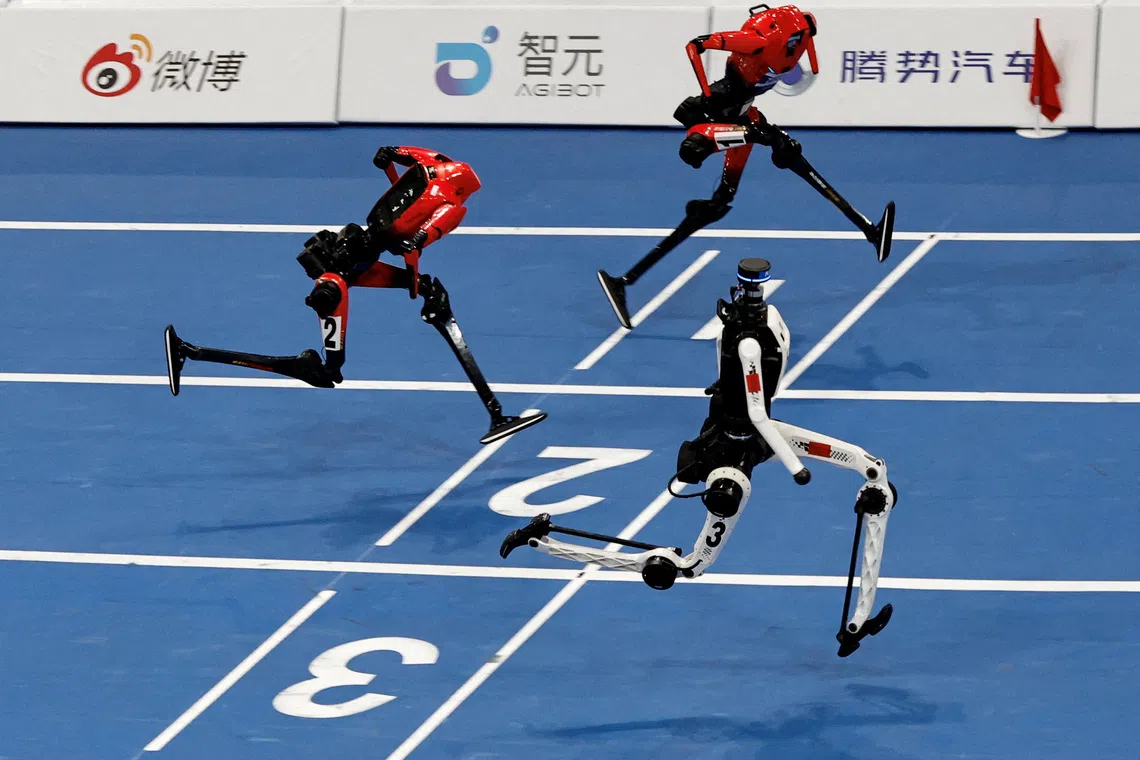
A Chinese humanoid robot has completed a 100-meter sprint in 8.64 seconds, beating Usain Bolt’s human world record of 9.58 seconds and highlighting rapid advances in robotic mobility.
The robot, Tiangong Ultra, reached an average speed of nearly 42 kph (26 mph) during its fastest run. Experts said the achievement demonstrates major improvements in balance, motors and control systems, but also shows that robots are not simply reproducing human running.
Unlike human sprinters, Tiangong starts from an upright position rather than using starting blocks and initially accelerates more slowly. Its advantage comes later, when powerful electric motors allow it to maintain an extremely fast cadence with shorter steps.
Bolt completed his 2009 world-record race in about 41 steps, while Tiangong appears to require more than 50. Researchers said the shorter stride may help the robot remain stable while taking advantage of the characteristics of its motors.
Robots also avoid some biological limitations faced by athletes. Human sprinters experience muscular and neuromuscular fatigue toward the end of a race, while Tiangong was able to maintain its speed through the finish.
However, the record also exposed important weaknesses. During one run, the robot continued at high speed into a padded wall, illustrating the gap between raw speed and capabilities such as perception, braking, direction changes and autonomous decision-making.
Researchers say those abilities will be more important than straight-line speed if humanoid robots are to operate safely and effectively in real-world environments.